Chapter 12: The 2026 Unconstitutionality Index: 18 rules for every law

Article I of the Constitution vests legislative power in Congress. In practice, however, administrative agencies issue the vast majority of binding rules governing economic activity and social policy. Congress enacts major legislation and delegates broad discretion to agencies, which then fill in the details through rule-writing, at times claiming authority well beyond the original statutory intent. This persistent imbalance gives rise to the Unconstitutionality Index: the ratio of agency rules to laws enacted by Congress.
In 2025, federal regulatory agencies issued 2,441 rules, an all-time low in modern regulatory recordkeeping. Meanwhile, Congress enacted 133 laws signed by the president. This yields an Unconstitutionality Index of 18 rules issued for every law passed, as shown in Figure 26. The decade-long average is 22 rules per law.
The 2025 Index closely mirrors 2024’s 19 rules per law, when agencies issued 3,248 final rules and the 118th Congress enacted 175 laws. Recall that, apart from 2025 and the 2019 dip during President Trump’s first term, annual rule counts have always exceeded 3,000, surpassing 4,000 during the 1990s and exceeding 7,000 in the 1970s and early 1980s, as detailed earlier and in Appendix E.
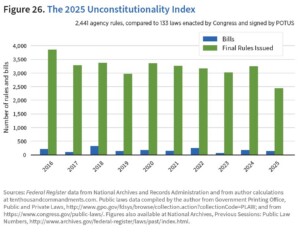
Of the 133 laws enacted in 2025, 65 were signed by President Biden in early January before leaving office, while 68 laws were enacted by the first session of the 119th Congress and signed by President Trump. Both laws and rules vary widely in scope and significance, ranging from technical adjustments to sweeping policy changes.
Clearly, the Index can fluctuate substantially with changes in either its numerator or denominator. An uncharacteristically high score of 44 rules per law in 2023 resulted primarily from Congress enacting just 68 laws that year, compared with a recent peak of 313 laws enacted in 2018. Timing and archival practices also affect annual totals.
The past year was unusual in another respect: a significant share of both laws and regulations were deregulatory. Of the 68 laws signed by President Trump, 22, or nearly one-third, were resolutions of disapproval overturning late-term Biden regulations under the Congressional Review Act. Many 2025 regulations likewise consisted of delays, rescissions, or enforcement relaxations rather than new mandates.
As always, agency rules issued in a given year rarely correspond directly to laws enacted that same year. Many current regulations stem from earlier statutes such as the Inflation Reduction Act, infrastructure legislation, and the CHIPS and Science Act. Beyond formal rulemaking, agencies increasingly rely on executive orders, guidance documents, memoranda, notices, informal interpretations, and other forms of regulatory dark matter that can substitute for traditional lawmaking. Were these instruments fully accounted for, the Unconstitutionality Index would be considerably higher. Appendix M presents a long-term comparison of rules and laws over multiple decades and also depicts executive orders and memoranda for additional context.
Despite its limitations, the Unconstitutionality Index provides a useful indicator of the extent to which lawmaking has migrated away from Congress. It highlights Congress’s persistent delegation of authority and its failure to reclaim its constitutional role. The Index also helps keep a spotlight on remedies such as regulatory budgeting, regulatory reduction commissions, and requirements for congressional approval of major rules—reforms to which we now turn.