Chapter 13: Getting things undone: An agenda for rightsizing Washington

We close with an appeal to restore enumerated powers. This would solve the overregulation dilemma, and would have prevented it in the first place. Reforms should give Congress tighter oversight over a smaller administrative state, in which departments, agencies, and enabling statutes have all been terminated, while limiting Congress’s own future overreach. This report also includes a regulatory report card template for improving regulatory transparency and extending it to regulatory dark matter. Such disclosure is as necessary to regulatory oversight as the federal budget is to spending oversight.
Overdelegation is rampant, but secondary compared to recent debt-fueled legislation that flouts Congress’s own enumerated powers. The CARES Act, Families First Coronavirus Response Act, American Rescue Plan, Infrastructure Investment and Jobs Act, Inflation Reduction Act, CHIPS and Science Act, and even lesser-known new laws like the Corporate Transparency Act, the Airport and Airway Extension Act, and the TAKE IT DOWN Act reaffirm policymakers’ top-down stance toward economic and social planning.
Congress should make it hard to both spend and regulate. It should do this with the zeal it once showed in pursuing requirements for a two-thirds majority vote for revenue increases, because the issues are intertwined. Had that effort succeeded, Washington may have been rightsized by now, given the degree to which hyper-spending and legislative abuse are driving so much rulemaking and accompanying regulatory dark matter.
Today, that rightsizing can only occur when Congress repeals or amends statutes that sustain the counterproductive regulatory enterprise. It must abolish, downsize, defund, and deny appropriations to agencies, subagencies, and programs.
The antitrust regulatory apparatus, for example, should be repealed, along with the Federal Trade Commission and Federal Communications Commission’s enabling statutes in their current form. Abuses of crises and national emergency declarations require sweeping privatization and localization of federal functions, along with ending grants and subsidies of all kinds that fuel economic regulation and social dependency (which the federal apparatus largely fails to recognize as deregulation). Such steps are necessary to abolish the custodial state’s whole-of-government forays into climate, equity, competition policy, censorship, social engineering, and more. These interventions undermine the nation’s stability, productivity, and fairness.
Recent editions of this report, 2023 and 2024 in particular, surveyed some of Congress’s more prominent regulatory reform bills. This time, we recap some of the underlying concepts and newer options. Foremost, Congress should enforce the existing regulatory controls it now ignores, including on-time publication of the annual Information Collection Budget, the cost-benefit Report to Congress, and the accompanying aggregate cost assessment required by the 1999 Regulatory Right-to-Know Act. Congress must verify and document that rules and guidance are submitted to both houses of Congress and to the GAO as required by the Congressional Review Act , and to affirm a stance that rules and guidance not reported are void.
The cost-benefit fantasy needs to be retired as well. Federal agencies cannot reliably perform cost–benefit analysis, for the same reason that students cannot grade their own tests. Creative regulators, who enjoyed OMB support under Biden, can alternate between maximizing suspect net benefits as provided for in OMB’s Circular A-4 guidance on regulatory analysis, or they can simply claim that benefits justify costs, as specified in EO 12866.
If OMB oversight is compromised when a progressive administration is in power, then that function needs to be drastically reformed or replaced. Alternatively, a tough and skeptical Congressional Office of Regulatory Analysis could be established. A pilot project of sorts had been instituted at the turn of the century but was defunded.
We have established that regulatory costs cannot be objectively ascertained, yet the public is bound regardless. That means that Congress must take direct responsibility and approve all costly or controversial regulations before they become binding. Along with reaffirming constitutional norms, that approach forces Congress to internalize costs of nonquantifiable interventions like those outlined in Appendix C.
The current incarnation of this principle is the REINS Act, or Regulations from the Executive in Need of Scrutiny Act. Its forerunner was the better-named Congressional Responsibility Act, which would “prohibit a regulation from taking effect before the enactment of a bill comprised solely of the text of the regulation.” A lesser but related step toward democratic accountability is requiring a Senate-confirmed official to sign off on new rules. That could backfire and worsen the problem if it results in permanent legitimization of the administrative state by an officialdom that has long forgotten or simply disregards what preceded it.
Routine review and rule purging could be enabled by a Regulatory Reduction Commission modeled after the military Base Realignment and Closure Commission. This body would compile regular reports on outdated, unnecessary, and duplicative rules that Congress would eliminate by joint resolution. In a related fiscal policy development that might open the door to some cross-fertilization, the House Budget Committee during the 118th Congress pondered a bipartisan Fiscal Commission Act to address the national debt. With appropriate containment of today’s administrative free-ranging, a limited regulatory budget could help assess, disclose, and cap costs of regulations and guidance documents individually and in the aggregate.
With respect to those guidance documents, Congress must address and contain that abuse, starting by requiring guidance documents to uniformly attest to their nonbinding nature and by formalizing guidance document disclosure. No Code of Federal Regulations-style database yet exists for guidance. Even the nascent portals Trump established by executive order were cast aside by the Biden administration (see Table 5). The Guidance Out of Darkness (GOOD) Act to establish public portals wherein agencies must post their guidance documents has been the primary vehicle here, at times with strong bipartisan support. Further steps beyond the GOOD Act are needed, such as requiring a single portal rather than individual agency portals and implementing a Guidance Information Number (GIN) classification system mirroring the Regulation Identifier Number for rules. Guidance has risen in significance and should be coordinated and cross-referenceable with Federal Register and Unified Agenda rule reporting. As noted earlier, even numerical cataloging for rules and executive orders is relatively new, and guidance can catch up to them.
Online databases like Regulations.gov make it far easier than in the pre-Internet era to explore regulatory trends and acquire information on rules. But more can be done to reinforce the foregoing reforms. Vital information should be summarized for the public, researchers, and Congress in annual regulatory transparency report cards and historical tables, components of which might resemble Box 2. Possible venues include the federal budget, the Unified Agenda, the Economic Report of the President, Regulations.gov, or as part of a resurrected Regulatory Program of the US Government.
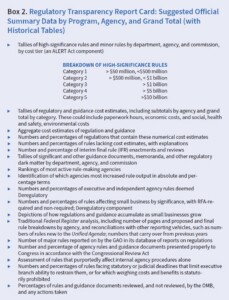
Large-scale rules boast bewildering terminology, as do guidance documents. Various terms each have their own boutique definitions and requirements, including significant, major and economically significant. A report card might inspire some consolidation and easier mapping between the Unified Agenda, the GAO, and the Federal Register. In addition to revealing burdens, effects, and trends, a report card can illuminate what policymakers do not know or appreciate about the regulatory state, such as how few rules receive cost-benefit analyses that actually question the wisdom of injecting coercion into voluntary human affairs, rather than simply assuming its expansion.
Congress needs to take spending policy and regulatory policy alike seriously. It must emphasize regulatory oversight and transparency, and clamp down on guidance document abuse and other forms of regulatory dark matter that evade protections against rogue executive rulemaking. Congress must limit not only executive power, but its own as well. It has increasingly ignored those limits, though it does not have to be that way. Congress must mind its own business and establish regulatory guardrails that the executive branch cannot erode again.