Chapter 4: Regulatory dark matter

Although executive actions are typically understood to deal with the internal operations of the federal government, they increasingly can have binding effects and influence private behavior. Executive orders, presidential memoranda, notices, fact sheets, and other proclamations make up a substantial component of policymaking. This may explain some of the counterintuitive decline in rule counts even as federal scope expands in spending, contracting and procurement, public-private partnerships, supply chains, and specific technology interventions such as hydrogen hubs and blueprints for artificial intelligence. Presidents of both parties routinely threaten unilateral executive actions if Congress fails to act on their agenda.
Executive orders
Executive orders (EOs) date back to George Washington’s administration, but their numerical cataloging and archiving has not been consistent until recent decades. Since the nation’s founding, presidents have issued at least 15,892 of them (see Appendix G).
The United States was several decades old before a president issued more than two dozen executive orders as did President Franklin Pierce (1853–1857). Orders numbered in the single digits or teens until President Abraham Lincoln’s federal consolidations and the subsequent Reconstruction period. President Ulysses S. Grant’s total of 217 set the 19th-century record.
From the 20th century onward, executive orders have numbered over 100 during every presidency and have sometimes soared into the thousands. President Franklin D. Roosevelt, the longest-serving president in history, issued 3,467 executive orders.
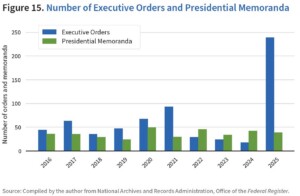
The 239 executive orders in 2025 stand out in Figure 15 as a 1,228 percent surge over 2024. Joe Biden issued 14 of that total, whereas Trump issued 225, bumping the 10-year average to 66. Recognizing that overlap occurs in transition years, the following are calendar-year breakdowns of total and average annual executive orders published in the Federal Register during recent administrations. (Calendar-year counts are provided to preserve comparisons with annual rules counts. Full dispositions in Appendix G will differ slightly.)
- Bill Clinton years (1993–2000): 364 executive orders, average of 46 per year.
- George W. Bush years (2001–2008): 302 executive orders, average of 38 per year.
- Barack Obama years (2009–2016): 291 executive orders, average of 36 per year.
- Donald Trump first term (2017–2020): 212 executive orders, average of 53 per year.
- Joe Biden years (2021–2024): 164 executive orders, average 41 of per year.
Admirably, Executive orders sometimes aim at regulatory review and streamlining in addition to their popularity for implementing policy. Bill Clinton’s 1993 EO 12866 retained OMB’s central regulatory review function established by Ronald Reagan’s EO 12291 but sought “to reaffirm the primacy of Federal agencies in the regulatory decision-making process.” Joe Biden’s EO 14094, “Modernizing Regulatory Review” of 2023, eliminated the streamlining of Trump’s EO 13771, “Reducing Regulation and Controlling Regulatory Costs,” and raised the threshold for a significant regulatory action from $100 million annually to $200 million. It also transformed OMB’s Circular A-4 and subsequent regulatory review guidance, which direct how cost-benefit analysis is performed. This softened oversight and biased OMB’s methodology to make it find more regulations net-beneficial. Once back in office, Trump revoked Biden’s undermining of regulatory review, establishing a new regime prominently featuring a one-in, ten-out mode of operation. Several among Trump’s regulatory streamlining orders invoked the Department of Government Efficiency (DOGE), including:
- EO 14158: “Establishing and Implementing the President’s ‘Department of Government Efficiency.”
- EO 14170: “Reforming the Federal Hiring Process and Restoring Merit to Government Service.”
- EO 14210: “Implementing the President’s ‘Department of Government Efficiency’ Workforce Optimization Initiative.”
- EO 14218: “Ending Taxpayer Subsidization of Open Borders.”
- EO 14219: “Ensuring Lawful Governance and Implementing the President’s ‘Department of Government Efficiency.’”
- EO 14222: “Implementing the President’s ‘Department of Government Efficiency’ Cost Efficiency Initiative.”
- EO 14270: “Zero-Based Regulatory Budgeting to Unleash American Energy.”
- EO 14267: “Reducing Anti-Competitive Regulatory Barriers.”
Among other regulation-related executive orders, EO 14215, “Ensuring Accountability for All Agencies” is notable for bringing independent agencies such as the Federal Communications Commission under OMB review for the first time.
Presidential memoranda
Presidential memoranda and notices can be trickier to tally than executive orders. They may or may not be published in the Federal Register or other readily accessible sources depending on a given administration’s own determination of “general applicability and legal effect.” Nor are memoranda, determinations, notices, proclamations, presidential orders, and other documents reliably classified or numbered the way executive orders are.
These decrees can range from minor declarations celebrating events or people to the more consequential. The more important memoranda include a 2022 continuation of the national emergency concerning COVID-19; proclamations expanding national monuments by hundreds of thousands of acres and prohibiting private industrial or commercial activity in those lands; or actions affecting gun dealers involving background checks and serial numbers. Trump’s April 9 memorandum, “Directing the Repeal of Unlawful Regulations,” was notable in building upon EO 14219 by employing the Administrative Procedure Act’s “good cause” exemption to bypass notice-and-comment procedures for certain unlawful and harmful rules.
As Figure 15 shows, Trump issued 39 memoranda compared to Joe Biden’s 42 memoranda in 2024. Trump’s 49 in 2020 mark the highest single-year count to appear in the Federal Register database, which records totals back to 1994. Appendix M (The Unconstitutionality Index, discussed later), depicts annual totals of both executive orders and memoranda over the past two decades.
The following are among Trump’s 39 memoranda from 2025:
- Designation of Officials of the United States Agency for International Development to Act as Administrator, 01/13/2025.
- Delivering Emergency Price Relief for American Families and Defeating the Cost-of-Living Crisis, 01/28/2025.
- Return to In-Person Work, 01/28/2025.
- Keeping Americans Safe in Aviation, 01/31/2025.
- Limiting Lame-Duck Collective Bargaining Agreements That Improperly Attempt to Constrain the New President, 02/14/2025.
- Reciprocal Trade and Tariffs, 02/19/2025.
- Defending American Companies and Innovators from Overseas Extortion and Unfair Fines and Penalties; 02/26/2025.
- Strengthening the Suitability and Fitness of the Federal Workforce, 03/25/2025.
- Presidential Waiver of Statutory Requirements Pursuant to Section 303 of the Defense Production Act of 1950: Reviving the Manufacturing and Defense Industrial Base for Munitions and Minerals, 06/04/2025.
- Use of Appropriated Funds for Illegal Lobbying and Partisan Political Activity by Federal Grantees, 09/03/2025.
- Preventing Illegal Aliens from Obtaining Social Security Act Benefits, 04/18/2025.
- Hiring Freeze, 01/28/2025.
- Regulatory Freeze Pending Review, 01/28/2025.
- America First Trade Policy, 01/30/2025.
- Putting People Over Fish: Stopping Radical Environmentalism to Provide Water to Southern California, 01/30/2025.
- Promoting Beautiful Federal Civic Architecture, 01/30/2025.
Recognizing that overlap occurs in transition years, here are calendar-year breakdowns of total and average memoranda published in the Federal Register by recent administrations:
- George W. Bush (2001–2008): 129 memoranda, average 16 per year.
- Barack Obama (2009–2016): 255 memoranda, average 32 per year.
- Donald Trump (2017–2020): 137 memoranda, average 34 per year.
- Joe Biden (2021–2024): 152 memoranda, average 38 per year.
The pertinent question regarding federal intervention is what these executive orders and memoranda do, and the authority or lack thereof used to justify them.