Chapter 3: Numbers of rules and page counts in the Federal Register

The Federal Register is the daily repository of all proposed and final federal rules and regulations. Although its page counts are often cited as a measure of regulatory activity, it is hardly a perfect one. A short rule may be costly, whereas a lengthy one may be relatively cheap. The Federal Register also contains many administrative notices, corrections, rules relating to the governance of federal programs and budgets, presidential statements, and other materials. These contribute bulk and bear some relation to the flow of regulation, but are not strictly regulations. Blank pages, skips, and corrections also affect page counts. Shortcomings notwithstanding, it remains worthwhile to track the Federal Register’s page counts as a proxy for federal activism.
The 2025 Federal Register closed out at 60,917 pages. The Biden administration issued 7,648 of those before Trump’s inauguration, giving Trump a net of 53,269 pages. This represents a 43 percent drop from 2024’s record-high 106,109 pages under Biden (see Figure 8). The 2025 Federal Register page tally is the lowest seen since 1992, when page counts stood at 57,003 under George H.W. Bush. It also bests Trump’s own record low of 61,314 in 2017 that followed Barack Obama’s then-record high of 95,913.
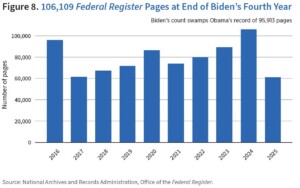
A drop in page counts between administrations is typical, as incoming presidents freeze the pipeline temporarily and launch their own priorities. Figure 8, for example, captures the substantial drops in each instance between Obama and Trump; Trump and Biden; and Biden and Trump.
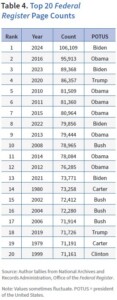
Of the 20 all-time high Federal Register page counts, seven occurred during the Obama administration, as Table 4 shows. Biden and Bush both have four in the top 20. For the history of Federal Register page totals since 1936, see Appendix D.
Federal Register pages devoted to final rules
Isolating the pages devoted to final rules rather than gross page counts removes pages dedicated to proposed rules and also non-rule material such as agency notices, corrections, and presidential documents, although those can also have regulatory effects.
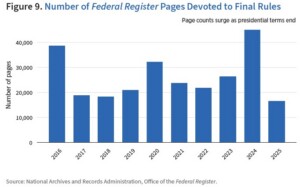
Biden’s fourth year concluded with 45,028 pages devoted to final rules, the highest on record and a 71 percent increase over 2023. Under Trump, pages fell 63 percent to 16,461. The last time pages were that low was 1992 when they stood at 15,491 (see Figure 9).
As Biden’s record might imply, final rule page counts can sometimes tend to surge as presidential terms near their end and midnight rules are issued as agencies rush to implement as much of the outgoing administration’s unfinished policies as possible. The previous page count record for final rules was 38,639 pages in Obama’s final year of 2016. This declined to 18,214 pages in 2018 after the first-term Trump streamlining got under way. Obviously, some rules are bulkier than others and affect final rule page tallies. In Trump’s first term, for example, his streamlining-oriented Safer Affordable Fuel-Efficient (SAFE) Vehicles Rule for model years 2021-2026 clocked in at 1,105 pages.
Alongside these final-rule pages, the page counts for proposed rules in the regulatory pipeline are noteworthy given their implications for future regulatory costs. They are also a leading indicator for possible growth or decline in future final rules.
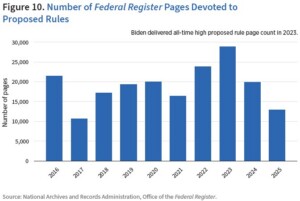
Federal Register pages devoted to proposed rules fell 39 percent from 19,952 to 12,920 in 2025. Biden’s 2023 count of 28,892 stands as the all-time high (see Figure 10), although Biden’s number of proposed rules was relatively low. Before Biden, the number of pages devoted to proposed rules peaked at 23,102 in 2011 under Obama. The 10,704 in 2017 during Trump’s first term were the lowest since 1981.
Federal Register pages published by decade
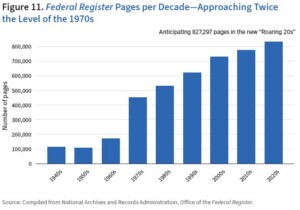
Calculating Federal Register pages per decade provides one more way to characterize the Federal Register and longer-term trends (see Figure 11). The results suggest that a million pages per decade may become the norm.
During the 2010s, 775,734 pages were added to the Federal Register (for a simple average of 77,573 pages each year). Six years into the 2020s, including Trump’s first-term final calendar year and Biden’s four, the average is 82,730 annually. Figure 11’s extrapolation for the remainder of the 2020s implies an expected inventory of 827,297 pages, approaching twice the level of the 1970s when overregulation surfaced as a concern and liberalization in transportation and financial services occurred.
Federal Register final and significant final rules
A trend toward fewer but costlier and larger rules may be underway. It is supplemented by guidance documents and sub-regulatory decrees that can substitute for formal rulemaking, which we call regulatory dark matter. The 2023 and 2024 editions of this report detailed this regulatory dark matter phenomenon. For the year 2023, for example, Biden could have, had he been so inclined, freely claimed that his was the lowest final rule count of any president apart from Trump. But that is not the same as being less of a regulator than predecessors. As is common, Biden sported an affinity for antitrust, trade, energy, and tech interventions; plus family leave, health, and other social policy pursuits that may never appear as rules in the Federal Register and thus are not readily tracked in OMB rule reviews.
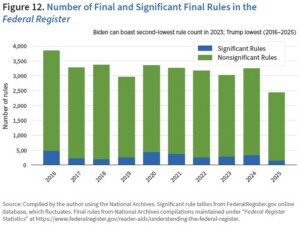
Sticking with conventional rules for now, the 60,917-page Federal Register of 2025 contained 2,441 rules, which is the lowest rule count of all time, besting Trump’s own record-low 2,964 rules in 2019 (see Figure 12). These stand as the only sub-3,000 annual rule counts since recordkeeping began in the 1970s. Moreover, of the 2,441 rules, 243 belong to Biden, leaving Trump a net of 2,198. Further still, a number of these consist of unrules in pursuit of Trump’s streamlining agenda. For comparison, Biden’s 106,109-page Federal Register of 2024 contained 3,248 final rules. In 2016, the final full year of the Obama administration, the number of final rules reached 3,854, the highest count since 2005.
Rule counts were routinely higher in the past. Before 2005, rule counts exceeded 4,000 for all years. The annual average in the 1990s was 4,596, and stood even higher in the decades prior. The seeming paradox of fewer rules but a fatter Federal Register may be explained in part by rules getting longer or more detailed, as may be observed in Appendix E.
The subset of the total final rules deemed significant under EO 12866 is also presented in Figure 12. Just 155 significant rules, many deregulatory in character, were logged in 2025, as distinct from 342 such rules under Biden in 2024. While Biden’s significant rules clearly exceed those of Trump, they did not resume Obama-era levels, when significant rules topped 400 three times (see Appendix E in earlier editions of this report).
In recognition that overlap occurs in transition years, here are calendar-year breakdowns of final and significant final rules published in the Federal Register during recent administrations:
- Barack Obama (eight years): 3,038 significant rules, average 380 per year.
- Donald Trump first term (four years): 1,121 significant rules, average 280 per year (some deregulatory).
- Joe Biden (four years): 1,273 significant rules, average 318 per year.
Box 1 in the later section on the Unified Agenda will inventory the costliest tier of these significant rules for 2025.
Cumulative final rules in the Federal Register
The annual outflow of over 3,000 final rules (apart from Trump’s 2,441 rules in 2025 and 2,964 in 2019) has resulted in 126,536 total new rules since the first edition of Ten Thousand Commandments was published in 1993. Since 1976, when the Federal Register first began itemizing rules, 223,626 final rules have been issued. Since 1996, the year the Congressional Review Act (CRA) passed, 107,650 rules have been issued (see again Appendix E for these milestones). Given that only 42 CRA resolutions of disapproval have been enacted to revoke final rules, that yields a rather uninspiring overturn success ratio of just 0.0004 percent. If deconstruction of the administrative state happens, it will not be coming by means of the CRA.
Proposed rules
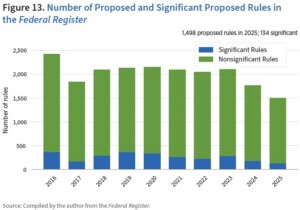
Proposed rules stand at 1,498 for 2025, the lowest tally since recordkeeping began (see Figure 13). Joe Biden issued 109 of them before he left office in January, yielding Trump a net of 1,389 proposed rules. Interestingly enough, the 1,769 proposed rule count in Joe Biden’s record-breaking 2024 Federal Register itself set an all-time low, illustrating the trend of fewer but more substantive regulations taking up more page space. Trump’s 1,837 proposed rules in the first year of his first term is the previous all-time low, despite having included more than 150 Obama proposals issued during the first weeks of 2017. As observable in Appendix E, the average number of proposed rules in the 1990s was 3,164 per year. The average from 2000 to 2010 was 2,692 annually.
In addition, 134 proposed rules in 2025 are deemed significant. Like Trump’s 2025 overall number of proposed rules, this stands as the lowest count for this subset since compilations began in 1995. A number of Trump’s significant deregulatory proposed rulemakings populate these already low flows. These include the Environmental Protection Agency’s proposals on reconsideration of the Obama-era 2009 Endangerment Finding on carbon emissions, repeal of certain gas emission standards, fossil-fuel powered power generating usings, and partial waivers in the Renewable Fuel Standard program; the Department of Housing and Urban Development’s removal of its Affirmatively Furthering Fair Housing rule; and the National Highway Traffic Safety Administration vehicle Corporate Average Fuel Economy standards. Conversely, Trump does have some costly proposed rules of which to take note, including Department of Homeland Security Trade rules and Food and Drug Administration nicotine-yield regulation.
The expanding Code of Federal Regulations
The Code of Federal Regulations (CFR) is where the Federal Register’s rules come to rest in small print in bound volumes of magenta, teal, and fuchsia. It is not as dramatic as the yearly flow of tens of thousands of pages in the Federal Register, but is still a sight to behold.
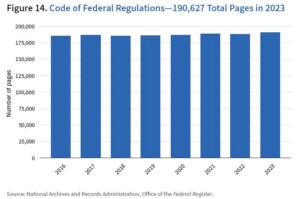
In 1960, the CFR contained 22,877 pages. By 1975, that count, including the CFR’s index, had surged to 71,224. As of year-end 2023 (2024 figures have not been logged yet at the National Archives), the count stood at 190,627, as seen in Figure 14. That is a 168 percent increase in the CFR since 1975. In 2008, George W. Bush’s final full year in office, the count stood at 157,974.
The number of CFR bound volumes now stands at 244, compared with 133 in 1975. Appendix F has a detailed breakdown of numbers of pages and volumes in the CFR since 1975.
The CFR archives agency rulemakings, just as the United States Code does for statutes. But no official archive adequately accounts for executive actions and sub-regulatory guidance documents. The closest approach to an official government-wide archive was Trump’s 2019 EO 13891, “Promoting the Rule of Law Through Improved Agency Guidance Documents,” which established online inventories on agency websites and required formal rulemakings on public-fairness procedures. Biden revoked it, and Trump has not yet formally reinstated it. We next turn to consideration of such regulatory dark matter.