Chapter 7: Unified Agenda of regulatory actions

Along with the Report to Congress, the Federal Register, and the Code of Federal Regulations, another vehicle for regulatory disclosure is the spring and fall editions of the Regulatory Plan and Unified Agenda of Federal Regulatory and Deregulatory Actions. Agencies outline regulatory goals and intentions in the Unified Agenda, particularly in the fall Regulatory Plan component.
As of this writing, the Trump administration has not published a fall Agenda, marking the latest failure to publish the document since the Obama administration skipped the spring 2012 edition altogether. Accordingly, the analysis that follows treats the late-year spring Agenda as definitive for year-end purposes—much as this report substitutes analysis of the one-in, ten-out program’s Final Accounting for what would ordinarily be a review of an updated OMB Report to Congress on regulatory costs and benefits.
The Unified Agenda is not a comprehensive compendium of all rules like the Federal Register. Instead, it presents a cross-section of regulatory priorities from more than 60 federal departments, agencies, and commissions across three categories:
- Active actions: prerule measures and proposed or final rules in development.
- Completed actions: rules finalized (or withdrawn) during the (roughly) six months since the prior Unified Agenda.
- Long-term actions: rulemakings anticipated to take place beyond a 12-month horizon.
The Unified Agenda reflects administrations’ differing priorities and surrounding political realities, such as a dramatic and incongruent rulemaking pause under Obama during the 2012 election season (the same timeframe during which the spring 2012 Agenda was allowed to lapse). The Biden administration’s pursuit of regulatory net benefits contrasted sharply with the one-in, two-out streamlining mindset reflected in the semiannual Unified Agendas between 2017 and 2020, when hundreds of entries were explicitly labeled deregulatory. It is important to note that agencies are not required to limit their regulatory activity to the material published in the Unified Agenda unless an administration directs otherwise. Rather, the Unified Agenda “reflect[s] what the agency wants to make public, not necessarily all activity under consideration, and some highly controversial issues may be withheld.”
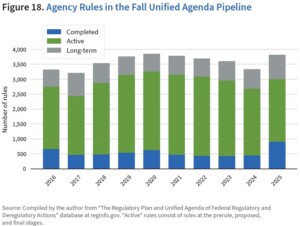
The spring Agenda appeared late, in September 2025. That snapshot showed 69 departments, agencies, and commissions listing 3,816 rules in the active (prerule, proposed, and final), recently completed, and long-term stages. Figure 18 breaks these down alongside prior years’ fall Agendas. Note the increase over the 3,331 rules in the fall 2024 Agenda under Biden, in part attributable to a number of Trump’s aforementioned “unrules” in the form of removals, extensions, administrative updates and enforcement relaxations that nonetheless require rule-writing that populates the Agenda and Federal Register. Here’s a breakdown of the Agenda’s 3,816 entries:
- 2,098 entries are active (prerule, proposed, or final).
- 911 entries are completed actions. These are up sharply from Biden’s last Agenda, but many are removals, compliance date extensions, and administrative updates, and not new rules.
- 807 entries are long-term items, also up sharply over prior years; many deregulatory in scope.
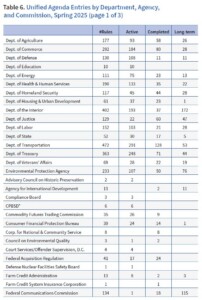
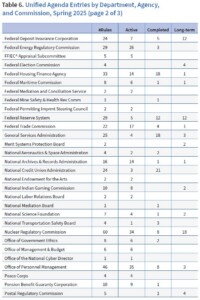
Table 6 breaks out by department, agency, and commission the spring 2025 Agenda’s 3,816 rules in the active, completed, and long-term stages.
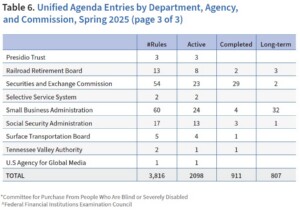
The Active stage typically features well over 2,000 rules annually. Most Active rules in any given edition of the Unified Agenda are carryovers from prior editions as they advance through stages. Many have been in the pipeline for some time. In the spring 2025 edition however, 868 active rulemakings appear for the first time, compared to 275 in the final Biden Agenda of fall 2024. In both Biden’s first year and Trump’s first-term final year, there were fewer than 500 first-time active rules.
Historically, through 2013, the Unified Agenda often exceeded 4,000 active, completed, and long-term rules. Unified Agenda counts were highest in the 1990s, peaking at 5,119 rules in fall 1994 before a series of mid-1990s regulatory reforms were enacted by Congress. The fall 2017 Unified Agenda pipeline of 3,209 contained the fewest rules since 1983, even without counting that Trump edition’s 540 deregulatory entries. (For a history of the total numbers of rules in the Unified Agenda from 1983 to the present, see Appendix I.)
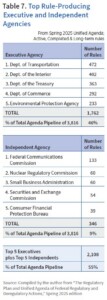
A relative handful of executive branch agencies each year account for the greatest number of rules in the pipeline. In the spring 2025 Unified Agenda, the Departments of Transportation, Interior, Treasury, Commerce, and the Environmental Protection Agency are the most active (see Table 7). These top five, with 1,762 rules among them, account for 46 percent of the 3,816 rules in the pipeline. The Department of Health and Human Services, with 190 rules, takes sixth place.
The top five independent agencies in the Unified Agenda pipeline by rule count (excluding the multiagency Federal Acquisition Regulations System’s 41 rules) are the Federal Communications Commission, Nuclear Regulatory Commission, Small Business Administration, Securities and Exchange Commission, and the Consumer Financial Protection Bureau. Their total of 346 rules accounts for nine percent of the 3,816 rules in the spring Unified Agenda. Combined, the top five executive and independent agencies account for 2,108 rules, or 55 percent of the total.