Chapter 8: Economically significant rules

From 1993 until April 2023, rules with annual economic effects of at least $100 million were classified as economically significant. Biden’s EO 14094 raised the cost threshold for a significant regulatory action to $200 million and changed its name to a Section 3(f)(1) Significant (S3F1) designation. Trump restored the $100 million threshold in 2025.
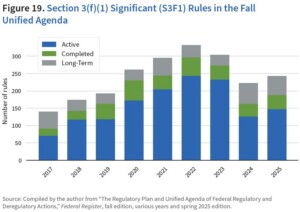
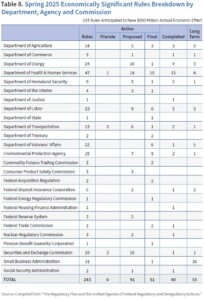
As Figure 19 shows, 243 rules in the spring 2024 pipeline (again, treated here as a consolidation of spring and fall editions in the absence of fall Agenda) are designated as having at least $100 million in annual economic effects, compared to 222 in Biden’s final year. A large proportion of them are deregulatory, whereas Biden’s 222 (and his 304 in 2023) were S3F1 rules meeting the threshold of $200 million in economic effect. Of Trump’s 243 rules, 40 are recently completed, 148 are active, and 55 are long-term. Table 8 inventories these 243 rules by the 25 issuing departments and agencies. Of the completed economically significant rules, four were from the Department of Energy and 13 from Health and Human Services. The deregulatory nature of many of these significant rules contrasts with the $77 billion in annualized regulatory costs added over four fiscal years, as compiled from OMB’s latest Report to Congress editions presented earlier in Table 3. Restoring OMB’s report would provide a more complete picture of Trump’s actions.
Appendix J contains the full compendium of 148 active (prerule, proposed, and final) economically significant rules and 55 long-term rules under development in the spring 2025 Unified Agenda.
Recognizing that overlap occurs in transition years after elections (for example, Biden issued 68 significant rules between the fall Unified Agenda and Trump’s inauguration), the following are calendar-year breakdowns of average high-significance active rules in recent administrations in their fall Unified Agendas. Note that Biden showed considerably more activity despite the higher $200 million cost threshold he himself established in 2023:
- George W. Bush (eight years): average 87 in fall Unified Agendas.
- Barack Obama (eight years): average 133 per year.
- Donald Trump (four years): average 120 per year.
- Joe Biden (four years): average 202 per year.
Figure 19 represents flows of the fall Unified Agendas. While this creates a thorough year-end snapshot of active and long-term rules, incorporating the spring Unified Agendas alongside fall editions is necessary for a full picture of the completed subset during any given year. Figure 20 captures these since 2016, as well as the 40 completed economically significant rules of spring 2025 (again, no fall edition is available). Note also that the surge of 116 completed rules in 2024 under Biden marks the highest count in this interval, even as these rules met the higher S3F1 $200 million threshold.
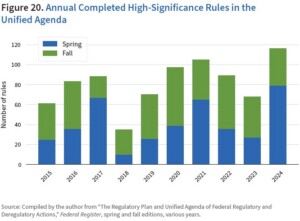
Again recognizing transition year overlap, the following are calendar-year breakdowns of completed highly significant rules under recent administrations. Biden’s average is the highest at 95 completed per year, even with the late-term shift to the higher $200 million threshold.
- George W. Bush (eight years): average 49 completed economically significant rules per year.
- Barack Obama (eight years): average 69 completed economically significant rules per year.
- Donald Trump first term (four years): average 73 economically significant rules per year (including more than 50 deregulatory during the term).
- Joe Biden (four years): average 95 highly significant rules per year.
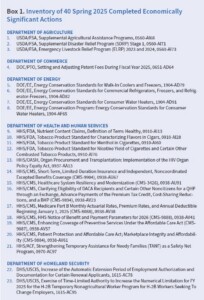
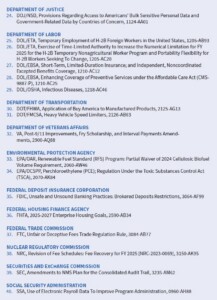
Box 1 inventories the spring 2025 Agenda’s 40 completed economically significant actions. Of the 40 completed actions, many are deregulatory. Formally restoring that classification would be a key metric to reinstate in 2026. For example, despite Biden’s EO 14094 raising the threshold for economic significance, major rules always retained a $100 million threshold as codified in the 1996 Congressional Review Act. Furthermore, rules can be classified major for reasons other than cost. The larger population of major rules in the spring 2025 Agenda stands at 60.
The emphasis on the high-cost rule subsets should not distract policymakers and analysts from the remaining bulk of rules in the annual pipeline. Many of these can and do impose substantial costs or effects in their own right.