Don’t Panic: A Skeptic’s Guide to the AI Jobs Doomsday
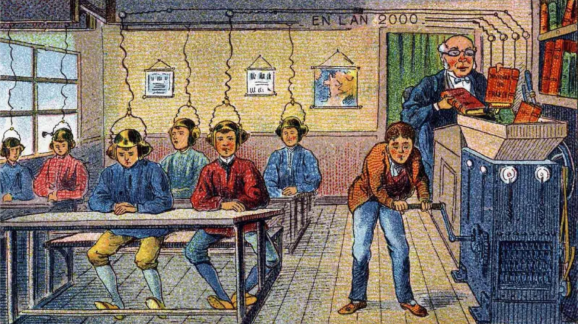
As technology advances it has periodically bred the fear that progress will destroy jobs and livelihoods. History teaches that these fears are usually misplaced. A century and a half ago, most people worked on farms, performing back-breaking labor 10 hours of the day. Modern agricultural techniques have drastically reduced the amount of labor needed to manage farms. Yet these developments have not resulted in widespread unemployment, and few people are nostalgic for the arduous life that once prevailed.[1]
The current iteration of that fear is Artificial Intelligence, a.k.a. “AI.” The capabilities of computer programs have grown exponentially, most notably with the release of ChatGPT in late 2022. Tech companies have been investing billions in AI development, creating a technological gold rush. Businesses are clamoring to get on board both because they fear being left behind and because they anticipate genuine opportunity in developing AI-based tools.
Ninety-five percent of CEOs say they are optimistic about AI adoption, calling the technology transformative. Only 5 percent of those CEOs viewed AI as overhyped. “They think it is going to add to productivity, help the economy, improve the global economy, improve competitiveness, but it will weaken the employment market,” said Stagwell Chairman Mark Penn.[2]
The race to develop AI-based technology is premised on the belief that it will be the next major stage in automation, eliminating a variety of human tasks in the same way that dishwashers eliminated the need to clean dishes by hand. The difference is that this time the jobs lost are in more skilled professions previously assumed immune to replacement by machines because they required knowledge and critical thinking skills. The age of the sentient computer is supposedly dawning, and that could have profound implications.
“If AI surpasses human intelligence and acquires the ability to improve itself, it could confer unshakable scientific, economic and military superiority on the country that controls it,” said The Wall Street Journal.[3]
Will these innovations come at the cost of jobs? AI will undoubtedly result in creative destruction where, along with the advances, certain jobs may be rendered obsolete, and therefore those who cannot adapt to these changes will be left behind. Nevertheless, those concerns are probably overblown.[4] Innovation historically has not caused widespread unemployment in the broader economy. It is usually associated with greater job gains as surrounding industries adapt to the changes, creating new jobs in the process. The advent of the automobile may have been problematic at first for the leathermakers who made buggy whips and bridles for horses. But it didn’t destroy the leather-making industry. After all, someone had to make the leather that covered the seats of the cars coming off the assembly lines.
Bill Beach, economist and former head of the Bureau of Labor Statistics, points out that AI is not only a new technology, “but it is also a new form of labor and that is the part that is puzzling everyone.”[5]
AI is a technological development unlike any that have come before. Alarmists are using that novelty and the uncertainty it brings to repeat the same pessimistic predictions they made when previous technological revolutions took place. However, while AI may be different, we should expect the economy to adapt to AI just as it did to previous innovations.
Predictions of job disruptions
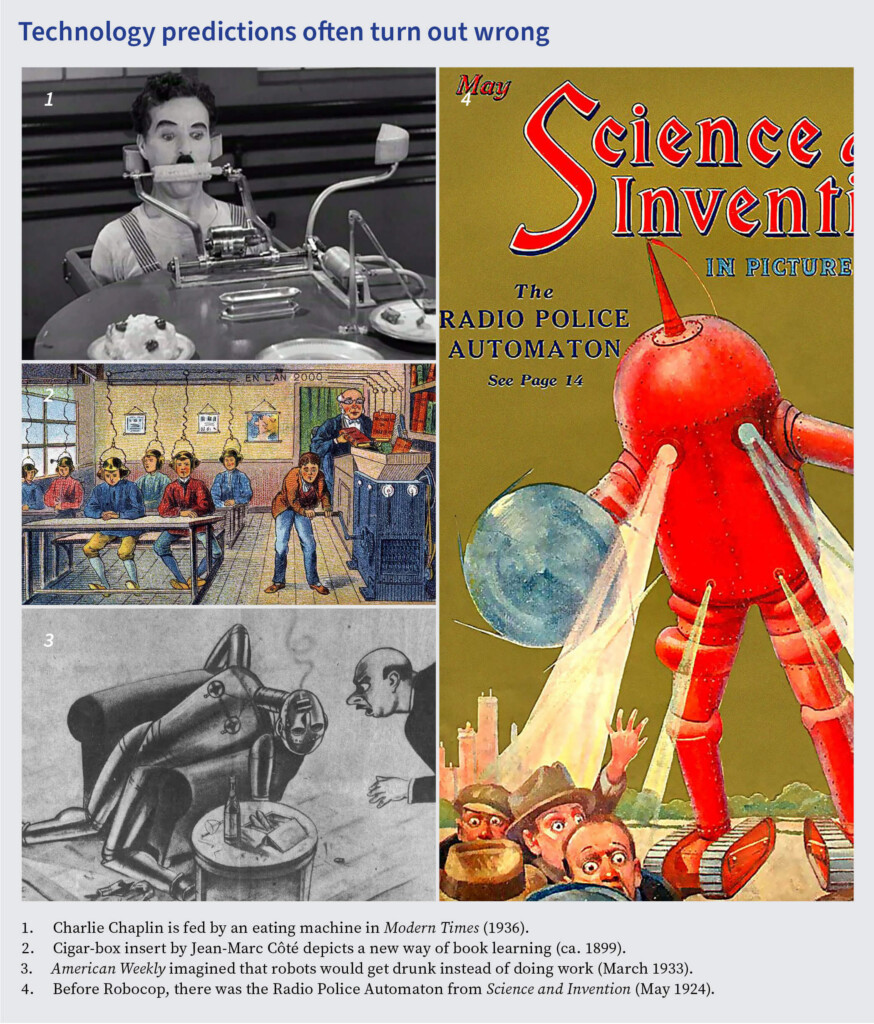
New waves of technology have historically disrupted jobs. A certain level of displacement is inevitable given that technologies are often designed to replicate tasks done by humans. Teasing out the actual effect on employment in the aggregate is far from easy.
Predictions range from minor disruption to major economic upheaval. A 2025 World Economic Forum survey found that 40 percent of employers expect that AI can be used to reduce their workforces. The survey predicted that trends in AI and related technology will create 11 million jobs while replacing 9 million jobs.
The WEF survey also found that 86 percent of businesses expected technology, AI in particular, to transform their operations by 2030.[6] A 2023 report by the WEF projected that automation would destroy 83 million jobs and create 69 million jobs by 2027. That amounts to a net loss of 14 million jobs (2 percent of the global workforce). AI was cited as a driving factor, though not the only one.[7]
A 2025 report by the Indeed Hiring Lab found that 80 percent of jobs will be moderately or highly transformed by AI.[8] A 2023 McKinsey report projected that by 2030, 30 percent of current work hours could be replaced by AI-driven automation. It found that the biggest future job losses would happen in office support, customer service, and food services.[9] These are, notably, the less skilled professions that have traditionally been replaced by automation, not the ones that AI has been touted as replacing—jobs requiring critical thinking or specialized knowledge. AI-based automation would, in the name of efficiency, result in 1.6 million fewer clerks, 830,000 fewer retail salespersons, 710,000 fewer administrative assistants, and 630,000 fewer cashiers.
Eric Schmidt, former CEO of Google, predicted in 2025 that within one year, most programming work would be done by AI.[10]
An October 2025 Wall Street Journal story about Amazon and other companies cutting jobs reported:
Behind the wave of white-collar layoffs, in part, is companies’ embrace of artificial intelligence, which executives hope can handle more of the work that well-compensated white-collar workers did. Investors are pushing the C-suite to work more efficiently with fewer employees. … The white-collar jobs on the chopping block have been roles that many U.S. workers aspired to secure.[11]
Goldman Sachs predicted that up to 50 percent of jobs could be fully automated by 2045, driven by generative AI and robotics.[12] Goldman Sachs previously estimated that 300 million jobs could be lost to AI, affecting 25 percent of the global labor market.[13]
Jamie Dimon, CEO of JPMorgan Chase, estimated in a 2025 shareholder letter that AI will dominate repetitive tasks within 15 years.[14]
To some, like Sen. Bernie Sanders (I-VT), the ranking member on the Health Education, Labor and Pensions Committee, AI is nothing short of an existential threat to the ability of millions to earn a living. In an October 2025 committee hearing, he said:
Artificial labor could not only put millions of people out of work from their existing job. It could also replace new jobs that could have been created. A factory worker who loses their job cannot be told to learn to code if artificial labor also takes the coding job. At the very least, artificial labor could bring rapid and destabilizing job displacement.
Sanders said, “AI could replace up to 97 million jobs in 10 years.” The senator had obtained this estimate from ChatGPT and presented his analysis with no sense of irony. He later conceded, “The reality is no one knows what will happen.”[15]
Jobs and innovation—the lessons of history
The history of the automobile offers one of the best lessons in how innovation affects employment. Car manufacturing began in the late 19th century, and by 1917, the US industry collectively employed 175,000 people, jobs that previously didn’t exist.[16] Today, the same industry employs just under 1 million.[17]
In 1913, Henry Ford’s assembly-line innovation allowed cars to be produced more quickly with fewer workers. Since then, car designs have been continually refined, making them faster, more spacious, and more maneuverable, and incorporating luxuries like air conditioning. The assembly line itself was increasingly automated, allowing for even greater production using even fewer workers. This change, however, became controversial because unions saw it as costing jobs. The unions opposed the growing trend to automation.[18]
In mid-1979, overall manufacturing employment in the United States hit a high of 19.5 million. It declined to a low of 16.7 million in 1983, before rebounding to 17.9 million in December 1989.[19] In the three and a half decades since then, manufacturing has declined to 12.5 million,[20] though output has increased substantially.[21] The industry is producing more with less.
The auto manufacturing sector in particular suffered in the 1980s, going from 1 million workers in 1979 to a low of 770,000 by 1982, but eventually rebounding in 1998 to its current level of about 1 million.[22] This period was also one of intense international competition, with Germany and Japan eating into American markets, most notably the domestic auto market.
One of the reasons Germany and Japan gained market share over the US auto industry in the first place was that they were quicker to automate, which made their cars cheaper to produce. These foreign-made cars were also more fuel-efficient. The US economy fell into a steep recession in 1980, so the car-buying public began switching to cheaper foreign imports. In just one year, 1979 to 1980, foreign automakers’ US market share jumped from 21.2 percent to 26.1 percent. Sales of US-made cars tumbled 20 percent over the same period.[23] US manufacturers had to automate their assembly lines simply to maintain their competitive edge. This move did cost jobs within the domestic auto industry, but by the end of the decade, the industry had recovered to about 900,000 jobs, and today the number sits at 1 million. In short, it was resistance to automation that hurt Detroit, and automation that saved it.
This experience also demonstrates that the United States does not operate separately from the rest of the world. The US economy has been dominant over the past 20 years, partly because it has been the most open to new technologies. Should the United States hinder its AI industry for fear of job losses, it may lose leadership economy-wide instead of in just one industry.
US manufacturing lost 2.3 million jobs in the recession of 1981–82, according to a Labor Department survey, and regained 1.5 million by 1984, for a net loss of 800,000 over the four-year period. During the 1980s, the US service sector grew by about 10 million jobs. Growth in sectors such as shipping, buoyed by a demand for the now-cheaper US exports, contributed to that result.[24]
Overall, US unemployment was 5.9 percent in mid-1979 and 5.3 percent by mid-1989.[25] During this same period the working-age population swelled by 21.5 million, or about 13 percent.[26] So, while some manufacturing jobs were lost, overall unemployment actually declined slightly over that period despite an increase in job seekers. New jobs in new fields were created by automation. Somebody had to operate the machines, build and maintain them, and transport them to foreign countries.
This is the nature of automation: It focuses on eliminating the more tedious tasks, freeing up time, labor, and resources for other pursuits.
Innovation leads not just to newer jobs but also to higher pay and higher standards of living. Historian James Bessen calculated the real hourly wages for weavers and spinners in the first half of the 19th century.[27] Beginning around 1860, factories adopted new technologies such as the power loom, which has been credited with increasing output by a factor of 40. Bessen’s research showed that workers’ wages were stagnant in the three decades prior to 1860 but rose substantially in the three ensuing decades. His theory is that, in the absence of the technology, the market for textiles was stagnant. This technological innovation increased production, expanding the market for cloth products and necessitating more moderately skilled workers as well as more workers with specialized skills, such as operating or maintaining machinery.
Workers’ views on new technology
A worker’s view of a new, emerging technology is directly related to their fears that it will affect their ability to make a living. In the 1990s, few in the broader workforce saw the emergence of the internet as a threat, despite its genuine transformation of how work was done. The internet and the advent of streaming video destroyed the video rental business and contributed to the demise of bookstore chains like Borders. But few now view the loss of such retail jobs as a tragedy. And many welcomed the new formats of books and films.
A 1995 survey reported that 72 percent of respondents saw computers and the internet as at least compatible with their jobs, if not beneficial. Only 24 percent had concerns about its effect.[28]
Artificial Intelligence has had a markedly different result, provoking widespread anxiety because of its potential to replace workers. A 2025 CNBC survey reported that 68 percent of workers were uncomfortable with AI. Just 31 percent looked at it positively.[29]
“AI can be unsettling even if you face no direct threat from it, just as an out-of-control border bothered people unaffected by illegal immigration. Both undermine your sense of control,” noted Wall Street Journal columnist Greg Ip.
Critics like Sen. Sanders nevertheless argue that this time the outcome will be different, that sufficiently advanced forms of AI can target professions that were previously immune to technological change. The Writers Guild of America and SAG-AFTRA, the film and TV actors union, went on strike in 2024 in part because they were concerned studios would use AI to put their members out of work.[30] This concern is felt keenly in other professions that require skilled creative labor, such as journalism, screenwriting, and graphic design.
“America’s bosses are getting blunt about the reality that AI leads to job cuts. The standard warning goes something like this: If a bot doesn’t replace you, a human who makes better use of AI will,” another Wall Street Journal story reported.[31]
How artificial intelligence actually works
Over the years, there have been many interpretations of artificial intelligence. Generally, it refers to computer software of varying complexity that can do tasks that seemingly involve some level of independent thought and creativity. The most recent versions of artificial intelligence differ from previous innovations because they suggest that AI could replace not just a single task or job but a broad range of them.
A simple example is recommending additional purchases to online shoppers. Online retailer Amazon developed that capability in the late 1990s. The website uses algorithms to predict what products a shopper might like based on his purchase history. It considers purchases by people who buy similar things on the assumption that they may have similar likes and dislikes. Feedback is factored in as well. If the customer buys what was recommended, then the algorithm notes that and searches for more similar items to recommend. In this sense, the algorithm “learns” what the purchaser wants. It can even seem insightful. “Amazon.com Recommendations Understand Area Woman Better Than Husband,” declared a headline for the satirical website The Onion.[32]
AI programs take this basic process—collecting data and running odds—but increase the amount of data and the number of calculations involved to refine the output. The resulting programs are vastly more complex and often appear to be thinking.
Currently, the main variant of AI is what is known as a large language model (LLM). These programs, such as OpenAI’s ChatGPT, have been trained on libraries of news articles, books, websites, academic articles, and other sources. The idea is to give the algorithms steadily larger pools of data to work from. Hypothetically, the process could continue to be refined over time until the programs scale up enough to simulate human thought.
Being trained on written work available online gives LLMs many advantages over previous versions of AI. For one, they can communicate in natural language, making it easier for users to interact with them and ask more complex questions than they can put to a standard search engine. Second, they can connect different sources in ways that search engines can’t. If you ask it what is known about a topic, it can pull information from multiple sources and summarize them for you.
In addition, LLMs are a form of generative AI that can seemingly produce original content, including journalism, essays, art, and animation. Instead of being merely a search or spell check program, for example, an AI writing program can be directed to create articles from scratch based on inputting particular data. AI programs can already provide detailed written answers to questions. Other programs have been used to create song pastiches that can approximate long-dead country singers like Hank Williams crooning gangster rap lyrics. They can animate alternate versions of famous movie scenes. AI advocates believe (and critics fear) that it may soon be able to generate the kind of in-depth work that only humans have been able to create: long-form news stories, original film and television scripts, and graphics and animation. Many businesses are keen to adopt it, believing it can automate tedious tasks currently performed by humans. The unknown factors are how much human labor AI will replace, how fast it will develop, and what jobs human workers will still be able to do.
New technologies—expectations vs. reality
Emerging technologies frequently come with expansive claims that they will bring us closer to imagined science-fiction futures only to fall short of those predictions. In the 2000s, the hot issue was stem cells, which were expected to deliver miraculous medical cures. Paralyzed actor Christopher Reeve claimed in 2002 that they could help him to walk again in two to three years.[33] 3D printing was supposed to effectively give us the replicator technology seen in the Star Trek TV series, but that has yet to happen. Nanotechnology was another supposedly transformative technology. Advances in all of those areas have been made, but they’ve never come close to the expansive claims that were initially promised.
Even transformative technology, like the internet, changes things in unexpected ways. Remember when the internet was supposed to make it easier to preserve and access reliable information, rather than drowning us in a sea of trivial and often unreliable data?
Claims that AI will completely eliminate the need for certain high-skilled professions have already had a few notable flops. Nobel Prize–winning AI scientist Geoffrey Hinton created a stir in 2016 when he declared, “People should stop training radiologists now. It’s just completely obvious that within five years, deep learning is going to do better than radiologists.” This didn’t happen. Radiology jobs were not lost, and radiologists remain in high demand and well paid. “In retrospect, [Hinton] believes he spoke too broadly in 2016,” The New York Times reported in 2025.[34]
The doomsday scenario and the limits of AI
AI’s emergence has prompted even more extreme fears than that of machines replacing human jobs. What if AI outpaces humans entirely? Can AI become so intelligent that it gains sentience and ushers in the type of robot apocalypse seen in The Terminator films and other science fiction franchises?[35]
“Mitigating the risk of extinction from AI should be a global priority alongside other societal-scale risks such as pandemics and nuclear war” declared a 2023 open letter “Statement on AI Risk” whose signatories included Sam Altman, CEO of OpenAI, and Microsoft founder Bill Gates, among many others.[36]
“Today’s systems are not anywhere close to posing an existential risk. But in one, two, five years? There is too much uncertainty. That is the issue,” said Yoshua Bengio, an AI researcher at the University of Montreal and one of the signatories. “We are not sure this won’t pass some point where things get catastrophic.”[37]
One such popular scenario for how this could happen is the so-called “paperclip apocalypse,” a thought experiment created in 2014 by University of Oxford philosopher Nick Bostrom.[38] He theorized that a super-intelligent AI tasked with creating paperclips would divert additional resources to creating paperclips and find methods to prevent itself from being turned off, resulting in the world being drowned in excess paperclips.
The point of the thought experiment was not that paperclips represented a particular concern—the scenario could be any product—but rather that super-intelligent AI could outpace human efforts to keep it under control.
One reason why such scenarios seem plausible to many is that popular culture has already trained us to think that sentient computers are inevitable. Robots and computers with human-level intelligence were commonplace in films, novels, and comic books at least as far back as the 1950s. Popular entertainment has frequently grappled with the implications and potential threats of computer sentience.
Audiences in 1968 trembled as HAL 9000 coldly attempted to murder his spaceship’s own crew in 2001: A Space Odyssey. Two decades later, The Terminator predicted a world where computers dominate humans and create robotic Arnold Schwarzeneggers to hunt down resistors. In 1999, The Matrix posited that the computers had already won and had imposed a manufactured reality on an unaware humanity.
No such scenario is plausible in the near future. Truly sentient AI has not been achieved and likely remains a long way off, assuming it is even possible. Even AI innovators argue that current technology does not think and that programs capable of simulating human thought are not yet within reach.
“We are not going to get to human-level AI just by scaling LLMs, and whatever you can hear from some of my more adventurous colleagues, it’s not going to happen within the next two years,” said Yann LeCun, leader of Meta Platform’s AI project in 2025.[39]
“Hypothetical is such a polite way of phrasing what I think of the existential risk talk,” said Oren Etzioni, the founding chief executive of the Allen Institute for AI, a research lab in Seattle.[40]
The gold rush to invest in AI
Billions are being invested by the major tech companies on the assumption that AI is the next big leap in technology, and no company wants to be left behind. Since the release of ChatGPT, investment flows into AI have increased nearly eightfold, according to the World Economic Forum.[41] Morgan Stanley projected in the fall of 2025 that $3 trillion will be poured into the AI buildout by 2028.[42] The Wall Street Journal reported that AI investment was the biggest contributor to US GDP growth in the first two quarters of 2025.[43] The MacroStrategy Partnership, an independent research firm, claimed in October 2025 that investment in AI technology was 17 times the size of the dot-com bubble of the early 2000s.[44]
The investment is going into real estate, data centers, and power facilities needed to run the AI programs. The Wall Street Journal reported in October of 2025 that AI was behind a turnaround in San Francisco’s fortunes. The city had previously suffered a depressed real estate market among other woes.[45] Instead, tech firms investing in AI were buying up empty office buildings. The Journal also reported that Altman plans to build 250 gigawatts worth of computing capacity at an estimated cost of $10 trillion by 2033. That is roughly equivalent to Germany’s current power needs. Rather than destroying San Francisco’s job market, AI may be rescuing it.
How will AI affect jobs?
Beach calls AI “enhanced labor” because it performs tasks that previously could not be automated. This capability is a potential boon because workers will be able to make things they could not previously make and learn new skills faster than they ever could. “Any time you add more labor into the economy, you get more output,” Beach notes.
Turning a press release into a news story, for example, has traditionally required a human mind, but the job was usually not mentally taxing for the journalist involved. Such work was frequently handed off by editors to interns or rookie hires. Editors would still need to read the copy and make any necessary changes.
Stephen Lewarne, professor of economics and finance at Franciscan University of Steubenville, Ohio, argues that the fact that tasks may be affected by AI doesn’t mean the workers will be rendered redundant. They’ll move to different tasks instead. Lewarne says:
Technology automates, accelerates or reduces the cost of specific tasks within a job, allowing employees to spend more time on higher-value activities. As a result, output expands and wages often rise. Software developers, for instance, routinely use AI tools to generate boilerplate code, test functions and debug routines – tasks that once consumed hours. The result isn’t fewer developers, but developers producing more complex systems faster, with demand for experienced talent rising rather than falling.[46]
Consider, for example, AI’s potential effect on the legal profession. Many parts of legal work are labor intensive: researching cases and precedents, drafting memos and discovery summaries, etc. This work does require significant editing and oversight, but using AI to create first drafts could speed the process, reducing billable hours. Legal work would become less costly and, therefore, potentially more accessible.
Or think of the retail merchant who writes and stars in their own tacky late-night TV advertisements. Generative AI will allow that merchant to create the graphics and animations on their own, resulting in far more elaborate and ambitious tacky late-night ads.
In neurosurgery, AI programs are being used to study past surgeries and map out procedures to train new brain surgeons. The programs can study and extract best practices from vastly more examples than a human can. The actual medical procedure, however, would still require a human surgeon. Thanks to the AI programs, more of those surgeons can be trained. “It helps me orientate myself during mock surgery and helps identify what steps and what stages are coming up next,” said Nicola Newell to the BBC in 2023.[47] Newell was training to be a brain surgeon.
Jobs created by AI
The headlines about AI replacing jobs obscure the fact that the technology itself will also create jobs that didn’t previously exist. Somebody has to build, update, and use the AI programs, after all. LinkedIn estimates that AI created 640,000 white-collar jobs between 2023 and 2025. By the end of 2025, 6 percent of job ads were for positions related to AI use, up from 2 percent in 2018.[48]
These were jobs directly related to the new technology, such as head of AI, AI engineer, and AI trainer, the latter being the people who work with the programs to improve their performance. Thus far, these are primarily in AI companies. But other sectors, such as health care, finance, and manufacturing, are snatching up AI tech workers to keep up with the technology.
AI’s effect on job training
AI could become problematic if it closes off avenues for entry-level work. Journalists, for example, must start somewhere. Using AI programs to replace the tasks of writing or editing basic copy may cut off an area of important learning.
The Harvard Business Review warns that there is a potential danger in allowing AI to remove too many obstacles and make tasks too easy:
[P]rogress comes from intelligent failures: the false starts, stumbles, and disappointments that occur when tackling difficult, uncertain tasks. Entry-level jobs—by providing safe spaces to try, fail, and try again, where the stakes are lower than at the top—are vital for building adaptive and confident professionals.[49]
That concern, however, assumes that AI is used to completely replace humans doing that type of work. Just as likely, workers will be tasked with using AI to produce a higher volume of work more quickly. Fortune staff journalist Nick Lichtenberg penned more than 600 stories in a six-month period for the publication by using AI tools. Lichtenberg used AI to generate stories based on public documents, then rewrote them to fix any factual and grammatical errors.[50]
There is a danger that, in the rush to increase production in this manner, standards will decline over time. But producing a poor-quality product will also alienate consumers and hurt the company that tries it. The market will find an equilibrium.
“[T]he fear [is] that AI will flood the world with mediocrity,” says AI advocate Brian Gross. “No one denies that AI can churn out a quick, cheap facsimile – and that some executives will happily take the savings. The real question is whether audiences will settle for the facsimile once the novelty wears off.”[51]
Perspectives from the cutting edge of AI use: Video games
Video game developers have some of the best and most insightful takes on the uses and limits of AI because they are at the cutting edge of utilizing it in existing technology. Video games require AI systems to control the opponents that fans play against. Game developers have become skilled at developing programs that can react against and even predict player actions. Each year, developers attempt to outdo one another in creating interactive environments that feel real—the industry term is “immersive.”
Developers tend to be optimistic but pragmatic. “History has shown us that every major technological leap creates whole new industries, opportunities, and specialists,” says Glen Schofield, creator of the Dead Space series. “AI is a technological leap. It’s like the PC, internet or cellphone, and just like those it’s going to create another wave. It’ll change the way we work and the way we do things. Yes, some jobs are going to shift, they may go away, but new ones—millions of them—will be created over the years.”[52]
Schofield’s advice to workers: “Learn some AI that makes you better, faster and more efficient. That’s how you’re going to make yourself indispensable.”
Strauss Zelnick, chairman and CEO of videogame company Take-Two, which produces the popular Grand Theft Auto and Red Dead Redemption series, disputes the idea that AI will take over human jobs. He argues that AI cannot do that because it cannot be truly creative. In a 2025 speech, he said: “AI … is the combination of big datasets. … And by definition, a data set is what? Backward looking. By definition, creativity is what? Forward looking. And to the extent that AI appears to be forward looking, it is what? A predictive model.” [53]
Todd Howard, CEO of Bethesda Games Studios, makers of the Elder Scrolls and Fallout series, agrees that AI can be useful, but cannot substitute for people. “I view [AI] as a tool. Creative intention comes from human artists, number one. But I think we look at it as a tool for, is there a way we can use it to help us go through some iterations that we do ourselves faster?” Howard told the online magazine Eurogamer. “But we want to protect the artistry. The human intention of it is what makes our stuff special.”[54]
Many game developers fear that corporations don’t understand this distinction and will attempt to use AI as replacement labor. The games industry had an estimated 20,000 layoffs in 2023–2024.[55] The layoffs were mainly a correction following a brief hiring boom during the COVID pandemic. Others point to AI as a possible reason the industry allowed such a brain drain. “It has certainly been hollowing out the bottom of the games industry to a dangerous degree,” says Mark Darrah, a former developer for BioWare.[56]
Games that have utilized AI programs to create truly randomized, original content—a process dubbed “procedural generation”—have left most fans underwhelmed. The process involves a kind of computerized “mad libs” where the game tries to predict what the player wants and throws in randomized elements at the same time. Players view this type of product (often derisively called “slop”) as inferior to content created by human developers.
Howard’s Bethesda Games Studios released a space-travel simulation game titled Starfield in September 2023 whose big draw was that it had more than a thousand planets for players to visit and explore. The game used procedural generation to create those planets and the content that appeared on them (locations to explore, enemies to fight, etc.). Heavily hyped at release, Starfield peaked at more than 330,000 players at launch, according to online video game retailer Steam, but has since struggled to hold onto those players. As of December 2025, the player base is just over 3,000 people, about 1 percent of the number at launch. By contrast, Bethesda’s 2011 The Elder Scrolls V: Skyrim, which features primarily human-made content, averages about 32,000 players on a given day.[57] Starfield’s Steam reviews sit at mixed, with commenters citing the lack of creativity in the procedurally generated planets as a problem. “Everything you find on a planet is exactly the same as you find on every other planet. Every mining outpost, every laboratory, every settlement looks the same, and often has exactly the same loot and enemies,” notes a reviewer.[58]
“Players aren’t longing for generic, soulless side quests or synthetic AI voices,” said Phil Rogers, CEO of Embracer Group, at the publishing company’s 2025 annual meeting.[59]
AI-generated content has obtained such a negative reputation in the video game sphere that developers are careful to avoid advertising that they use AI programs. They fear a consumer backlash if they do, as well as other potential downsides. [60] Take-Two warned shareholders in 2025:
Any integration of any AI technologies into our products or services may result in new or enhanced governmental or regulatory scrutiny, litigation, confidentiality or security risks, ethical concerns, negative user perceptions as to automation and AI, or other complications that could adversely affect our business, reputation, or financial results.[61]
Tech investor Matt Shumer provided an example of the gulf between investor enthusiasm for and consumer skepticism of AI-generated content. Shumer posted a minute-and-a-half-long clip on X (formerly Twitter) of an AI-generated demo for a video game.[62] “AI games are going to be amazing,” he declared. The result was instead a piece of unintentionally surreal art.[63]
The clip showed an action game played from a first-person perspective, close in style to Activision’s popular Call of Duty franchise. Throughout the demo, the landscape around what would be the player character continually morphed into new forms with no apparent reason for the shifts. The player’s soldier avatar was shown charging into an underground subway platform only for the location to suddenly become an above-ground subway platform, then a rooftop, then an urban alleyway. Items like ladders and air conditioning units appeared randomly in places where they shouldn’t. A truck in the clip rotated in a way no truck can. The rapid changes in the clip were bizarre and disconcerting. Any game that performed that way would likely frustrate players, noted PC Gamer magazine. The AI clip was widely mocked by video game fans on X.[64]
Players and developers alike welcome AI as a part of the toolset of game development. At the same time, they recognize that AI cannot substitute for the human factor that makes games special.
Proposed AI-related state and federal legislation
Legislators in all 50 states introduced legislation in 2025 to regulate artificial intelligence.[65] All told, an estimated one thousand pieces of legislation to regulate AI have been proposed.[66] Most seek to prevent hypothetical harm from AI. They are not reactions to actual incidents of harm.
Colorado Gov. Jared Polis (D), for example, signed the Colorado AI Act in May 2024.[67] The law sought to prohibit the use of algorithmic programs that could result in discrimination in employment, housing, health care, and financial services. The law was rejected by federal court in April 2026. The following month, Polis signed a scaled-back replacement law that said companies had to disclose the use of AI-based tools in any action that involved hiring, firing, providing credit, housing, insurance, or health care and allow for human review of those decisions. Enforcement would be solely up to the state.[68]
Florida Gov. Ron DeSantis (R), meanwhile, has proposed a citizen’s bill of rights for AI that would enhance prohibitions on deepfakes, prohibit insurance companies from using AI to process claims, and likewise prohibit health care providers from using AI for mental health therapy, among other provisions.[69] The proposed legislation, the Artificial Intelligence Bill of Rights, failed in the statehouse in March 2026.[70]
New York Gov. Kathy Hochul (D) signed a law in December 2025 that requires AI developers to publish information about their safety protocols and report “incidents” to a state oversight board.[71] Hochul has also proposed legislation to require disclosing AI use in public media, especially in relation to election advertising.[72]
In the US Congress, Sen. Marsha Blackburn (R-TN) has proposed The Republic Unifying Meritocratic Performance Advancing Machine Intelligence by Eliminating Regulatory Interstate Chaos Across American Industry Act (TRUMP AMERICA AI) Act.[73] Blackburn’s legislation is primarily intended to prevent unlikely worst-case scenarios. It would require AI developers to create protocols to “manage and mitigate” catastrophic risk, among other features. The Federal Trade Commission would enforce the proposed law, which has not advanced out of the Senate.
President Trump has taken a cautiously optimistic stance towards AI. He signed an executive order on December 11, 2025, that sought to assert federal priority over such state regulations.[74] The order said that any AI policies more restrictive than federal rules could result in government funds being withheld. The administration has also actively lobbied states not to impose regulations on AI, arguing that that should be a federal prerogative.[75]
The White House published a National Policy Framework for Artificial Intelligence in March 2026 that made protecting children and communities the top two priorities.[76] The framework also called for protecting free speech, intellectual property rights, and workers while also ensuring that the United States was dominant in the field. It also reiterated that the federal government’s policies should override state policies.
The White House is reportedly also considering requiring tech companies to submit their AI programs for government vetting on national security grounds.[77]
The administration’s primary stated concern regarding AI is strategic. It fears that state regulations would restrict AI development and give China an edge in developing and deploying the technology. “[W]e remain in the earliest days of this technological revolution and are in a race with adversaries for supremacy within it,” stated the executive order. That implies that the federal government sees AI policy as a key national security issue. Trump has, notably, cited national security as a rationale for many of his policies, including immigration restrictions, tariffs, and the proposed acquisition of Greenland.
The Trump administration, in short, wants to be able to determine who wins the AI development race. Trump also signed a pair of executive orders intended to fast-track development of AI-related infrastructure. Those orders aim to reduce regulatory obstacles, including environmental reviews, and provide federal subsidies for infrastructure development. The orders propose what is essentially an industrial policy for AI, a “carefully crafted national framework” that aims to make the US dominant in the field. That framework would also “ensure that children are protected, censorship is prevented, copyrights are respected, and communities are safeguarded.” A total of $500 million in funding has been authorized.[78]
The best path forward
When it comes to crafting federal policy for new technologies, it is hard to improve on President Ronald Reagan’s quip to bureaucrats, “Don’t just do something! Stand there!” The reality is that elected lawmakers and federal regulators typically have a dim understanding of emerging technology. And they certainly have no better ideas than anyone else, let alone scientists, on how to guide its development. Scientists themselves frequently struggle to predict where the technology will go and the effects it will have. Expecting legislators or regulators to be ahead of the scientists is folly. Even the policies proposed by well-informed officials are likely to be out of date by the time they are implemented.
The Competitive Enterprise Institute has endorsed a temporary moratorium on state-level regulations “long enough for lawmakers to study the issue and come up with a solution that provides rules for interstate commerce that protects consumers and preserves America’s ability to innovate.”[79] A similarly cautious approach is advised for federal regulations, especially regarding AI’s possible effect on jobs. That it will affect employment is the only certain thing we know. Harms should be addressed as they arise and only where the connection to AI is indisputable. Existing laws should be invoked first and AI-specific laws pursued only where existing regulatory frameworks are proven inadequate.
AI is still a developing technology, one subject to much misunderstanding about what it is and what it will do. It may indeed prove to be a transformative technology that generates prosperity and revolutionizes work. Undoubtedly mistakes will be made along the way, with some investors losing out and some industries getting disrupted. But this has been the way of all technological innovations. It is better to let private industry work its way through these issues. Let entrepreneurs take their own risks without taxpayer dollars. Let innovators do their work without looking over their shoulders for regulators. And let the benefits emerge as they become apparent.
About the author
Sean Higgins is a research fellow at the Competitive Enterprise Institute. He was formerly Washington correspondent for Investor’s Business Daily and a senior writer for the Washington Examiner.
Notes
[1] Marian Tupy, “The Ever-Changing Nature of Work,” Human Progress, January 28, 2019, https://humanprogress.org/the-ever-changing-nature-of-work.
[2] The Chief Executive Council, “What CEOs See on the Horizon for AI,” December 18, 2025, https://chiefexecutivescouncil.org/what-ceos-see-on-the-horizon-for-ai.
[3] Josh Chin & Raffaele Hung, “The AI Cold War that Will Redefine Everything,” Wall Street Journal, November 10, 2025, https://www.wsj.com/tech/ai/the-ai-cold-war-that-will-redefine-everything-4e1810b2.
[4] For the optimistic take on innovation, see Matt Ridley, The Rational Optimist: How Prosperity Evolves (Harper, 2010).
[5] William W. Beach (Commissioner of Labor Statistics, 2019-2023), telephone interview with author, December 16, 2025.
[6] World Economic Forum, Future of Jobs Report 2025, (January 2025), https://reports.weforum.org/docs/WEF_Future_of_Jobs_Report_2025.pdf.
[7] World Economic Forum, Future of Jobs Report 2023, (April 30, 2023), https://www.weforum.org/press/2023/04/future-of-jobs-report-2023-up-to-a-quarter-of-jobs-expected-to-change-in-next-five-years.
[8] Annina Hering and Arcenis Rojas, “AI at Work Report 2025: How GenAI Is Rewiring the DNA of Jobs,” Indeed Hiring Lab, September 2025, https://d341ezm4iqaae0.cloudfront.net/hiringlaborg/2025/10/02114336/IndeedHiringLab_AI_Report.pdf.
[9] McKinsey Global Institute, Generative AI and the Future of Work in America, (July 26, 2023), https://www.mckinsey.com/mgi/our-research/generative-ai-and-the-future-of-work-in-america.
[10] Times of India, “Former Google CEO Warns AI Could Surpass Human Intelligence in Next Few Years: What Is Artificial Superintelligence and Why It Matters,” July 7, 2025, https://timesofindia.indiatimes.com/technology/tech-news/former-google-ceo-warns-ai-could-surpass-human-intelligence-in-next-few-years-what-is-artificial-superintelligence-and-why-it-matters/articleshow/122299329.cms.
[11] Lindsay Ellis, Owen Tucker-Smith, and Allison Pohle, “Tens of Thousands of White-Collar Jobs Are Disappearing as AI Starts to Bite,” Wall Street Journal, October 28, 2025, https://www.wsj.com/economy/jobs/white-collar-jobs-ai-324b749c.
[12] Jack Kelly, “These Jobs Will Fall First as AI Takes over the Workplace,” Forbes, April 25, 2025, https://www.forbes.com/sites/jackkelly/2025/04/25/the-jobs-that-will-fall-first-as-ai-takes-over-the-workplace.
[13] Jack Kelly, “Goldman Sachs Predicts 300 Million Jobs Will Be Lost or Degraded by Artificial Intelligence,” Forbes, March 31, 2023, https://www.forbes.com/sites/jackkelly/2023/03/31/goldman-sachs-predicts-300-million-jobs-will-be-lost-or-degraded-by-artificial-intelligence.
[14] Kelly, “These Jobs Will Fall First as AI Takes over the Workplace.”
[15] Senate Committee on Health, Education, Labor and Pensions, “Sanders Releases Report on Big Tech Oligarchs’ War Against Workers, Warns AI Could Eliminate Nearly 100 Million U.S. Jobs,” news release, October 6, 2025, https://www.help.senate.gov/dem/newsroom/press/news-sanders-releases-report-on-big-tech-oligarchs-war-against-workers-warns-ai-could-eliminate-nearly-100-million-us-jobs; see also Senate Committee on Health, Education, Labor and Pensions, The Big Tech Oligarchs’ War Against Workers, minority staff report, October 6, 2025, https://www.sanders.senate.gov/wp-content/uploads/10.6.2025-The-Big-Tech-Oligarchs-War-Against-Workers.pdf.
[16] Daniel Clark, Autoworkers and Their Unions, (Oxford University Press, October 24, 2018), https://academic.oup.com/edited-volume/61644/chapter-abstract/539904161.
[17] Bureau of Labor Statistics, “Automotive Industry: Employment, Earnings, and Hours,” accessed April 2, 2026, https://www.bls.gov/iag/tgs/iagauto.htm.
[18] Peter Perl, “Fear, Frustration Underlie GM-United Auto Workers Negotiations,” Washington Post, September 8, 1984, https://www.washingtonpost.com/archive/politics/1984/09/09/fear-frustration-underlie-gm-united-auto-workers-negotiations/19c3cba1-7f27-4940-9a20-02412ade7e0c.
[19] Bureau of Labor Statistics “All Employees, Manufacturing (MANEMP),” FRED Economic Data, Federal Reserve Bank of St. Louis, accessed February 12, 2026, https://fred.stlouisfed.org/series/MANEMP.
[20] Bureau of Labor Statistics, “Employment Situation Report — April 2026,” news release, USDL-26-0786, May 8, 2026, https://www.bls.gov/news.release/pdf/empsit.pdf.
[21] Board of Governors of the Federal Reserve System, “Industrial Production: Total Index (INDPRO),” FRED Economic Data, Federal Reserve Bank of St. Louis, accessed May 22, 2026, https://fred.stlouisfed.org/series/INDPRO.
[22] Bureau of Labor Statistics, “Shifts in Auto Industry Employment, 1979-98,” The Economics Daily, September 28, 1999, https://www.bls.gov/opub/ted/1999/Sept/wk5/art02.htm.
[23] Reginald Stuart, “U.S. Car Makers See Slow Year,” New York Times, June 19, 1979, https://www.nytimes.com/1979/06/19/archives/us-car-makers-see-slow-year-bigmodel-glut-forces-cutback-us-auto.html; see also Sean Fleming, “A Short History of Jobs and Automation,” World Economic Forum, September 3, 2020, https://www.weforum.org/stories/2020/09/short-history-jobs-automation.
[24] Lois Plunkert, “The 1980’s: A Decade of Job Growth and Industry Shifts,” Monthly Labor Review 113, no. 9 (September 1990), p. 3, https://www.bls.gov/opub/mlr/1990/09/Art1full.pdf.
[25] Bureau of Labor Statistics, “Unemployment Rate [UNRATE],” FRED economic data, Federal Reserve Bank of St. Louis, accessed July 7, 2026, https://fred.stlouisfed.org/series/UNRATE.
[26] Bureau of Labor Statistics, “Civilian Noninstitutional Population [LNU00000000],” FRED economic data, Federal Reserve Bank of St. Louis, accessed July 7, 2026, https://fred.stlouisfed.org/series/CNP16OV.
[27] James Bessen, Learning by Doing: The Real Connection Between Innovation, Wages, and Wealth, (Yale University Press, 2015), quoted in Bureau of Labor Statistics, “Assessing the Impact of New Technologies on the Labor Market: Key Constructs, Gaps, and Data Collection Strategies for the Bureau of Labor Statistics,” report, February 7, 2020, https://www.bls.gov/bls/congressional-reports/assessing-the-impact-of-new-technologies-on-the-labor-market.htm.
[28] Greg Ip, “The Most Joyless Tech Revolution Ever: AI Is Making Us Rich and Unhappy,” Wall Street Journal, November 17, 2025, https://www.wsj.com/tech/ai/the-most-joyless-tech-revolution-ever-ai-is-making-us-rich-and-unhappy-6b7116a3.
[29] Ip, “The Most Joyless Tech Revolution Ever.”
[30] SAG-AFTRA, “SAG-AFTRA Strikes Video Games Over A.I.,” news release, August 16, 2024, https://www.sagaftra.org/sag-aftra-strikes-video-games-over-ai.
[31] Callum Borchers, “These AI Power Users Are Impressing Bosses and Leaving Co-Workers in the Dust,” Wall Street Journal, November 5, 2025, https://www.wsj.com/tech/ai/these-ai-power-users-are-impressing-bosses-and-leaving-co-workers-in-the-dust-801e96b9.
[32] The Onion, “Amazon.com Recommendations Understand Area Woman Better Than Husband,” January 9, 2007, https://theonion.com/amazon-com-recommendations-understand-area-woman-better-1819568885.
[33] CBS News, “Christopher Reeve Speaks Out in Favor of Stem Cell Research,” CBS News, January 31, 2002, https://www.cbsnews.com/news/christopher-reeve-speaks-out-in-favor-of-stem-cell-research.
[34] Barton Swaim, “Is AI the Next Climate Change?” Wall Street Journal, February 4, 2026, https://www.wsj.com/opinion/is-ai-the-next-climate-change-e7a11637.
[35] For an example of such fears, see Eliezer Yudkowsky and Nate Soares, If Anyone Builds It, Everyone Dies: Why Superhuman AI Would Kill Us All, (Little, Brown and Company, 2025).
[36] Center for AI Safety, “Statement on AI Extinction Risk,” accessed February 12, 2026, https://aistatement.com.
[37] Grace Dean, “One of the ‘Godfathers’ of AI Says that Today’s Systems Don’t Pose an Existential Risk, but Warned that Things Could Get ‘Catastrophic’,” Business Insider, June 12, 2023, https://www.businessinsider.com/yoshua-bengio-artificial-intelligence-ai-existential-risk-humanity-technology-nyt-2023-6.
[38] Joshua S. Gans, “Self-Regulating Artificial General Intelligence,” National Bureau of Economic Research Working Paper No. 24352, February 2018, https://www.nber.org/system/files/working_papers/w24352/w24352.pdf.
[39] Yann LeCun, “Yann LeCun: We Won’t Reach AGI by Scaling Up LLMs,” interview by Alex Kantrowitz, Big Technology Podcast, May 30, 2025, YouTube video, 15:00, https://www.youtube.com/watch?v=4__gg83s_Do.
[40] Cade Metz, “How Could AI Destroy Humanity?” New York Times, June 19, 2023, https://www.nytimes.com/2023/06/10/technology/ai-humanity.html.
[41] World Economic Forum, The Future of Jobs Report 2025.
[42] Morgan Stanley, “GenAI Revenue Could Surpass $1 Trillion by 2028,” March 4, 2025, https://www.morganstanley.com/insights/articles/genai-revenue-growth-and-profitability.
[43] Justin Lahart, “AI Is Juicing the Economy. Is It Making American Workers More Productive?” Wall Street Journal, October 13, 2025, https://www.wsj.com/tech/ai/ai-worker-productivity-economy-77498195.
[44] Steve Goldstein, “The AI Bubble Is 17 times the Size of the Dot-Com Frenzy – and Four Times the Subprime Bubble, Analyst Says,” MarketWatch, October 3, 2025, https://www.marketwatch.com/story/the-ai-bubble-is-17-times-the-size-of-the-dot-com-frenzy-this-analyst-argues-046e7c5c.
[45] Berber Jin, “How Sam Altman Tied Tech’s Biggest Players to OpenAI,” Wall Street Journal, October 20, 2025, https://www.wsj.com/tech/ai/sam-altman-open-ai-nvidia-deals-d10a6525.
[46] Stephen Lewarne, “We’re Planning for the Wrong AI Job Disruption,” Wall Street Journal, January 28, 2026, https://www.wsj.com/opinion/were-planning-for-the-wrong-ai-job-disruption-2264d219.
[47] Tulip Mazumdar, “Safer Brain Surgery Using AI Possible within Two Years,” BBC News, September 27, 2023, https://www.bbc.com/news/health-66921926.
[48] Te-Ping Chen, “New Jobs Being Created by AI,” Wall Street Journal, April 2, 2026, https://www.wsj.com/tech/ai/wanted-head-of-human-ai-solutions-the-new-jobs-being-created-by-ai-870c6ed5.
[49] Amy C. Edmondson and Tomas Chamorro-Premuzic, “The Perils of Using AI to Replace Entry-Level Jobs,” Harvard Business Review, September 16, 2025, https://hbr.org/2025/09/the-perils-of-using-ai-to-replace-entry-level-jobs.
[50] Isabella Simonetti, “An AI Upheaval Is Coming for Media. This Journalist Is Already All In,” Wall Street Journal, March 26, 2026, https://www.wsj.com/business/media/an-ai-upheaval-is-coming-for-media-this-journalist-is-already-all-in-3511d951.
[51] Brian Gross, “Technology Has Expanded Creativity for Centuries. What Makes AI different?” Los Angeles Times, December 18, 2025, https://www.latimes.com/opinion/story/2025-12-18/ai-myth-of-creativity.
[52] Shaun Prescott, “Elon Musk Is ‘Full of Crap’ for Claiming xAI Will Make an AI-Generated Game in a Year, Says Glen Schofield: ‘I Want to Actually Say that to Him,” PC Gamer, October 16, 2025, https://www.pcgamer.com/gaming-industry/can-elon-musks-xai-make-an-ai-generated-game-in-a-year-hes-full-of-crap-says-glen-schofield.
[53] Andy Chalk, “AI Is ‘a Combination of Metadata with a Parlor Trick,’ Take-Two Boss Says: ‘A Great Thing’ for Business, but It’s Not Creative and Never Will Be,” PC Gamer, October 23, 2025, https://www.pcgamer.com/software/ai/ai-is-a-combination-of-metadata-with-a-parlor-trick-take-two-boss-says-a-great-thing-for-business-but-its-not-creative-and-never-will-be.
[54] Victoria Kennedy, “Fallout and Elder Scrolls Boss Todd Howard Defends AI in Game Development, but Aims to ‘Protect Artistry’ and ‘Human Intention’ in His Games,” Eurogamer, December 5, 2025, https://www.eurogamer.net/fallout-and-elder-scrolls-boss-todd-howard-defends-ai-in-game-development-but-aims-to-protect-artistry-and-human-intention-in-his-games.
[55] Ed Nightingale, “Games Industry Layoffs Surpass 10,000 for 2024 so Far,” Eurogamer, May 23, 024, https://www.eurogamer.net/games-industry-layoffs-surpass-10000-for-2024-so-far. See also Chris Dring, “What Is Going on with Layoffs in the Video Games Industry?” Eurogamer, March 4, 2024, https://www.eurogamer.net/what-is-going-on-with-the-video-games-industry.
[56] Mark Darrah, email to author, December 9, 2025.
[57] “The Elder Scrolls V: Skyrim Special Edition Charts,” Steam Community, accessed December 12, 2025, https://steamdb.info/app/489830/charts; “Starfield Charts,” Steam Community, https://steamdb.info/app/1716740/charts.
[58] “User Reviews for Starfield,” Steam Community, accessed February 12, 2026, https://steamcommunity.com/app/1716740/reviews/?browsefilter=toprated&snr=1_5_100010_.
[59] Chris Kerr, “Embracer CEO Acknowledges AI Concerns but Says the Tech Can Become a Catalyst for Creativity (and Profit),” Game Developer, September 24, 2025, https://www.gamedeveloper.com/business/embracer-ceo-acknowledges-ai-concerns-but-says-the-tech-can-become-a-creative-catalyst-.
[60] Josh Wolens, “Swery/Suda51 Collab Hotel Barcelona Sheepishly Apologises for AI Content, Promises ‘We Are Opposed to Any Professional GenAI Use’ that Kills the Planet, Steals Jobs, or Is Otherwise ‘Unethical’,” PC Gamer, October 1, 2025, https://www.pcgamer.com/games/roguelike/swery-suda51-collab-hotel-barcelona-sheepishly-apologises-for-ai-content-promises-we-are-opposed-to-any-professional-genai-use-that-kills-the-planet-steals-jobs-or-is-otherwise-unethical.
[61] Jason Schreier, “Video Game Companies Have an AI problem: Players Don’t Want It,” May 23, 2025, Bloomberg, https://www.bloomberg.com/news/newsletters/2025-05-23/video-game-companies-have-an-ai-problem-players-don-t-want-it.
[62] Matt Shumer, @mattshumer “AI games are going to be amazing,” X (formerly Twitter), October 23, 2025, https://x.com/mattshumer_/status/1981406315693187430.
[63] Lincoln Carpenter, “Tech Investor Declares ‘AI Games Are Going to Be Amazing,’ Posts an AI-Generated ‘Demo’ of a God-Awful Shooter as Proof,” PC Gamer, October 24, 2025, https://www.pcgamer.com/gaming-industry/tech-investor-declares-ai-games-are-going-to-be-amazing-posts-an-ai-generated-demo-of-a-god-awful-shooter-as-proof.
[64] Carpenter, “Tech Investor Declares ‘AI Games Are Going to Be Amazing’.”
[65] National Conference of State Legislatures, “Artificial Intelligence 2025 Legislation,” accessed February 12, 2026, https://www.ncsl.org/technology-and-communication/artificial-intelligence-2025-legislation.
[66] Chelsea Canada, “New Trends Emerge as States Refine AI Legislation,” National Conference of State Legislatures, January 22, 2026, https://www.ncsl.org/state-legislatures-news/details/new-trends-emerge-as-states-refine-ai-legislation.
[67] Annette Tymen and Jason Priebe, “Artificial Intelligence Legal Roundup: Colorado Postpones Implementation of AI Law as California Finalizes New Employment Discrimination Regulations and Illinois Disclosure Law Set to Take Effect,” Seyfarth, September 12, 2025, https://www.seyfarth.com/news-insights/artificial-intelligence-legal-roundup-colorado-postpones-implementation-of-ai-law-as-california-finalizes-new-employment-discrimination-regulations-and-illinois-disclosure-law-set-to-take-effect.html.
[68] Automated Decision-Making Technology, S.B. 26-189, 2026 Colo. Sess. Laws, ch. 131, https://leg.colorado.gov/bills/sb26-189.
[69] Florida Office of the Governor, “Governor Ron DeSantis Announces Proposal for Citizen Bill of Rights for Artificial Intelligence,” news release, December 4, 2025, https://www.flgov.com/eog/news/press/2025/governor-ron-desantis-announces-proposal-citizen-bill-rights-artificial.
[70] Artificial Intelligence Bill of Rights, Florida S.B. 482, 2026 Regular Session, https://www.flsenate.gov/Session/Bill/2026/482.
[71] New York Office of the Governor, “Governor Hochul Signs Nation-Leading Legislation to Require AI Frameworks for AI Frontier Models,” news release, December 19, 2025, https://www.governor.ny.gov/news/governor-hochul-signs-nation-leading-legislation-require-ai-frameworks-ai-frontier-models.
[72] New York Office of the Governor, “Governor Hochul Unveils Proposals to Protect Consumers and Workers,” news release, January 13, 2026, https://www.governor.ny.gov/news/governor-hochul-unveils-proposals-protect-consumers-and-workers.
[73] Office of Sen. Marsha Blackburn, “Blackburn Unveils National Policy Framework for Artificial Intelligence,” news release, December 19, 2025, https://www.blackburn.senate.gov/2025/12/technology/blackburn-unveils-national-policy-framework-for-artificial-intelligence.
[74] Exec. Order No. 14365, Federal Register 90, p. 58499 (December 11, 2025).
[75] Amrith Ramkumar, “White House Pressures Republican States to Kill or Neuter AI Bills,” Wall Street Journal, April 24, 2026, https://www.wsj.com/politics/policy/trump-republican-state-ai-regulation-74fd83c6.
[76] White House Office of Science and Technology Policy, “National Policy Framework for Artificial Intelligence: Legislative Recommendations,” report, The White House, March 20, 2026, https://www.whitehouse.gov/wp-content/uploads/2026/03/03.20.26-National-Policy-Framework-for-Artificial-Intelligence-Legislative-Recommendations.pdf.
[77] Tripp Mickle, Julian E. Barnes, Sheera Frenkel, and Dustin Volz, “White House Considers Vetting A.I. Models Before They Are Released,” New York Times, May 4, 2026, https://www.nytimes.com/2026/05/04/technology/trump-ai-models.html.
[78] Steve Holland, “Trump Announces Private-Sector $500 Billion Investment in AI Infrastructure,” January 21, 2025, Reuters, https://www.reuters.com/technology/artificial-intelligence/trump-announce-private-sector-ai-infrastructure-investment-cbs-reports-2025-01-21.
[79] Competitive Enterprise Institute, “Who Will Write the Future?” news release, February 5, 2026, https://cei.org/news_releases/who-will-write-the-future-cei-releases-new-video-on-the-artificial-intelligence.