How State Directed Payments turned Medicaid into an interstate transfer scheme

Photo Credit: Getty
Medicaid’s financing rules have long allowed states to expand spending while shifting much of the cost to federal taxpayers. One of the most important examples is the growth of State Directed Payments (SDPs), which states can pair with provider taxes or intergovernmental transfers to draw down more federal money. The result is not simply higher Medicaid spending but a system that lets some states export costs to taxpayers in other states.
Earlier this week, I submitted a comment to CMS supporting a proposed rule that will implement the One Big Beautiful Bill Act’s limits on SDPs. In the submission, I detailed the magnitude and effects of SDPs and provider taxes.
State Directed Payments create fiscal externalities
Economic theory teaches that the fewer resources a consumer or group must contribute, the more of a service they will demand. Applying that logic to Medicaid, if a state paid for the entirety of its Medicaid benefits, they would be much more careful and prudent with their spending, monitoring fraud and eligibility, and they would tend to focus the program more narrowly on the people who need it most.
Prior to the Affordable Care Act, Medicaid funding was driven primarily by the FMAP formula, and many states chose to cover only certain demographics such as mothers with children, children, and the disabled, up to an income threshold that was below the poverty line. The ACA, however, expanded Medicaid and gave states the option of expanding coverage to everyone up to 138 percent of the federal poverty level, and the federal government would contribute 90 percent of the total cost of Medicaid for these “expansion” beneficiaries. With the lower contribution required from states, 41 states expanded Medicaid.
With both the original FMAP formulation and the higher reimbursement level for Medicaid expansion, states’ incentives to cover more services or potential beneficiaries through Medicaid vary. For some states, broadening Medicaid means they’ll receive three federal dollars for every state dollar they spend, while others will receive only one dollar for the same level of spending. And spending on the ACA-expansion population (those who were not eligible for the state’s Medicaid program prior to the ACA) returns nine federal dollars for every state dollar spent.
These federal reimbursement policies promote Medicaid expansion, create different incentives across states according to their FMAP and expansion status, and make Medicaid programs dependent on the state’s administrators’ sensitivity to the different incentives and ability to discover financial loopholes. Provider taxes, paired with SDPs, are one such loophole.
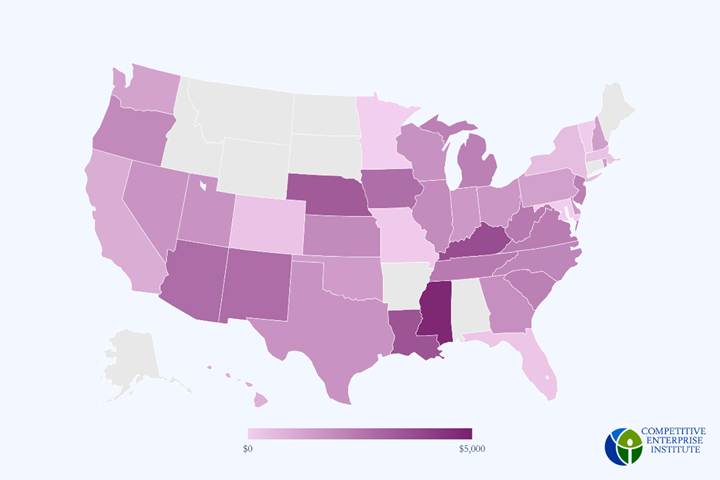
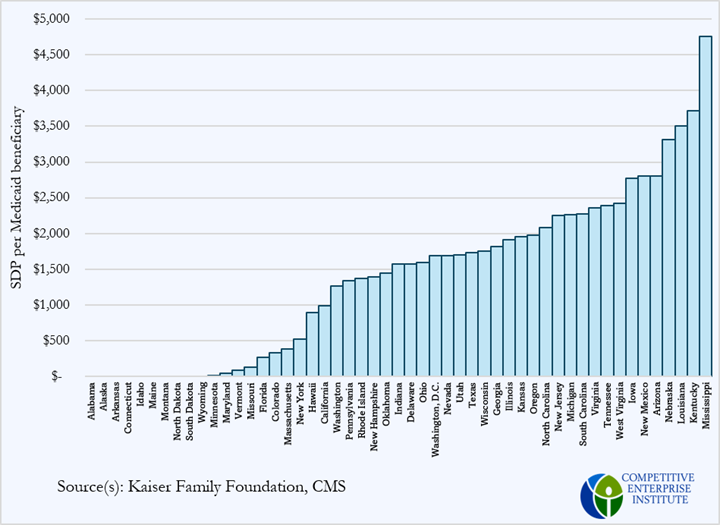
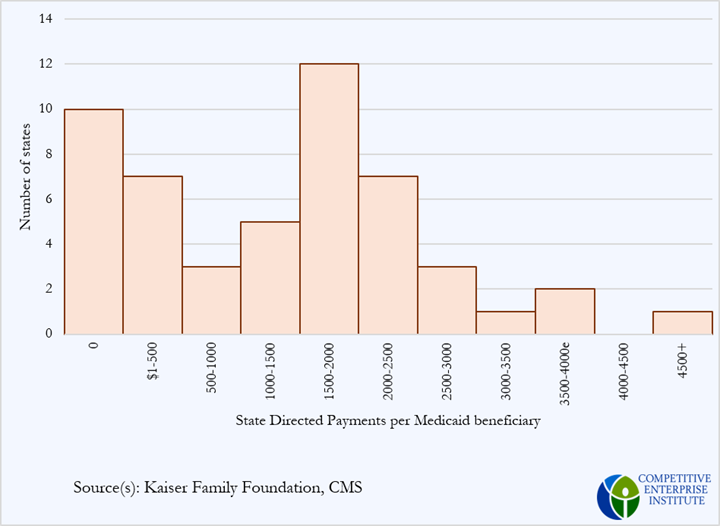
The chart below shows the distribution of SDPs per Medicaid beneficiary. Mississippi has the highest level, while the Northeast states, many of the Great Plains states, Florida, Alabama, and Alaska all have some of the lowest. Per beneficiary SDPs range from $0 to $4,761, with a broad dispersion across states.
Explore more on this topic: