Abolish, shuffle, repeat: The SOTU’s ill omen for federal retrenchment
Shrinking the federal government and abolishing agencies sounds simple — decisive, even. In practice, however, it appears neither can be done under modern administrative- and legislative-state realities.
Donald Trump’s State of the Union (SOTU) address and this week’s Department of Education announcement touting “additional partnerships” with other departments provide the latest evidence of this constraint.
Trump’s SOTU covered hot pocketbook issues like inflation and affordability but largely ignored government bloat and the need to cut spending, abolish agencies, and dismantle regulatory regimes — everything necessary for meaningful deconstruction.
“We cut a record number of job-killing regulations,” Trump remarked while observing the shrinking of SNAP rosters. Yet there was no extended treatment of regulatory reform, administrative restraint, and spending discipline as governing philosophy. Those themes — despite significant successes in initiatives like one-in, ten-out — largely took a back seat to visceral cultural and law-and-order priorities.
Even cost-of-living narratives ripe for a deregulatory treatment were met instead with proposals to expand government, such as bans on Wall Street home purchases and Most-Favored-Nation drug pricing. Tech company power self-production (to energize data centers) and retirement savings liberalization contained kernels of a lesser-government trajectory, but were framed as activist policies. Trump said, “We’re telling the major tech companies that they have the obligation to provide for their own power needs,” when unleashing the now largely non-existent option of whether to provide their own power would suffice; and federal $1,000 retirement matching contributions are financed, ultimately, by taxpayers themselves.
That framing reflects the White House’s broader vision — unfortunately, a big-picture one rather than a limited one. Unlike Trump’s 2017 budget, which proposed abolishing 19 federal entities outright, the 2026 budget offered no comparable list of agencies to eliminate by statute. Although it proposed deep cuts and program eliminations across departments as part of a larger downsizing push, much of that was restored during the appropriations process.
Agencies like the Consumer Financial Protection Bureau remain. Cultural endowments such as the National Endowment of the Humanities and National Endowment of the Arts have survived repeated defunding attempts, although funding for the Corporation for Public Broadcasting was rescinded. USAID’s functions were largely folded into the State Department rather than erased.
Trump’s SOTU offered little regrouping or renewed call for structural downsizing — a silence made more conspicuous by developments elsewhere. This week’s announcement from the Department of Education, once envisioned as 2026’s showcase example of abolishing a federal department, touted instead “Additional Partnerships to Break Up the Federal Education Bureaucracy.”
The announcement’s title is somewhat oxymoronic — but unnervingly consistent with Washington history. In federal policymaking, terms like “abolition,” “break up,” and “devolving to the states” too often serve as code for horizontal migration rather than real elimination. Partnerships do not terminate Department of Education functions nor represent vertical movement to states.
While New Deal relics like the Civilian Conservation Corps and Works Progress Administration were genuinely abolished, the dominant pattern has been the side-shifting on display now. Cold War-era energy agencies folded into the Department of Energy (est. 1977); Eisenhower’s US Information Agency into State in 1999; and the Immigration and Nationalization Service into the Department of Homeland Security in 2003. The Interstate Commerce Commission was abolished in 1995, but comparable authority was recreated at the Department of Transportation.
Even the classic case of the Civil Aeronautics Board “regulating” itself out of existence under Alfred Kahn and the Airline Deregulation Act’s elimination of federal control over fares, routes, and market entry did not erase aviation regulation. Authority migrated, and in some areas expanded. The Federal Aviation Administration retained safety oversight and extended its reach into new domains such as drones. After 9/11, the Transportation Security Administration (TSA) layered on an entirely new security regime. Periodic GOP talk of abolishing the TSA has gone nowhere.
So where do regulations go when Congress shutters an agency? Not away — if precedent is any guide.
That same pattern now appears in the evolving story of the Department of Education here during SOTU week. The new statement from Education Secretary Linda McMahon proclaims: “As we continue to break up the federal education bureaucracy and return education to the states, our new partnerships with the State Department and HHS represent a practical step toward greater efficiency, stronger coordination, and meaningful improvement.”
Arguably, this represents more than horizontal movement. Given where these programs are landing, they are not being devolved at all but reframed as national priorities. Education policy increasingly becomes national security (State Department) and public health or emergency response (HHS) policy.
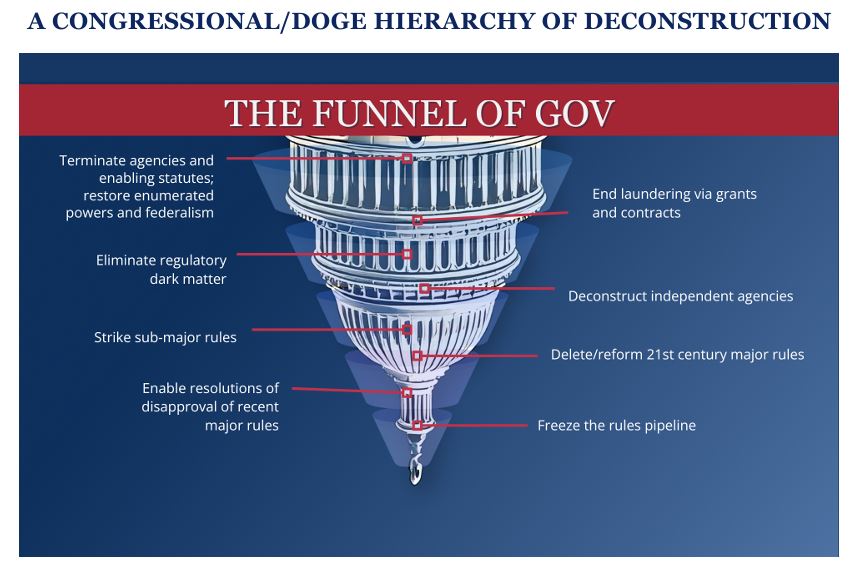
As previously counseled, this pattern poses a serious challenge for lawmakers serious about shrinking government’s ambit. Statutory language — should Congress rise to the occasion — must do more than eliminate an agency on paper. It must explicitly address the disposition of rules, programs, and delegated powers as well. The regulatory apparatus must contract rather than migrate.
That requires terminating authorities, revisiting underlying mandates, abolishing grants and subsidies that serve as regulatory pipelines, and restoring functions to states or private institutions. In this respect, the SOTU — so early in Trump’s second term — represents a missed opportunity to articulate a governing philosophy centered on structural retrenchment rather than episodic restraint.
For more:
“Where do regulations go when Congress shutters an agency?” Competitive Enterprise Institute
“The Surprising Deregulation Legacy Of Jimmy Carter—And Why It Still Matters,” Competitive Enterprise Institute
“Let the deconstruction commence: Congress’s actionable hierarchy for administrative state burial and constitutional resurrection,” Competitive Enterprise Institute
“The Federal Spending-Regulation Trap: Here’s An Escape Plan At Last,” Forbes