Everyone hates congestion pricing…until it is shown to save time, air, and sanity
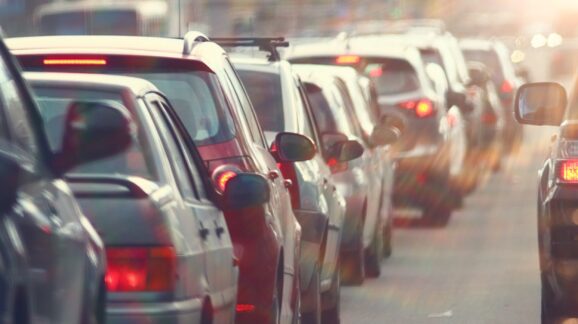
Photo Credit: Getty
New York City is famously referred to as “the city that never sleeps.” The hustle and bustle that makes New York City iconic makes it a symbol of urban dynamism but also comes with the flip side of gridlock. Daily congestion is more than a delay in a commute. Congestion shapes the city’s economy, affects air quality, and erodes quality of life. Large-scale evidence in the United States indicates that longer daily commutes are associated with elevated stress, depression, and fatigue, suggesting that the cost of traffic goes well beyond lost time. A study published in Nature Human Behavior last week offers additional empirical evidence on a New York City policy designed to address gridlock: congestion pricing.
How congestion pricing works
Congestion pricing is an economic mechanism used to allocate limited road capacity more efficiently. Drivers pay a fee to enter or drive within the designated congestion zone during peak hours. The fees are typically collected electronically via license plate cameras, transponders, or tolling accounts. Charges are automatically billed to the vehicle owner or account holder. Revenues are collected by the managing transportation authority and are typically reinvested in maintenance, transit improvements or, owing to political pressure and lobbying, unrelated transportation projects.
Congestion pricing can take different forms. Flat congestion charges are simpler to implement but blunt, as they apply the same fee regardless of demand fluctuations. Variable pricing, in contrast, responds to real-time traffic levels, rising during peak congestion and falling when traffic is lighter.
Price signals and why they matter
Some might hear the word “price” and assume it is a corporate ploy to empty people’s wallets. Far from being a gimmick or a punishment of the working class, prices are signals that coordinate human behavior and commerce in the face of scarcity. Prices reflect the balance of supply and demand. When a good is scarce relative to demand, prices rise, signaling individuals to use it more efficiently or seek alternatives.
Roads in New York City are no exception to the law of supply and demand; road capacity is not infinitely expandable. During rush hour, each additional car on the road imposes costs on everyone else, whether those are time delays, fuel consumption, pollution, or noise. Putting a price on peak-hour access makes these costs visible to drivers, which allows drivers to make more informed decisions and gives cities a tool to encourage alternatives during peak hours.
Understanding public resistance to congestion pricing
The idea is intuitive and beneficial, but it has no shortage of opposition. Before implementation, 64 percent of New Yorkers opposed congestion pricing. There is intuition behind its unpopularity. Drivers hate it because it feels like a tax or penalty on driving. Why pay for public roads when they were previously free? Small business owners fear that congestion tolls will raise their costs and scare away customers, despite a Federal Highway Administration (FHWA) review finding a “generally low level of measured economic and business impacts.” Lawmakers serving suburbanites worry that it will hit their constituents in the wallet. Some environmentalists are concerned that congestion pricing will simply shift pollution to low-income neighborhoods.
Some politicians, like New York State Sen. Steven D. Rhoads, have framed opposition to congestion pricing as being another tax. In reality, congestion pricing is a voluntary, targeted user fee that applies only when and where drivers impose costs. This market-based alternative makes it more efficient than broad, untargeted taxes because it addresses behavior precisely where the negative externality of gridlock occurs. Congestion pricing could also offer the possibility of reducing other broad taxes, such as the gasoline tax.
New York’s long road to implementation
Despite opposition to congestion pricing in New York, Gov. Andrew Cuomo was able to get it included in the state budget and approved in 2019. It took a while for it to go from state approval to implementation because of the FHWA approval process. Under FHWA regulations, tolls that would affect federal highways require FHWA approval, including an environmental assessment. The environmental assessment was not completed until June 2023 and the project itself received FHWA approval in November 2024. This case study is a reminder that even when states decide to innovate, federal micromanagement can needlessly turn a straightforward policy into a multi-year affair.
Meanwhile, Gov. Kathy Hochul delayed the congestion pricing program in June 2024 over concerns about disproportionate effects on low-income drivers. Under legal pressure from environmentalist groups, the pricing was reduced from $15 to a more politically palatable $9, with additional discounts and phased rates. As such, Hochul changed course and allowed the congestion pricing to begin in January 2025.
Congestion pricing improves air quality
The Nature Human Behavior study mentioned earlier is significant because it is the first quasi-experimental study on congestion pricing and air quality in the US. Quasi-experimental studies use real-world variation in congestion pricing to approximate a controlled experiment, which means that they can better examine causal effects.
Not only that, but the magnitude of the results also shows that the benefits of congestion pricing materialize quickly, not over years, by reducing amounts of a fine particulate matter known as PM2.5. These pollutants are tiny particles that originate from such sources as vehicle exhaust, factories, or dust. This study found that six months after implementing congestion pricing, daily maximum PM2.5 concentrations in the congestion-reduction zone dropped by 22 percent relative to conditions without congestion pricing. In the surrounding boroughs, pollution declined by about 12 percent, thereby addressing environmentalist concerns.
By cutting pollutants, congestion pricing strengthens the environmental and public-health case for market-based approaches to urban mobility. While PM2.5 exposure potentially carries health risks, the epidemiological literature informing PM2.5 regulation is often a product of inaccessible data, weak quality controls, and public choice mis-incentives that promote publication bias, data manipulation, and selective outcome reporting. As CEI Senior Fellow Marlo Lewis, Jr. noted, there is good reason to question whether stricter regulatory limits on PM2.5 would yield significant health benefits. Market-based approaches like congestion pricing, however, offer a voluntary, efficient alternative to reduce PM2.5 exposure without imposing additional top-down mandates. In that respect, congestion pricing represents a “no regrets” approach to environmental improvement.
Beyond cleaner air: Mobility gains and economic efficiency
Congestion pricing is not just better for your lungs. A National Bureau of Economic Research study shows that in New York City, congestion pricing increased average traffic speeds by 11 percent and reduced average trip times by 8 percent. Congestion pricing also reduced traffic in Stockholm by 20 percent and 27 percent in London. In Singapore, congestion pricing increased bus ridership by 10 to 20 percent, showing a significant modal shift. This makes sense, as congestion pricing reduces traffic by discouraging some drivers from using their cars. Rather than expanding road capacity, policymakers can use congestion pricing to manage transportation demand.
Market signals as a path to urban progress
In the end, congestion pricing works because it relies on market signals instead of government mandates. By letting prices reflect the true demand for scarce road space, drivers have information to make the decision as to whether they want to drive during rush hour or whether a different time, mode, or route makes more sense.
Large US cities dealing with their own congestion should look at New York City, as well as other countries, to realize that a self-financing solution like congestion pricing can improve air quality, reduce traffic, and speed up travel without requiring bureaucratic interference or billion-dollar construction projects that take years to complete.
Congestion pricing demonstrates that market mechanisms can do what government fiat and roadbuilding cannot. If cities are willing to trust price signals, they will not only move traffic forward, but also their economic progress.