The Railway Safety Act would derail progress one provision at a time
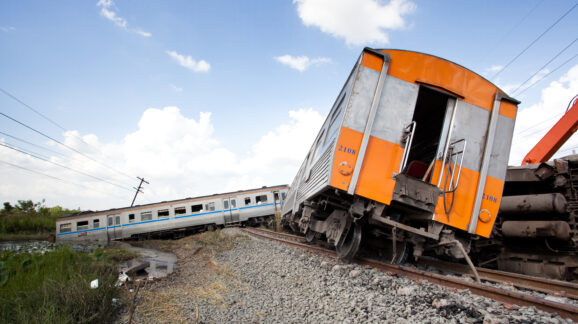
Photo Credit: Getty
On February 3, 2023, a Norfolk Southern freight train derailed in East Palestine, Ohio. The derailment spilled hazardous chemicals and prompted a massive, controlled burn that sent plumes of toxic gas into nearby communities, forcing evacuations.
When images of the calamity filled the news, Congress responded with the Railway Safety Act. The Act failed to pass in 2023, and lawmakers attempted another version last year.
Congress earns an “A” for effort because after the 2025 attempt failed, Sen. Jon Husted (R-OH) introduced yet another bipartisan version of the Railway Safety Act last week. Lawmakers pitch it as a comprehensive safety overhaul aimed at preventing another disaster like East Palestine, but the bill’s requirements risk bogging down rail operations in red tape. This legislation is political theatre masquerading as policy, not a meaningful effort to make America’s rails safer.
US rail has a laudable track record
Given Congress’s repeated efforts to pass the Railway Safety Act, one might assume US rail safety is “off the rails.” When looking at fatalities per million train-kilometers, the US has a higher fatality rate than other western nations. At first glance, this suggests that US rail is unusually dangerous. However, the reality is more complicated. Many other nations focus on passenger travel rather than long-haul freight, run shorter and lighter trains, and maintain denser networks.
Because of these structural differences, international fatality rates do not provide an apples-to-apples comparison. A clearer picture comes from the US’s own historical data, which reflects the scale and operational realities of American freight rail and shows the long-term trends in safety improvements over time.
Contrary to the impression left by high‑profile incidents, US rail safety has improved remarkably over the past four decades. Research from the Mercatus Center shows that economic deregulation following the 1980 Staggers Act accounted for 89 percent of the decline in railroad accident rates by giving carriers stronger incentives to invest in safer track and equipment.
This dovetails with my previous analysis showing that deregulation boosted rail productivity and efficiency. These productivity gains allowed railroads to make sustained capital investments in infrastructure and technology, including automated switches, advanced signaling, and improved communication systems.
The payoff from those investments shows up clearly in the federal safety data itself. The Federal Railroad Administration (FRA) data on rail injuries show a long-term decline in rail-related fatalities, from 1,417 fatalities in 1980 to 970 fatalities in 2025. This decline is especially notable because US railroads today carry more freight and passengers than in past decades.
Two-person crew mandate
With that context in mind, we turn now to examine the specific provisions of the Railway Safety Act and why they risk undermining rail safety and innovation rather than enhancing it. Proponents argue that a minimum two-person crew enhances safety by providing redundancy and enabling quicker responses to mechanical or operational problems.
Yet the East Palestine derailment occurred with a three-person crew, illustrating that adding crew members is no panacea. To further illustrate this point, CEI Research Fellow Sean Higgins makes an excellent point about the historical context: until the 1990s rail lines utilized three or more crew members. The federal government also acknowledges this trend, noting that technological advances and operational changes gradually reduced crew sizes from multiple members to two by the 1990s.
If crew size were the main determinant of safety, railroads would have been safer prior to these reductions. Yet accident rates have improved even as crews have become smaller, which undermines the proponents’ case.
As Higgins also mentions, empirical evidence does not support the notion that two-person crews reduce accidents because “there is no correlation between crew size and the accident rate.”
In 2016 and 2019, the federal government admitted during its assessment that claims two-person crews reduce accidents is unjustifiable. Even the FRA’s 2024 rulemaking on crew size requirement does not find new causal data to support the mandate. This could help explain why European rail systems permit and regularly use one‑person crews yet maintain lower fatality rates than the US.
In addition, there are concerns about how this mandate would affect future regulation. A core tension in rail safety regulation is that between modern technology and outdated regulatory frameworks. I detailed this tension with FRA track inspection rules written in 1971 that mandate visual inspections and the inspection intervals. Rooted in 1970s-era logic, this inspection mandate slows the adoption of superior technologies such as automated track inspection.
This dynamic is instructive for the two‑person crew mandate debate. US freight railroads already operate with two-person crews for most over-the-road operations, which is a practice codified in the FRA’s 2024 final rule. Mandating that staffing level in statute does not address a current safety gap and would legally lock in today’s standard, making it far more difficult to relax or adapt in the future.
Rather than improving safety, this approach risks creating barriers to technological evolution and innovation while preventing the rail industry from adopting safer, more efficient operational models.
Mandating mileage, not metrics
The East Palestine derailment was caused by a failed wheel bearing. Wayside hot‑box detectors are used to catch such conditions early by tracking bearing temperature and alerting crews when a reading crosses a designated threshold, which could give crews time to slow or stop before a catastrophic failure. In the case of East Palestine, the detectors registered elevated temperatures miles before the failure, but communications and threshold settings meant the crew was not alerted early enough to prevent the incident.
In response, the Railway Safety Act would impose federally mandated spacing requirements for these detectors and prescribe mandatory stop rules once certain temperature thresholds are triggered, codifying a uniform national standard rather than allowing railroads to tailor placement and response protocols to operating conditions.
A Cato Institute analysis estimates this requirement could cost the rail industry between $1.1 billion and $2.2 billion. Requiring defect detectors roughly every 15 miles instead of the current average of about every 25 miles would nearly double the number of wayside sensors that railroads must install, maintain, and operate across thousands of miles of track.
More frequent detectors not only involve substantial upfront installation costs but also increase ongoing maintenance and inspection expenses, as well as operational costs from higher rates of false positives that slow service.
Beyond cost, prescribing one detector configuration and rigid response rules risks locking in today’s technology and discouraging adoption of superior, data-driven approaches. Emerging telematics and on-board sensor networks (e.g., vibration, temperature, wheel-load monitoring) can provide continuous, real-time monitoring of railcar conditions and in some cases identify developing failures earlier than wayside detectors.
While bearing failures are serious when they occur, FRA data show that from 2020 to 2025, 149 out of the 11,704 accidents (1.3 percent) of the accidents were explicitly caused by bearing defects. This indicates that, although wayside detectors can help in specific cases, the vast majority of derailments are caused by other mechanical, track, or operational factors.
As CEI Senior Fellow Iain Murray warned in 2023, mandating fixed detector placement rules would risk “locking in specific technologies at the expense of innovation and flexibility.” Far from making railroads safer, this approach could actually increase the risk of accidents by preventing the adoption of more advanced, real-time monitoring technologies that detect problems earlier and more comprehensively.
Will slowing down speed up safety?
Federal rules in the Railway Safety Act would impose operational speed limits on high‑hazard trains, ostensibly to reduce derailment risk. Roughly 75 percent of derailments occur in rail yards, where the average speeds are around 5 miles per hour.
Most derailments occur in low‑speed rail yards, and FRA data show that human factors, track defects, and equipment failures dominate causal reporting. This is not to suggest speed is never a factor in any derailment, but rather that statutory speed limits would target a relatively minor risk.
Watching the clocks, not the tracks
The Railway Safety Act would direct the Department of Transportation to prohibit railroads from limiting the time employees need to complete inspections and impose qualified-inspector mandates for rail cars and locomotives. In a 2023 coalition letter opposing the earlier Railway Safety Act, CEI’s Iain Murray and other free‑market groups cautioned that such minimum time requirements treat inspection as a bureaucratic checklist rather than a safety outcome and would divert resources away from innovation and efficiency while doing little to address the actual causes of accidents.
If inspections were turned into a mandate focused on how long inspectors spend on tasks rather than on the safety problems they identify, it would risk freezing outdated practices into law, similar to the FRA’s approach to track inspections.
Specifying rigid prescriptive inspection time requirements creates a regulatory environment where companies are less willing to invest in faster, automated, or telemetric inspection technologies because deviating from the mandated process could trigger compliance concerns. By codifying how inspections are done rather than what they achieve, the Act could ironically make trains more vulnerable to the derailments it aims to prevent.
Symbolism over substance
The Affordable Care Act did not make healthcare more affordable, the Inflation Reduction Act did not reduce inflation, and the Railway Safety Act would not meaningfully address railway safety. After two failed attempts, the third time is hardly the charm. US freight rail has become safer precisely because deregulation unleashed efficiency gains that allowed sustained capital investment in infrastructure and technology.
By mandating crew sizes, detector standards, speed limits, and inspection times, the Railway Safety Act risks replacing railroads’ flexible, technology-driven safety progress with rigid legislative rules. Congress should reject sweeping mandates and instead let competition and investment continue making railroads safer and more efficient. Rail safety is too important to be guided by slogans and short‑term politics.