From airport security lines to the Danger Zone: TSA delays and public safety
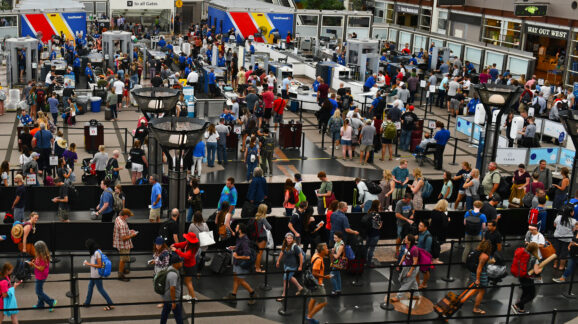
Photo Credit: Getty
The Transportation Security Administration’s (TSA) staffing shortfall is creating more than long lines. It may already be putting travelers’ lives at risk. Since the partial shutdown of the Department of Homeland Security on February 14, airport security officers with the TSA have not gotten paid.
Unsurprisingly, TSA staff absences have more than doubled and at least 300 TSA officers have quit. The reduction in TSA staff has created longer delays at airports throughout the US. As a result, Americans traveling by air have been met with long security lines, missed connections, and mounting frustration.
This chaos is understandably a thorn in travelers’ sides. Passengers are increasingly choosing to drive rather than fly and deal with airport security. This ordeal is a textbook example of the substitution effect, an economic term which describes when people switch from one option to another based on convenience, cost, or risk.
While the shift from air travel to automobile travel is predictable given the circumstances, it can also become a matter of life and death.
Flightless and behind the wheel
In spite of some high-profile airplane crashes, air travel is one of the safest forms of transportation available. Bureau of Transportation Statistics (BTS) data show that from 2003 to 2023, there were 787 deaths from air travel. While that may sound high, it is dwarfed by the 296,366 automobile passengers, the 114,861 pedestrians, and the 105,554 motorcyclists who died in transportation-related accidents during the same time period.
The National Safety Council contextualizes the BTS data into fatality rates: “Over the last 10 years, passenger vehicle death rate per 100,000,000 passenger miles was over 60 times higher than for buses, 20 times higher than for passenger trains, and 1,200 times higher than for scheduled airlines.” (Emphasis added.)
Aviation’s safety record is not accidental. Aviation operates within a structured framework where routes, spacing, and operations are coordinated to reduce uncertainty and human error. In contrast, drivers face a far more variable environment where factors such as traffic density, road conditions, and interactions with other drivers are constantly changing. Even the most careful driver can face adverse conditions, which helps explain why risk increases more quickly on the road.
From passenger shortfalls to potential fatalities
The numbers make the risk difference crystal clear: traveling by plane is far safer than traveling by car. Airport delays divert passengers to roads, where higher exposure per mile translates into a tangible increase in the likelihood of accidents. Data on enplanements and roadway fatalities offer a lens to gauge the human cost of air travel disruptions.
Late last month, Airlines for America projected a 4 percent increase in passengers this spring break compared to last year. TSA checkpoint data from March 1 to March 29 show a 2.6 percent increase, which leaves a gap of 997,575 enplanements. According to Cornell University research, every decline of 1 million airline enplanements to avoid flying translates into 15 additional road fatalities.
Applying these figures to the current shortfall, that would suggest approximately 15 excess deaths from March 1 to March 29 that are linked to these latest travel disruptions. The longer the shutdown persists, the more that estimate will rise. It is important to note that this back-of-the-envelope calculation is meant to demonstrate scale rather than pinpointing a precise figure. Nevertheless, it has implications for public safety.
Air travel efficiency is a public safety issue
When air travel becomes more time-consuming and cumbersome, some travelers will choose alternatives. They reroute trips, cancel plans, or choose to drive instead. Shifting from one of the safest forms of transportation to a much riskier one inevitably results in additional fatalities.
This dynamic underscores a larger institutional issue. As a self-regulating monopoly, the TSA lacks the performance incentives that would minimize delays and maintain reliability when under pressure. For example, CEI previously filed a lawsuit arguing that TSA had not adequately demonstrated that body scanners deliver the safety benefits they claim. This lawsuit is an example of how TSA’s institutional framework disincentivizes innovation or operational efficiency.
Privatizing airport security would introduce competition and accountability into a system that currently lacks both. Delays at the checkpoint should not translate into danger on the highway. No one should face greater risk simply because airport security has become too disruptive.