The Railway Safety Act would shift freight from safer rails to deadlier roads
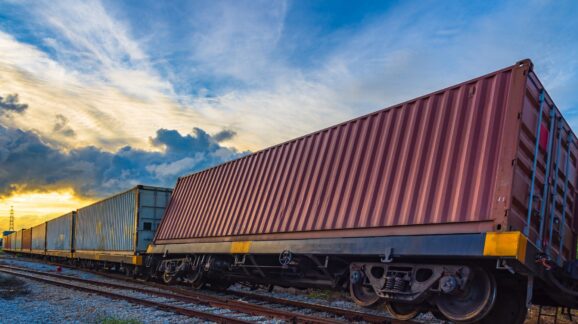
Photo Credit: Getty
More than 36,000 Americans died on US roads in 2025. Fewer than 1,000 died on the rail system. Yet while highway fatalities rarely attract sustained attention, a single freight-train derailment can dominate national headlines for weeks.
The 2023 East Palestine derailment has remained in the news for years and has helped prompt Congress to make another attempt to pass the Railway Safety Act (RSA). As previously illustrated, the RSA’s major provisions have not been shown to meaningfully improve safety outcomes. However, beyond the merits of individual mandates lies a broader problem.
Washington repeatedly treats transportation modes as isolated silos rather than parts of a unified transportation network. The result is a fixation on safety within one mode while ignoring how freight, costs, and risk shift across the system as a whole. The RSA fits squarely into that pattern. In reality, freight is allocated across competing systems based on relative cost, reliability, and regulatory friction.
As I have previously argued in the context of the recent TSA security delays, constraints on one mode of transportation do not reduce overall passenger demand. They shift some travelers onto highways, where risks are significantly higher.
A similar substitution effect exists in freight transportation, although it is not uniform across all categories of freight. Bulk commodities, for example, are often rail-captive because trucking them is typically cost-prohibitive.
When rail does compete, it does not compete against an idealized version of itself under perfect safety conditions. It primarily competes against trucks. And trucking is often the default alternative when rail becomes more expensive or operationally constrained.
For the sake of argument, let us assume that this substitution effect applies only to intermodal. Intermodal accounts for a quarter of rail ton-miles, which would be 375 billion ton-miles for intermodal in 2025. The next question is how shippers might react to these regulatory burdens.
For a conservative illustrative estimate, I apply a cross-price elasticity of 0.5 drawn from the Congressional Budget Office (CBO) freight demand modeling to the intermodal share of rail traffic. The CBO example typically reflects policies that increase trucking costs relative to rail, inducing diversion toward rail.
Here, I assume symmetry in cross-price elasticities and apply the inverse relationship. While actual elasticities vary by route, commodity, distance, service quality, and trucking capacity, this assumption implies that a 10 percent increase in rail shipping costs would divert roughly 5 percent of price-sensitive freight toward trucking.
Other rail regulations illustrate how sweeping safety mandates can impose multi-billion-dollar shocks. Positive Train Control (PTC) ultimately exceeded $10 billion. The RSA’s prescriptive wayside bearing detectors alone are projected to cost up to $2.2 billion.
Unlike those one-time capital expenditures, however, the RSA’s operational mandates, such as the prescriptive inspection protocols, would impose recurring compliance and labor costs, thereby creating sustained upward pressure on shipping rates. Taken together, these examples suggest a low- to high-single-digit increase in rail shipping rates over time, depending on the degree of cost pass-through.
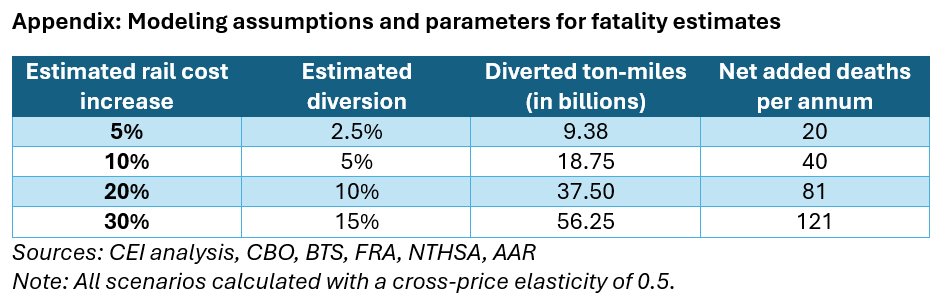
Applying a cross-price elasticity of 0.5 consistent with CBO freight demand modeling to the intermodal baseline yields four illustrative diversion scenarios under 5, 10, 20, and 30 percent cost increases, plus a long-run compounded case, ranging from 2.5 to 15 percent diversion rates from rail to highways (9.38 to 56.25 billion ton-miles).
To evaluate the net safety impact of this modal shift, federal transportation data can be normalized by ton-mile exposure. Because the relevant question involves systemwide safety externalities, the numerator includes all fatalities in crashes involving large trucks in order to capture risk to all road users from increased truck exposure. Dividing 5,340 large-truck-involved fatalities by 2.4 trillion highway ton-miles yields a commercial motor carrier fatality rate of 2.23 deaths per billion ton-miles.
Ton-mile normalization provides a useful first-order approximation of exposure, though actual risk varies with vehicle-miles traveled, road class, congestion, payload, and operating conditions. These factors are held constant for purposes of this illustrative comparison.
By contrast, rail had about 1.5 trillion annual ton-miles in 2024. Excluding trespassers, rail recorded 111 rail deaths that year. This adjustment with trespassers ensures consistency with the trucking measure, which captures systemwide crash externalities from freight activity instead of unrelated fatalities outside the transportation function.
Trespasser deaths are not typically affected by marginal changes in freight volumes, which makes operational rail fatalities the more comparable measure for assessing risk from modal shifts.
On this basis, rail exhibits a fatality rate of approximately 0.07 deaths per billion ton-miles. Freight trucking is thus roughly 32 times riskier than freight rail on this ton-mile measure, a result that is directionally consistent with federal data showing that freight trucks are responsible for 84.4 percent of freight fatalities despite moving 44.9 percent freight ton-miles.
This implies a net risk premium of 2.16 additional deaths per billion ton-miles. Under the 2.5 percent diversion scenario, this translates into roughly 20 additional fatalities per year, rising to more than 120 under the 15 percent scenario. These estimates likely understate the effect because they assume no diversion of manifest or other carload freight.
Regardless of the specific baseline assumptions one chooses to employ (see Appendix below for more detail), the structural conclusion remains as clear as it does ironic: policies that reduce rail competitiveness and shift freight onto highways impose transportation risks of their own.
Freight diverted from rail does not disappear. A significant amount ends up on America’s highways. More truck traffic and greater exposure to trucking risk necessarily imply more fatalities relative to rail. Paradoxically, a bill intended to improve rail safety will likely leave the transportation system as a whole more dangerous.