George and Sam: A friendship forged in freedom and entrepreneurship
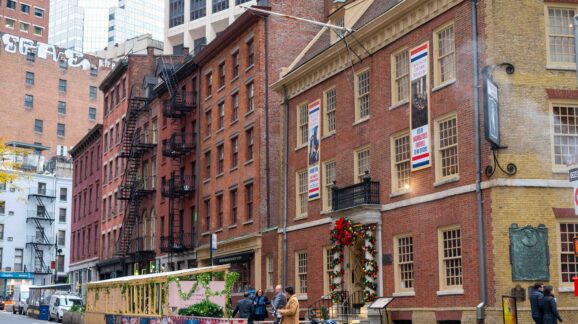
Photo Credit: Getty
In August 1783, after General George Washington had secured victory in the Revolutionary War but was still awaiting negotiation of Great Britain’s surrender, he penned a letter to a friend.
In glowing praise, Washington wrote, “You have invariably through the most trying times, maintained a constant friendship and attention to the cause of our country and its independence and freedom, and this testimony is also strengthened by my own observation, so far as I have had opportunity of knowing your character personally.” Washington added that the letter’s recipient was “one who is deserving the favor & attention of these U.[nited] States,” and a “warm friend.”
Who was this “warm friend” upon whom the Father of our Country showered this praise? Was it Alexander Hamilton, Thomas Jefferson, or one of Washington’s top officers or aides? No, this letter was sent to Samuel Fraunces, a New York City tavern owner who built his American dream and provided vital assistance in the war for independence so that others could build their dreams as well.
Last March, I was privileged to speak on the remarkable friendship of Washington and Fraunces at the Fraunces Tavern Museum. Located near Wall Street in lower Manhattan, Fraunces’s tavern was a hub of patriot activity in the Revolutionary War. It was also where Washington gave a farewell toast to his officers in November 1783, a few months after he wrote his glowing letter to Fraunces thanking him for his contribution to the causes of liberty and independence.
Today, the same building hosts a working bar and restaurant as in Fraunces’s day, as well as a museum celebrating the achievements of Fraunces and others during the Revolutionary War. The museum was kind enough to ask me to give one of its continuing series of monthly evening lectures, and to post my talk here on YouTube.
As I noted in the lecture, “it may be hard to picture Washington at a bar or tavern, let alone referring to a tavern owner as a ‘warm friend.’” Most Americans revere George Washington for his military and political achievements, but they often don’t know how to relate to him. They see him as the face on Mount Rushmore and the one-dollar bill, not as someone like Franklin, or Jefferson, or – now with the musical – Hamilton, that they could have conversations with about things in their 21st century lives.
But the story of Washington as an innovative entrepreneur who faced business successes and setbacks shows how he could relate to a tavern owner like Sam Fraunces. It also shows how we can relate to George Washington today.
If we look at George Washington’s and Samuel Fraunces’s entrepreneurial careers, we see they have a lot in common. Both were largely self-made businessmen who went into many business ventures with innovative techniques ahead of their time, including branding. Both made sacrifices to the cause of American independence that left them poorer. And both went into public service when called upon and used the skills and lessons they learned through entrepreneurship to advance the new nation of the United States of America.
As I describe in my book George Washington, Entrepreneur, recently released in paperback, Washington wasn’t exactly poor when he started out, but he wasn’t as wealthy as many of the other Founding Fathers either. His father died when he was 11, and, having two older half-brothers, he didn’t inherit much. His family lacked money to give him a formal education, so in his late teens, Washington became a freelance land surveyor, participating in the gig economy of the 18th century. Through his surveying jobs, Washington learned about land acquisition, and became skilled in what would now be called real estate speculation.
After fighting with distinction in the French and Indian War, Washington began tending to the Mount Vernon farm he had inherited from his older brother Lawrence. Compared to the many sprawling Virginia estates of the time, the 2,000-acre Mount Vernon was relatively modest when Washington acquired it. Although Washington received a boost in wealth when he married the widow Martha Custis, running a productive farm against the backdrop of British trade restrictions and taxes, as well as nature’s unpredictability, was not an easy task.
Washington began buying the land around Mount Vernon, building a beautiful homestead, and pioneering modern agricultural practices such as crop rotation. His first step was to abandon the most common cash crop of his native Virginia: tobacco. Washington worried that the tobacco crop was hurting Mount Vernon’s soil and saw the need to diversify to avoid “unprofitable returns,” as he noted in 1765.
Washington chose wheat as his main cash crop, and, pioneering the integration of related enterprises, he became a manufacturer of two products from his crop: flour and distilled whiskey.
Reconstructed in 2007 on their original foundations at Mount Vernon Estate and Gardens, Washington’s gristmill and distillery are architectural wonders that anticipated modern factories. The flour mill is three levels high with two sets of millstones, including French buhr stones that were used to make the finest quality of flour.
The mill produced about 278,000 pounds of flour per year, which was branded with the “G. Washington” name. It was sold throughout the colonies and exported to England and as far away as Portugal.
But it is the distillery that may offer the most fascinating example of Washington’s entrepreneurial prowess. After retiring from the presidency and returning to Mount Vernon – setting a precedent for voluntarily relinquishing power – Washington built a distillery in 1797 on the advice of his plantation manager James Anderson, a native of Scotland who knew a thing or two about distilled spirits, and his Irish Catholic friend and former aide during the war John Fitzgerald, who was a liquor merchant. The whiskey was made largely from crops grown at Mount Vernon. The distillery was soon producing 10,500 gallons of spirits annually, mostly rye whiskey, making it one of the largest whiskey distilleries in America.
Although his business enterprises were not as large as those of Washington, Samuel Fraunces certainly undertook an impressive set of entrepreneurial ventures starting from what appear to be modest circumstances. In the 1750s, Fraunces acquired two taverns in New York – including the one at which I lectured – and one in Philadelphia. He also opened a sort of outdoor café called Vauxhall Gardens, where food was served, concerts were performed, and wax figures were on display. He could be said to be one of the first interstate chain restauranteurs, a proto-Howard Johnson or Ray Kroc of McDonald’s, or given the lavish praise for his cuisine, even a celebrity chef chain restauranteur like Gordon Ramsay or Wolfgang Puck.
On the menus at Fraunces’s taverns were delicacies such as beef steak, mutton, veal cutlets, as well as fried and pickled oysters. For dessert there were a variety of cakes, tarts, and what were called “sweet meats,” which refers to candied foods such as sugar-covered fruits and nuts. And Fraunces was a marketer as well, frequently advertising these menu selections in local newspapers.
Having an a la carte menu – in which customers could order different food selections – was itself an innovation in the 18th century, where the norm at restaurants was a communal meal of the same food served at the same time in the afternoon. As historian Mary Tsaltas-Ottomanelli notes, Fraunces also advertised that nearby customers could come to the restaurant and take their food home in containers – a practice we know today as takeout.
For innovative colonial entrepreneurs like Washington and Fraunces, the onslaught of new British taxes and regulations were particularly frustrating. In Washington’s case, the regulatory edicts that sometimes went hand-in-hand with the taxes were the most threatening. By the 1760s, British Parliament increasingly saw colonial manufacturing upstarts like the enterprises at Mount Vernon – small as they were when compared to companies in Britain – as a threat to British manufacturers. Parliament began enforcing laws such as the Iron Act, Hat Act, and Wool Act to sharply restrict or ban colonial entrepreneurs from making everything from nails and horseshoes to textiles, all of which Mount Vernon was manufacturing and selling.
For Fraunces as a restauranteur, several items were subject to new British taxes, including paper for his menus, metals for pots, pans, and silverware, and glassware. As Tsaltas-Ottomanelli put it, “you can’t have a tavern and serve people ale if you can’t afford a cup to put it in.”
So there were specific abuses in Britain that moved Washington and likely Fraunces toward revolution, and a broader commitment to liberty took hold. We have very few actual writings from Fraunces, but in his letter to the US Congress in 1785, Fraunces wrote that “he was from Principle attached to the Cause of America.” And he proved this during the Revolutionary War many times.
At his taverns, Fraunces hosted many meetings of the Sons of Liberty and other groups planning the American Revolution. Fraunces also passed on intelligence he heard at the tavern from his British loyalist customers. These activities made Fraunces a wanted man when the British occupied New York City in late 1776.
Fraunces fled to Elizabeth, New Jersey, but the British still captured him in 1778 and transported him back to New York for imprisonment. Fraunces was forced to work as the family cook for British General James Robertson. He used his position in the kitchen to aid American prisoners, sneaking them scraps of food, giving them money and clothing, and even assisting some with escaping. Fraunces also passed on intelligence he heard in the Robertson household.
As a result of his sacrifice for the new nation, Fraunces suffered severe financial setbacks. His letter that I previously mentioned petitioned the Continental Congress for compensation for his services, and it responded with both a payment and an agreement to lease the tavern building for two years as office space for the Office of Foreign Affairs and the War Office. With that assistance, Fraunces was able to open a new tavern.
Then in 1789 after Washington became the first US president, Fraunces joined him as chief steward. He first went to work for Washington when the capital was briefly in New York, then moved with Washington in 1790, when the capital became Philadelphia. (The capital would, a decade later, permanently become Washington, DC.) Fraunces supervised the domestic staff, and, of course, paid particular attention to the food served at all the important dinners. Fraunces stayed with Washington until 1794, when he left to open a new tavern. Fraunces passed away a year after that, and he is buried in Philadelphia’s St. Peter’s Church burying ground.
There is a twist to Washington and Fraunces friendship involving a fact about Fraunces that history hasn’t yet fully resolved. As I’ve written, what began for Washington and many other patriots as a fight against British abuses would become a battle for universal human freedoms. And I have argued that Washington’s entrepreneurship exposed to him people from all walks of life and made him respect their dignity. As president, Washington met with and wrote letters to members of then-minority religions – including congregations of the Catholic, Jewish, Quaker, Baptist, and Presbyterian faiths – assuring them of their rights to worship freely and of full participation in American civic life.
Washington also increasingly turned against slavery and privately expressed opposition in his letters. And in his final act, in his will, he freed all 124 slaves he owned outright, provided financial support for the elderly and disabled former slaves, and attempted to provide for the education of the younger workers. In my book, I argue that Washington should be held historically accountable for holding slaves. But it also should be recognized that he was able to move the country and the world – in Washington’s time, slavery existed not just in America, but in much of the world – towards a “more perfect union.”
Washington’s friendship with Fraunces may be all the more significant because the fact of Fraunces’s racial identity has yet to be resolved, and there is strong – if not conclusive – evidence that Fraunces was black or mixed race.
I discussed some of the evidence at my talk at the Fraunces Tavern Museum, and this article explores that significant question further. For one thing, in his position as chief steward, Fraunces would have had a unique status as a minority supervising white workers in Washington’s presidential household. The research conducted on this question by the museum and other scholars is a worthy pursuit.
However, regardless of what the answer is, the story of the entrepreneurship and patriotism of Samuel Fraunces – as well as the story of George Washington – belongs to all of us. They are stories of courage, perseverance, principle, and creativity that should inspire all Americans to strengthen this great nation in its 250th year.