Has Washington bought off the deregulatory movement?
Photo Credit: Getty
Back during the Biden administration, I noted how rising federal spending and regulation seemed to swap unfunded mandates for funded ones – turning what should be independent state and local governments, and even businesses, into dependents seeking Washington’s dollars.
As I describe in Forbes, that dynamic may explain some of today’s lack of urgency for regulatory process reform from Congress. It’s curious, because the administration (apart from some of its own swampy antics) has continued its pursuit of unprecedented rollbacks and freezes.
In the 1990s, state and local officials joined small businesses in a rare bipartisan revolt against red tape. That effort produced several laws—the Unfunded Mandates Reform Act, Paperwork Reduction Act Amendments, and Small Business Regulatory Enforcement Fairness Act, among others. In retrospect these varied in effectiveness and even adherence, but they were meant to restore accountability and limit Washington’s reach.
Today, by contrast, Congress has stalled. Despite the Trump administration’s deregulatory push and 16 new Congressional Review Act resolutions overturning Biden-era rules and some very welcome reform of environmental permitting, there’s been none of the sweeping reform of the regulatory state some had come to expect. Proposals like Sen. Joni Ernst’s (R-IA) SCRUB Act and the GOOD Act would codify regulatory offsets, cost controls and transparency, but neither has advanced to Trump’s desk.
One reason is simple: dependence on DC among both businesses and lower-level governments. We have raised alarms elsewhere over the prominence of loan guarantees to small business and over business/government fusions that persist in the Trump administration even as rule counts are cratering.
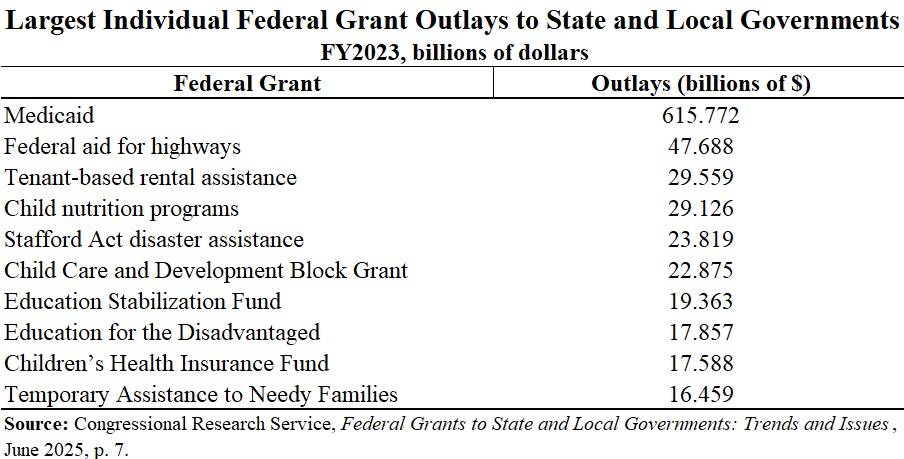
A new Congressional Research Service report now finds that federal grants to state and local governments exceed $1.1 trillion, roughly 16 percent of all federal outlays, and more than a third of state and local revenues.
These grants fund health care, transportation, education, job training, environmental programs and more—each with strings that extend Washington’s influence. The CRS chart below depicts the 10 largest programs, comprising some 77 percent of federal funds distributed:
All this cash represents resources already present in the states in the hands of our countrymen – but then collected by Washington, redistributed, and used to shape local policies, not to mention buy houses ringing Washington, DC for administrators and the consultant class calling the shots.
These grants can often act as regulatory instruments, laden with conditions and reporting requirements that erode federalism.
As the current shutdown illustrates though, instead of pushing back, state and local officials chase the next round of grants, even celebrating the accompanying regulations such as the net zero, DEI, and “care economy” strictures of the Biden era of what were once unfunded mandates that spurred rebellion are now funded mandates that buy compliance. As Animal House famously put it, “Thank you, sir; may I have another?”
As I conclude in Forbes, given all these transformations particularly since COVID and Biden’s inflation and infrastructure laws, rebuilding a lasting coalition for regulatory reform will take more than Trump’s regulatory streamlining or even the congressional regulatory reform that we so often advocate and on which the liberty movement has hinged so much of its agenda. That change is going to require breaking the far deeper cycle of dependency that binds states, localities and much of the private sector to Washington’s purse – a purse filled with cash that belonged to the states and households in the first place.
The better course is to leave the money—and the responsibility—in the states at the outset. That’s going to mean abolishing administrative state-enabling statutes, terminating agencies and programs, and dismantling the consulting class that thrives on it all.
So, until the flow of federal money stops, don’t expect rebellion—just a longer line. Let’s make the answer to my title query a resounding “No.”
For more, see: “$1 Trillion and Counting: Do Federal Grants Sabotage Regulatory Reform?” Forbes.