Deregulation by the numbers: One-third into 2026 — a rulebook rewrite?

Photo Credit: Getty
At the close of the first third of the year, a spring 2026 Unified Agenda formally outlining agency priorities has yet to appear. In fact, the most recent edition remains spring 2025 — released with a lag in September. In lieu of a fall Agenda, the Trump administration issued a December update on its one-in, ten-out program, claiming 112 deregulatory actions for every significant rule issued. We examined that tally in detail in the new Ten Thousand Commandments.
In the absence of a spring Agenda, we take an informal look at 2026’s regulatory streamlining progress so far. As of April 30, the Federal Register stood at 23,354 pages, containing 862 final rules and 585 proposed rules.
Of those 862 final rules, 76 qualify as “significant” under EO 12866 (meaning they carry at least $100 million in anticipated economic effects). Forty-six of those rules, or more than three-fifths, appear deregulatory, with only 12 being more conventionally regulatory in nature. The chart below presents these updates, leaving intact the state of play at the end of the first quarter that we wrote about here. We’ll update the table again at midyear.
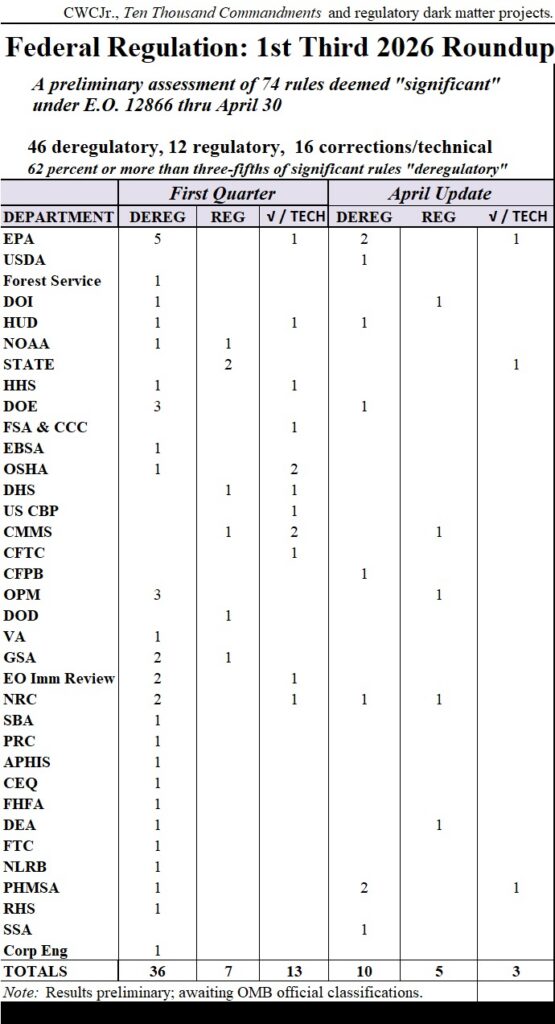
That top-line count of 76 significant deregulatory rulemakings understates the story of conventional rulemaking’s decline. Agencies generally must issue new rules to repeal, replace, or delay old ones, paradoxically inflating the Register. Non-significant rulemakings — excluded here — are also frequently deregulatory and can serve as offsets within the ten-for-one framework.
April’s significant deregulatory actions include the Environmental Protection Agency’s easing of oil and gas emissions guidelines and biofuel mandates; the Consumer Financial Protection Bureau’s restraint of disparate-impact liability; the Department of Energy’s reductions in conservation reporting requirements; the Department of Housing and Urban Development’s delays of green building and tenant-related mandates; and the Department of Agriculture’s removal of regulations implementing the National Environmental Policy Act. Particularly notable was the Pipeline and Hazardous Materials Safety Administration’s reinstatement of Trump-era limits on guidance document abuse.
More conventionally regulatory moves included certain drug enforcement compliance obligations, Nuclear Regulatory Commission licensing provisions, and Fish and Wildlife Service habitat designations affecting various mussel species.
The pace of roughly 215 final rules per month puts 2026 on track to be one of the lowest rulemaking years in history, extending Trump’s sharp break from the 3,000-plus rule norm of recent decades (2025 ended with just 2,441 final rules).
Moreover, many of today’s rules function as “unrules,” pushing net regulatory output even lower. Repeals, withdrawals, delays of effective dates, technical corrections, rescissions, requirement eliminations, streamlining initiatives, fee reductions, and sunset provisions are all prominent features of Trump 2.0.
Still, important caveats remain. Trade interventions, industrial policy initiatives, and other “swamp” dynamics can impose regulatory effects that never appear in the Federal Register and offset or overwhelm formal deregulatory gains. Sub-regulatory guidance and statutory mandates likewise exert influence beyond what rule counts — or even one-in, ten-out accounting — can capture.
This assessment precedes formal administrative classifications of the rules discussed here. It may not qualify as beach reading, but the eventual spring 2026 Unified Agenda — along with further updates on the one-in, ten-out initiative — will provide a clearer picture. If agencies can undo more than they do, that would be a good thing.
For more on deregulation in 2026, see:
“Federal regulation 1st quarter 2026 report: Bureaucracy on the back foot,” Competitive Enterprise Institute