Trump administration targets implausible emissions scenarios

Photo Credit: Getty
I submitted comments last week in support of the US Global Change Research Program’s proposal to amend the 2023 Fifth US National Climate Assessment (NCA5). The amendment would withdraw official support from NCA5 climate change impact assessments that rely upon implausible emissions scenarios.
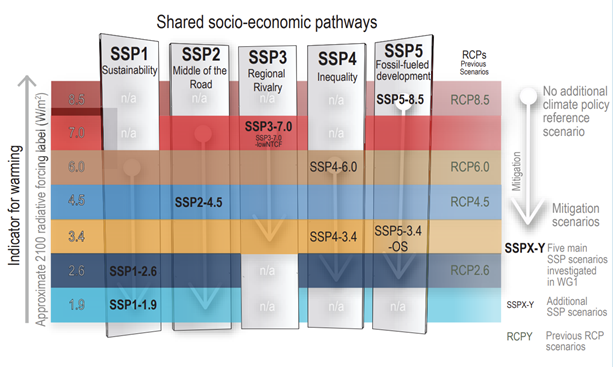
Such scenarios notably include Representative Concentration Pathway 8.5 (RCP8.5) and Shared Socioeconomic Pathway 5-8.5 (SSP5-8.5). RCP8.5 was the top-end (and most frequently mentioned) emissions pathway in the 2017 Fourth National Climate Assessment (NCA4) and the 2013 Fifth Assessment Report (AR5) of the Intergovernmental Panel on Climate Change (IPCC). SSP5-8.5 was the top-end (and most frequently mentioned) emissions pathway in NCA5 and the IPCC’s 2021 Sixth Assessment Report (AR6).
The “8.5” in both scenarios denotes a “radiative forcing” of 8.5 watts per square meter (W/m²) in 2100 relative to 1750. It represents an energy imbalance caused chiefly by rising greenhouse gas concentration, which reduces infrared radiation escaping to space. That retained energy warms Earth’s surface and atmosphere.
Overview of the proposed amendment
The proposed amendment would clarify that:
- “RCP8.5, SSP5-8.5, and equivalent high emissions pathways do not constitute plausible baseline futures for federal planning, policy analysis, or risk assessment.”
- “Any NCA5 result based on RCP8.5, SSP5-8.5, or equivalent high forcing should be treated as an implausible-scenario output and should not be used as a policy, planning, regulatory, public-communication, or grant-making premise unless independently reproduced under a plausible current-policy, or updated scenario and evaluated against observations.”
- “Any NCA5 figure, map, table, caption, callout, chapter highlight, regional summary, or impact statement that presents a high scenario result should carry the scenario label and the implausibility caveat in the same sentence, caption, box, or summary where the projected impact is communicated.”
Technical and targeted
The amendment rightly describes itself as “technical and targeted.” It would not withdraw NCA5 in its entirety. NCA5 findings may continue to inform federal work when they are “observationally grounded or reproduced under plausible scenarios.” Federal researchers may continue to use high emissions scenarios, even those at the “upper edges of plausibility,” in climate model experimentation, intercomparison, and sensitivity testing. However, such pathways may no longer be used as “expected, baseline, business-as-usual, likely, central, or policy-relevant federal planning futures.”
CEI recommendations
I offered several recommendations relevant to the ongoing public debate about emissions scenarios and the broader conversation about “restoring Gold Standard Science.”
Clarify that RCP8.5 was always beyond the “upper edge of plausibility”
It is not always clear whether USGCRP thinks RCP8.5 and SSP5-8.5 became implausible as energy markets evolved or were always implausible due to a “deeper structural deficiency.” To be sure, those explanations can be combined. I would put the matter this way. RCP8.5 (the older of the two pathways, published in 2011) was implausible from the start, but its divergence from reality became increasingly evident over time.
Quantify RCP8.5 assumptions
The proposed amendment states: “The scientific literature has increasingly concluded that achieving radiative forcing levels equivalent to RCP8.5 or SSP5-8.5 would require a combination of demographic, economic, technological, and energy-system developments that are inconsistent with current observations, mainstream projections, and present understanding of global energy markets.” Again, that suggests RCP8.5 was plausible under older observations and understandings and only became implausible as projections and observations diverged.
Quantitative information, presented in ascending order of improbability, would help clarify the pathway’s inherent implausibility. RCP8.5 assumes:
- Global population increases to 12 billion in 2100 even though the UN’s central estimate in 2010 was 10.1 billion. The UN’s current central estimate for 2100 is 10.2 billion.
- Primary energy-intensity of GDP improves by 0.5 percent annually after 2005 even though historical improvement averaged 1 percent annually during 1940-2000. During 2000-2025, the average annual improvement rate was approximately 1.5 percent.
- The abrupt slowdown in energy efficiency improvement “reflects the storyline assumption of slow technological change.” That’s right, everyone knows technology change will slow down in the 21st century! With that, we’re already on the upper edge of plausibility.
- The peak-oil era intensifies. Demand for coal-to-liquid motor fuel surges from about 0.12–0.13 million b/d in 2005 to 3.5 million b/d in 2025. The actual amount in 2025 is 0.2-0.25 million b/d, or about 15 times lower than the RCP8.5 projection.
- Global coal consumption increases “almost ten-fold” during 2005-2100, providing 46-47 percent of global primary energy by century’s end, a market share not seen since the late 1940s. Coal’s share in 2025 was 26 percent, down from 29 percent in 2011, RCP8.5’s debut year.
- Global energy consumption in the 21st century releases 7,300 gigatons of CO2 emissions. That is approximately 2.6 times larger than Carbon Tracker’s 2011 estimate of 2,795 gigatons of CO2 emissions embedded in global proved reserves of coal, oil, and natural gas. RCP8.5 was always an alternate reality scenario.
Trace the RCP8.5 path of mischief
The proposed amendment states: “Importantly, the high forcing pathways underlying RCP8.5 were not originally developed as forecasts of the most likely socioeconomic future. The Representative Concentration Pathways were designed primarily to provide a range of radiative forcing outcomes for climate-model experiments.”
The scenario developers certainly knew RCP8.5 was not a reference scenario or no-policy baseline. They implied or stated as much in Moss et al. (2010) and van Vuuren et al. (2011)—studies cited in the proposed amendment. However, the scenarists took little, if any, subsequent action to discourage the scenario’s misuse.
Moreover, RCP8.5’s misclassification as a reference case started early and hardened quickly. Although the authors of Riahi et al. (2011), a foundational study, do not call RCP8.5 the baseline scenario, they describe it as a baseline, in contrast to the other pathways, RCP2.6, RCP4.5, and RCP6, which they call “mitigation scenarios.” Reasonable inference: RCP8.5 is what happens when governments do not mitigate baseline emissions.
Similarly, two years later, in AR5, the IPCC structured its analysis around four RCPs, “one mitigation scenario leading to a very low forcing level (RCP2.6), two stabilization scenarios (RCP4.5 and RCP6), and one scenario with very high greenhouse gas emissions (RCP8.5).” Again, RCP8.5 looks like a probable future unless governments mitigate and stabilize emissions.
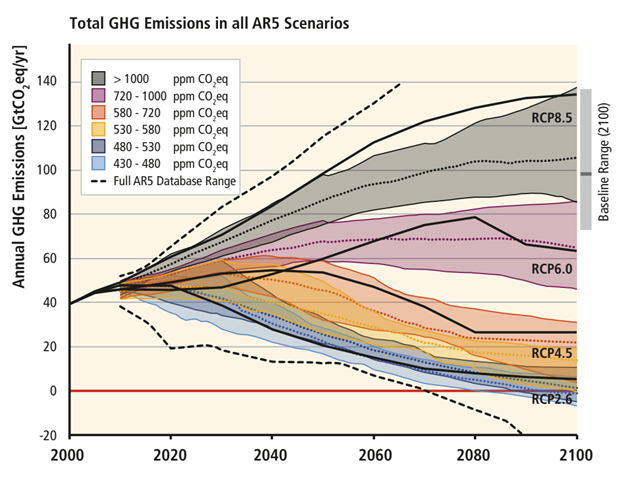
By 2014, the IPCC no longer leaves RCP8.5’s status to the reader’s imagination. The AR5 Working Group III report on mitigation places RCP8.5 smack dab in the middle of the IPCC’s “baseline” scenario range.
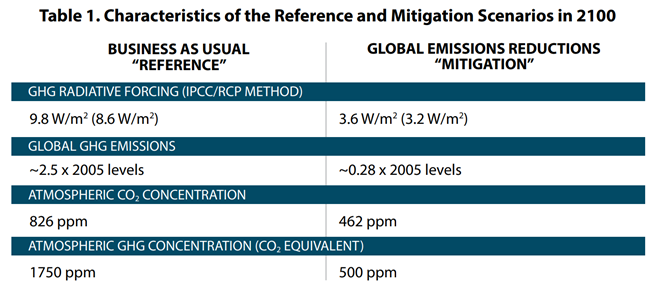
In June 2015, the Environmental Protection Agency (EPA) published Benefits of Global Action, presenting a scientific-sounding case for a global treaty like the one negotiated five months later in Paris. The report attributes frightful levels of harm to a pathway a bit warmer than RCP8.5, repeatedly identified as “business as usual” and “reference.”
In 2021, IPCC AR6 simply called SSP5-8.5 a “high reference scenario with no additional climate policy.”
Put more weight on inherent implausibility than ScenarioMIP’s pronouncement
USGCRP states: “These findings [about the socioeconomic narratives required to achieve RCP8.5 forcing levels] are not the principal basis for this proposed amendment. The primary basis remains the current ScenarioMIP-CMIP7 determination that forcing levels comparable to SSP5-8.5 are no longer considered plausible, even under assumptions that include rollback of currently implemented climate policies.”
ScenarioMIP is the international scientific committee that develops emissions scenarios for the IPCC. In July, ScenarioMIP proposed five new emissions scenarios for the IPCC’s forthcoming Seventh Assessment Report (AR7), with a new high-end emissions scenario “expected to result in forcings below SSP5-8.5.” ScenarioMIP’s retirement of RCP8.5 and SSP5-8.5 was a notable event, the first official retraction by IPCC-aligned scientists of a major systemic warming bias.
However, that should not be the “primary basis” for amending NCA5. The evidence of RCP8.5’s implausibility matters more than any expert body’s recognition of it.
The road ahead
Inflated emission pathways are one of three pervasive biases exaggerating the physical effects of GHG emissions and their harmfulness. The other two factors are a reliance on overly sensitive (warm-biased) climate models and undervaluation of mankind’s amazing capacity for adaptation. A worthy sequel to USGCRP’s current proposal would be an amendment clarifying and correcting the “hot model” problem in NCA5 and federal agency analysis generally.