The Regulatory Plan needs a regulatory plan

Photo Credit: Getty
As the Trump administration’s early emphasis on the Elon Musk-led Department of Government Efficiency, or DOGE, has tapered off, so too has its emphasis on the once-high-profile “ten-for-one” deregulatory campaign launched by Executive Order 14192, “Unleashing Prosperity Through Deregulation.” The order directed agencies to identify at least 10 existing regulations, rules, or guidance documents for elimination for every new one.
The administration later claimed to have “blown far past” its goal, and President Trump reiterated the commitment in April’s Economic Report of the President: “My administration is committed to removing 10 regulations for each new regulation imposed, with many agencies exceeding this goal.”
But more recent White House announcements celebrate individual regulatory rollbacks and broadly claimed cost savings rather than demonstrating compliance with the 10-for-1 requirement. A June 29, 2026, cost-of-living fact sheet, for example, touted “historic deregulation” and “unprecedented action,” highlighting such measures as revocation of the Obama-era greenhouse-gas Endangerment Finding and the rollback of vehicle emissions-related regulatory burdens. Yet it did so without foregrounding the 10-for-1 metric.
The new 2026 Regulatory Plan and Unified Agenda of Federal Regulatory and Deregulatory Actions promises to “promote liberty, unleash American energy dominance, preserve products consumers love, and eradicate the ideology of Diversity, Equity, and Inclusion,” and forecasts “record-setting $1.5 trillion in projected cost savings.” Yet even this signature vehicle for describing the administration’s regulatory agenda declined to showcase one-in, ten-out.
Yet, the Agenda itself reveals substantial deregulatory activity, as we documented on the July 4 holiday weekend. There were twice as many economically significant deregulatory actions than conventional notice-and-comment rulemakings of equivalent heft. Lesser deregulatory actions also count toward 10-for-1 success, but the Agenda is largely silent on them.
The Unified Agenda has long documented regulatory sprawl. The Biden administration, in particular, used its Modernizing Regulatory Review initiative to shift the Office of Management and Budget’s (OMB) role from regulatory watchdog toward promoter of an expansive progressive policy agenda. Against that backdrop, it is unfortunate that the Trump administration is downplaying its own deregulatory story at precisely the moment when the evidence could be most useful.
The Trump administration’s own Unified Agendas have also been troublingly irregular. There was no fall 2025 edition at all, and the spring 2025 edition was not released until September. At minimum, a regulatory accounting system should be regular, transparent, and comprehensible.
The broader problem is that the regulatory state needs a better system for documenting and constraining it. That requires congressional reform and, ultimately, dismantling the administrative state’s excessive delegation of legislative power.
The Congressional Review Act, enacted in 1996, has been used to overturn 42 rules, most during the Trump administrations. Yet more than 109,000 rules have been issued since its enactment.
Other accountability mechanisms have produced similarly disappointing results. Consider regulatory cost reporting. The most recent Report to Congress on the Benefits and Costs of Federal Regulations was an incomplete draft covering fiscal year 2023. No reports covering fiscal years 2024, 2025, or 2026 have emerged. The accounting simply isn’t working.
Even amid the purported “deconstruction of the administrative state,” the OMB oversight architecture for regulation remains inadequate, and, in important respects, has effectively collapsed. A major reset project spearheaded by Congress is warranted.
Along with constraining agencies’ rulemaking to what they disclose in the Agenda, several disclosure-oriented reforms could create permanent improvements to the next Unified Agenda — and every edition that follows.
Formalize and document deregulation
During Trump’s first term, the Unified Agenda’s landing page featured a radio button for “Deregulatory” actions alongside other classifications, as shown here.
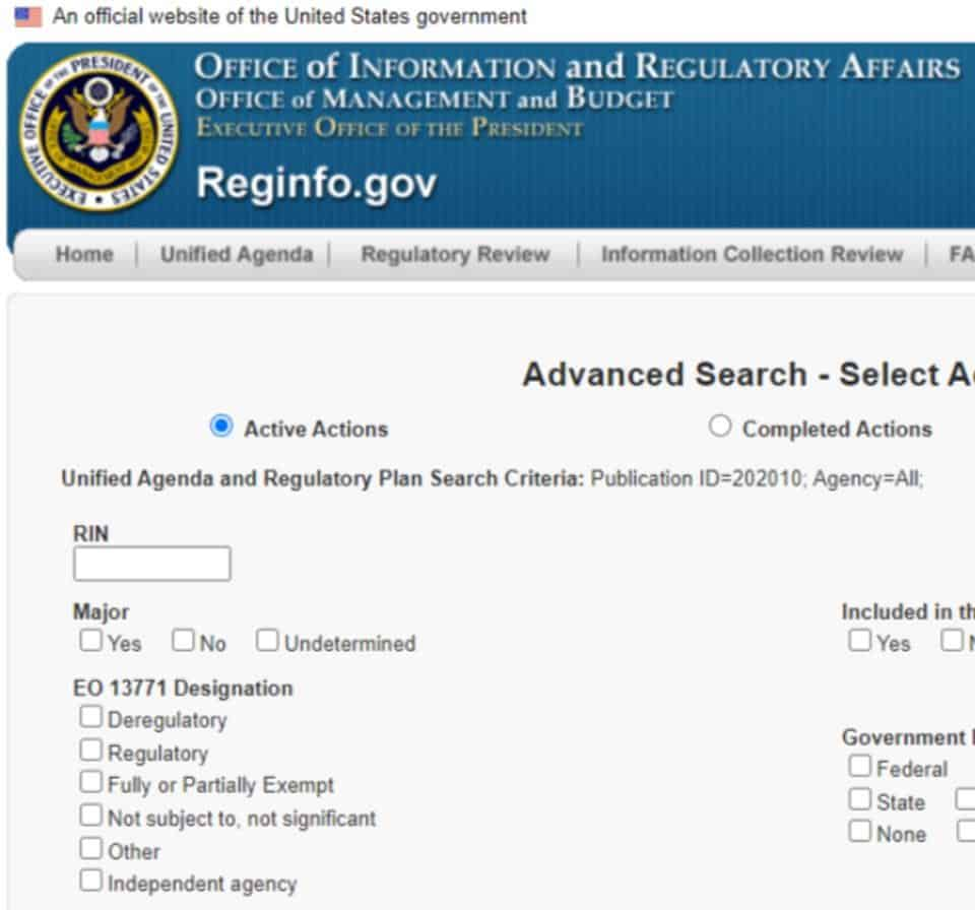
CEI had to dive into the underlying data to isolate Trump’s deregulatory rules in the new Agenda because the front-facing disclosure disappeared under Biden. Trump has yet to restore it.
The Agenda should also incorporate the call from the September 2025 White House memorandum, “Streamlining the Review of Deregulatory Actions,” to document the case for sweeping deregulatory actions across the federal enterprise. Ultimately, regulatory/deregulatory classifications should appear for every rule in the Unified Agenda and, ideally, extend to daily rule postings in the Federal Register.
If deregulation is a central policy of the administration, the public should not have to reverse-engineer the evidence.
Incorporate guidance documents
Trump has yet to reinstate the agency guidance-document portals created during his first term; and eliminated by Biden. Congress can make those portals permanent through the House-passed Guidance Out of Darkness (GOOD) Act, which the Senate Homeland Security and Governmental Affairs Committee marked up last month. This would be one of the easier — and rarer — regulatory-accountability wins available this year.
Prominent guidance documents should also be disclosed in the Unified Agenda. Agencies routinely use guidance, interpretive documents, notices, memoranda, and other instruments to influence conduct outside formal notice-and-comment rulemaking. An Agenda that describes the government’s regulatory footprint should disclose its major components, not merely those that fit the traditional definition of a rule.
Make regulatory transparency permanent
Disclosures like these have long been included in the Regulatory Transparency Report Card regularly featured in Ten Thousand Commandments.
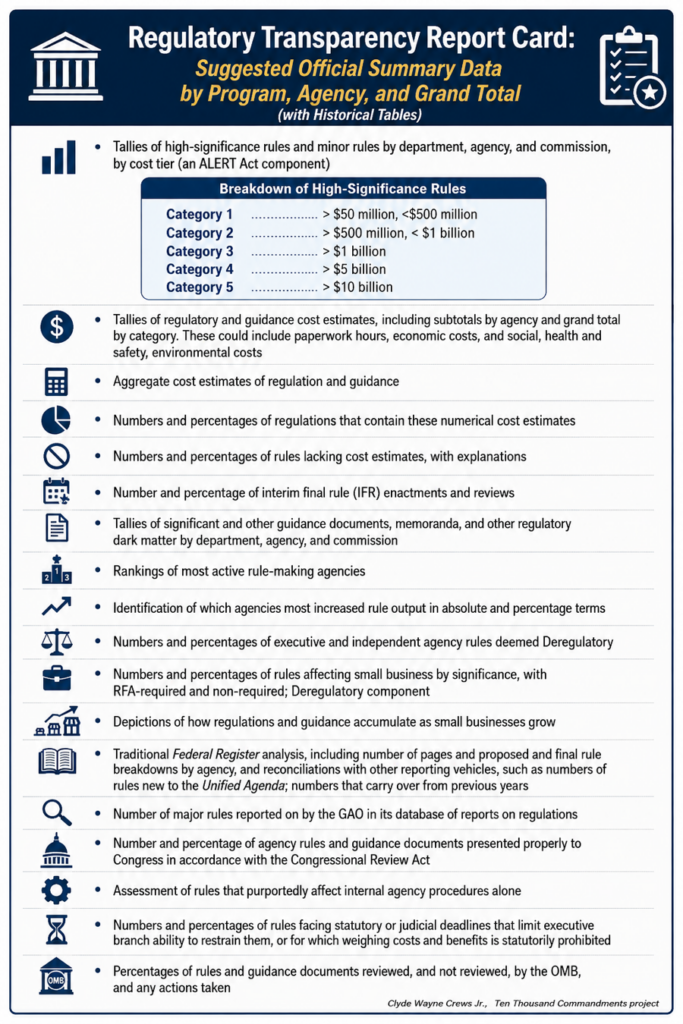
The Trump administration has plenty of regulatory and interventionist proclivities that undermine its call to “deconstruct” the administrative state. But it also has reason to boast about its 10-for-1 record while taking regulatory disclosure to a more useful level.
Trump can do both: celebrate about offsetting major rules while making the regulatory system more transparent, measurable, and accountable — and work with Congress to codify those reforms.
That said, there is a deeper problem that better disclosure alone cannot solve.
OMB still operates under an outdated “market failure” model of regulatory review, in which regulation is presumed legitimate when government can identify some deficiency in private markets. The more fundamental problem is often political failure: government intervention itself can generate concentrated benefits, dispersed costs, perverse incentives, and unintended consequences.
When Congress finally steps in — as part of ending over-delegation and restoring Congress to its enumerated constitutional powers — the OMB review architecture itself may need to be reconsidered.
We have proposed an Office of Political Failure Analysis to play this potential replacement role: helping Congress move from the presumption that administrative intervention is legitimate unless disproven toward a framework that recognizes the shortcomings of the administrative state and the necessity of market disciplines for anything legitimately called “regulation.”
That is ultimately what deconstruction should mean. Not merely eliminating this or that regulation, or counting how many rules go out for every rule that comes in, but restoring a constitutional presumption against open-ended administrative governance.
The administrative state is not simply a collection of bad regulations. It is a governing architecture that makes continuous and often unnecessary regulation possible in the first place.
For more, see:
“Diary of deconstruction: White House releases 2026 Unified Agenda of Federal Regulations,”
(see also 2025 edition), Competitive Enterprise Institute
“Deregulation’s year-end illusion,” Competitive Enterprise Institute
“OPFAIL: Establishing a Congressional Office of Political Failure Analysis,” Competitive Enterprise Institute