The Rulemakers: Which federal agencies dominate Trump’s 2026 Agenda?

Photo Credit: Getty
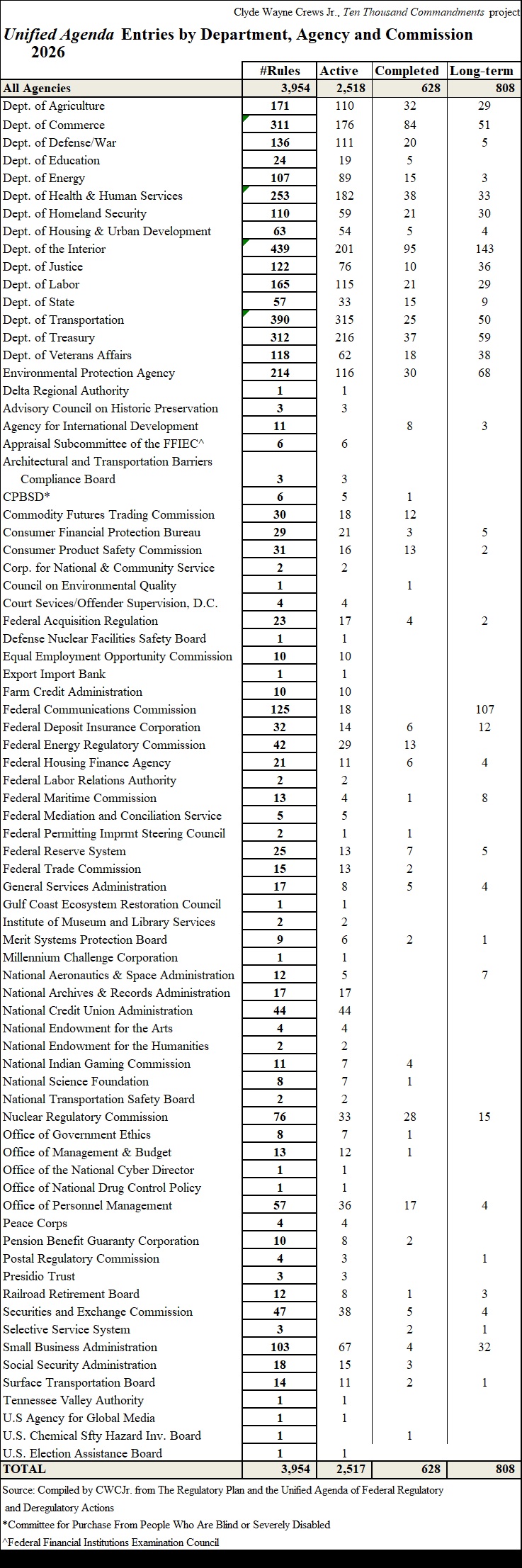
Over the Independence Day holiday, the Trump administration released its 2026Regulatory Plan and Unified Agenda of Federal Regulatory and Deregulatory Actions (Agenda), which we first examined in this blog post, “Diary of deconstruction.” It contains 3,954 rules (345 of them deemed economically significant), broken down as follows:
- 2,518 Active measures: prerule actions and proposed and final rules in the production process.
- 628 Completed actions: rules finalized (or withdrawn) during the roughly six months since the previous Unified Agenda.
- 808 Long-term actions: rulemakings anticipated beyond a 12-month horizon.
The full list of the 76 departments, agencies, and commissions, along with the number of rules for which each is responsible, appears in the Supplement at the end of this article.
A handful of executive departments account for more than half of the 3,954 rules — and, under Trump’s one-in, ten-out campaign, revisions to them. The Departments of the Interior, Treasury, Transportation, Commerce, and Health and Human Services comprise the top five, with 1,705 rules among them, or 43 percent of the total, as seen here.
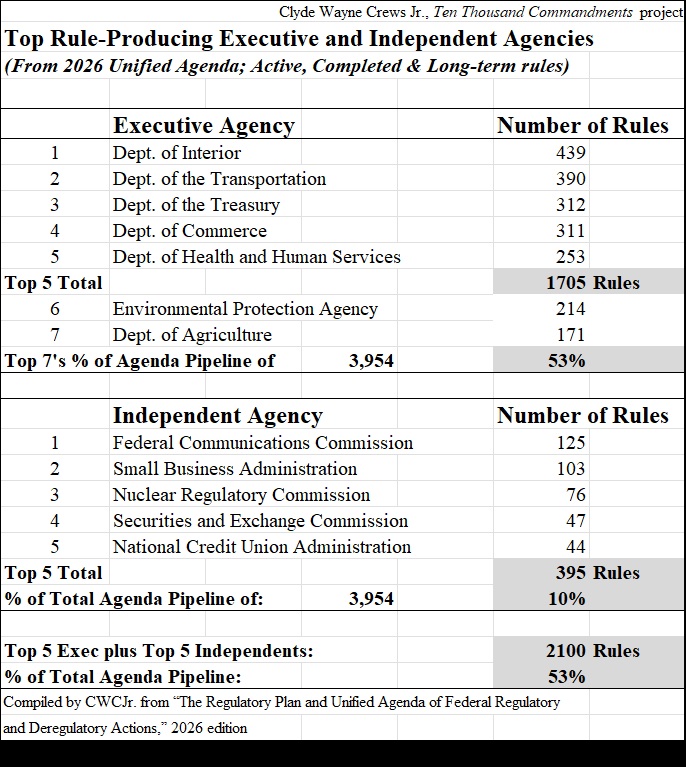
Adding the Environmental Protection Agency’s 214 rules and the Department of Agriculture’s 171 brings the total to 2,090, meaning the top seven departments and agencies alone account for 53 percent of all rulemaking activity.
Among independent agencies, the Federal Communications Commission, notable early in the administration for its “Delete, Delete, Delete” campaign, leads with 125 rules. Rounding out the top five are the Small Business Administration, Nuclear Regulatory Commission, Securities and Exchange Commission, and National Credit Union Administration. Together, their 395 rules account for 10 percent of all rulemaking in the 2026 Agenda. Combined, the top five executive departments and the top five independent agencies account for 2,100 rules, or 53 percent of the total.
While this inventory identifies where rulemaking activity is concentrated across the federal government, it does not by itself reveal the regulatory significance of that activity. Many Agenda entries are routine or procedural, while others carry substantial economic consequences. Moreover, some rulemaking is decidedly deregulatory, as we examined just prior to the release of the Agenda at midyear. An upcoming installment will detail the Agenda’s 345 economically significant rules — the subset most likely to shape the administration’s regulatory legacy.
Supplement
For more, see:
“Diary of deconstruction: White House releases 2026 Unified Agenda of Federal Regulations,” Competitive Enterprise Institute
“Mid-year 2026: Is Washington actually deregulating?” Competitive Enterprise Institute