Time to end the Christmas tree tax
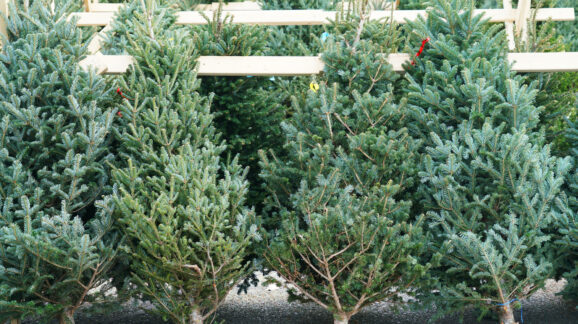
Photo Credit: Getty
Fun holiday fact: the federal government has a Christmas Tree Promotion Board.
It works a bit like a trade association does in the private sector. While private trade association members voluntarily pay a membership fee, Christmas tree growers pay a mandatory 15-cent tax on each tree they produce. This pooled money then funds marketing campaigns that encourage people to buy real trees instead of artificial trees.
The famous “Got Milk?” ad campaign ran on the same model, which is called a checkoff program. Dairy farmers pay a per-gallon tax on the milk they produce, which then funds the ads.
There is no proof that even the better-known checkoff program ad campaigns increase sales, let alone whatever the National Christmas Tree board does. Have you ever even seen a Christmas tree ad from the Christmas tree checkoff program? You are much more likely to see private ads online and on highway signs.
That said, real trees are getting an artificial boost from President Trump’s tariffs, which hit artificial trees harder. Americans import roughly two or three million real trees per year, mostly from Canada. While these are hit by tariffs, this pales in comparison to the tariffs on about 20 million artificial trees, which are mostly made in China and are subject to a higher tariff rate.
While the Christmas Tree Promotion Board might be getting its wish this year as prices push consumers towards real trees, consumers have less to celebrate. Even though real trees are becoming less expensive in relative terms, in absolute terms both types of tree are more expensive, especially after factoring in inflation as well as tariffs and the Christmas tree tax.
DOGE officially no longer exists, but if there is still any interest in Washington for cutting government waste, checkoff programs like the Christmas Tree Promotion Board are good candidates.
To be fair, checkoff programs seek to solve a legitimate collective action problem. Agricultural products are relatively homogeneous, which means it’s easy for one farmer to free-ride off of other farmers’ private marketing campaigns.
Individual farmers have little incentive to market their products, since their competitors can capture most of the benefits. The result is little marketing and lower sales for everyone. This incentive structure is similar to a prisoner’s dilemma in game theory.
Private trade associations are perfectly capable of solving this collective action problem. They already exist for hundreds of similarly homogeneous products across the economy. Unlike checkoff programs, their members can hold them accountable.
Since private trade association membership is voluntary, they have to prove their effectiveness or go out of business. They don’t enjoy the mandatory taxing power that checkoff programs wield.
In fact, Christmas tree growers already have private trade associations, even though they already fund the government’s Christmas Tree Promotion Board. The National Christmas Tree Association (NCTA), based in St. Louis, has members and affiliates who represent about three-quarters of America’s real Christmas tree sales, including 29 state trade associations.
Whether you prefer a real or an artificial tree, ending the Christmas tree checkoff program would be one way to depoliticize the holiday season. Tree farmers already do much of their own marketing anyway, with prominent signs and displays around tree growers’ lots in nearly every town.
Alexis de Tocqueville’s observation about Americans being a nation of associations is as true today as it was in the 1830s. There is no need for a Christmas tree tax that ultimately gets passed on to consumers to fund a checkoff program that is practically invisible, and that private associations have made redundant.