Two cheers for ending Humphrey’s Executor
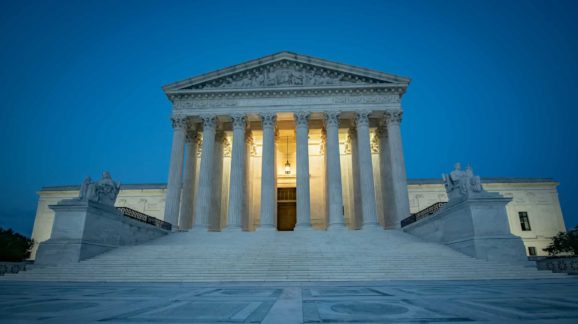
Photo Credit: Getty
Oral arguments in Trump v. Slaughter begin today. While debates over the legitimacy of presidential removal authority and the degree of Senate involvement date back to the Federalist Papers (No. 77), the Framers never intended to enable a stand-alone fourth branch of government. In that respect, the ability of a president to appoint and remove officials populating the executive branch is elemental.
Trump v. Slaughter will determine whether removal protection provisions contained within independent-agency statutes (specifically the Federal Trade Commission in this case) violate the separation of powers, and in turn whether Humphrey’s Executor v. United States’s unanimous decision that removal without cause is unlawful should stand. Humphrey’s Executor’s contentious implication is that “independent” agencies may operate apart from the president and that Congress can place administrative officers beyond Article II’s reach, insulating them and the civil service from executive supervision.
The concern for the liberty movement is that, even if Humphrey’s Executor falls, we will remain saddled with a Congress that over-delegates to executive branch agencies and independent ones alike. Worse, as recent major and sweeping legislative enactments have demonstrated, Congress recognizes no effective limits on its powers to intervene in economic and societal concerns as such.
Consider that even after the Supreme Court’s recent overturning of Chevron deference, the progressive left retains workarounds, such as:
- sweeping statutes unconstrained by enumerated powers;
- subsidies, contracting, and public-private frameworks that fuse state and corporate power;
- sub-regulatory guidance and other forms of regulatory dark matter that evade accountability.
Trump’s own interventionist impulses, such as partial nationalizations of private firms, are a warning to temper expectations that muscular presidential authorities over agencies will be used to limit state intervention in private enterprise.
Overturning Humphrey’s Executor would sever one of the Administrative State’s oxygen lines, but would by no means asphyxiate it. If, however, the decision forces reconsideration of the Federal Reserve – an institution whose monetary manipulation enables congressional deficit excess – that would brighten the outlook considerably.
Independent agencies arose a century after ratification of a Constitution that never contemplated fourth branch power centers. That makes removal authority a core constitutional function rather than a modern aberration. The anomaly is not merely Humphrey’s Executor; it is the Administrative State itself.
The core abnormality of the past century is the assumption that Washington may legislate on everything – energy, speech, finance, health, education, family – with no constitutional gravity. A win like Humphrey’s Executor reversal is necessary but will ultimately fail to deliver without structural restraint on Congress and a restoration of enumerated-powers principles.
A Congress that legislates broadly will continue to delegate broadly, and presidents will continue to inherit vast power, regardless of whether agencies downstream are deemed “independent” or have leadership that can be readily replaced. The liberty movement’s deeper work lies in recovering the truth that Congress is not omnipotent.
Until then, rolling back Humphrey’s Executor adds insulation but leaves untouched the furnace beneath: Congress’s appetite for wielding non-enumerated powers and the steady erosions of federalism and individualism that accompany powerful central government.
So two cheers for ending Humphrey’s Executor and restoring at-will presidential removal. Not three.