There are two main areas in which Congress can enact meaningful reform. The first is to rein in regulatory guidance documents, which we refer to as “regulatory dark matter,” whereby agencies regulate through Federal Register notices, guidance documents, and other means outside standard rulemaking procedure. The second is to enact a series of reforms to increase agency transparency and accountability of all regulation and guidance. These include annual regulatory report cards for rulemaking agencies and regulatory cost estimates from the Office of Management and Budget for more than just a small subset of rules.
In 2019, President Trump signed two executive orders aimed at stopping the practice of agencies using guidance documents to effectively implement policy without going through the legally required notice and comment process.
Featured Posts
Blog
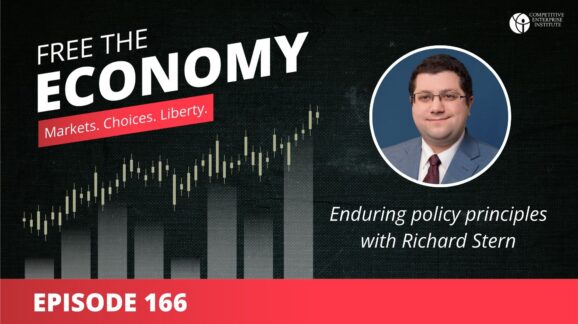
Free the Economy podcast: Enduring policy principles with Richard Stern
In this week’s episode we cover housing affordability, labor unions and train safety, the late Paul Ehrlich (1932-2026), and the late…

Blog
Idaho’s successful regulatory reform
Over at National Review, my colleague Hayden Stolzenberg and I examine some of Idaho’s recent regulatory reforms, as outlined in a recent CEI paper.

Blog
The missing guardrail in crisis politics: Discipline
Modern American governance has developed a troubling pattern. Economic shocks like the 21st century’s financial panics and pandemic are often met with vast expansions of…
Search Posts
Forbes
Regulation Renovation: The Executive Order To Make Deregulation Permanent
The White House Office of Management and Budget’s new Streamlining the Review of Regulatory Actions memorandum signals a preferential stance toward deregulation, urging…
Blog
The week in regulations, shutdown edition: Medicare payments and arms trafficking.
The Supreme Court held oral hearings for the V.O.S. Spirits tariff case. Former Vice President Dick Cheney passed away. Democrats had a very good election…
Blog
The deregulation machine hits bureaucratic resistance
A new White House Office of Management and Budget (OMB) memo, “Streamlining the Review of Deregulatory Actions,” poses an ambitious test: can agencies use…
Blog
Free the Economy podcast: Truth, lies, and economics with Jeremy Horpedahl
In this week’s episode we talk about Social Security’s cost of living, conserving rare earth minerals, and why California keeps losing…
Blog
The week in regulations, shutdown edition: Student loans and foreigners’ biometric data
President Trump announced a trade deal with China. The Federal Reserve cut interest rates. The continued federal shutdown meant another slow week in the Federal…
Blog
Darklore Depository 2025: An unofficial inventory of guidance documents and other regulatory dark matter
Halloween can remind policy wonks that some of the ghastliest regulatory chills come not from ordinary notice-and-comment regulation buried in the daily Federal Register, but…
Staff & Scholars

Clyde Wayne Crews
Fred L. Smith Fellow in Regulatory Studies
- Business and Government
- Consumer Freedom
- Deregulation

Ryan Young
Senior Economist and Director of Publications
- Antitrust
- Business and Government
- Regulatory Reform

Fred L. Smith, Jr.
Founder; Chairman Emeritus
- Automobiles and Roads
- Aviation
- Business and Government

Sam Kazman
Counsel Emeritus
- Antitrust
- Automobiles and Roads
- Banking and Finance

Marlo Lewis, Jr.
Senior Fellow
- Climate
- Energy
- Energy and Environment