There are two main areas in which Congress can enact meaningful reform. The first is to rein in regulatory guidance documents, which we refer to as “regulatory dark matter,” whereby agencies regulate through Federal Register notices, guidance documents, and other means outside standard rulemaking procedure. The second is to enact a series of reforms to increase agency transparency and accountability of all regulation and guidance. These include annual regulatory report cards for rulemaking agencies and regulatory cost estimates from the Office of Management and Budget for more than just a small subset of rules.
In 2019, President Trump signed two executive orders aimed at stopping the practice of agencies using guidance documents to effectively implement policy without going through the legally required notice and comment process.
Featured Posts
Blog
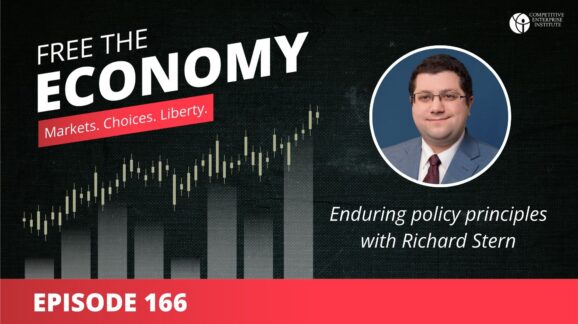
Free the Economy podcast: Enduring policy principles with Richard Stern
In this week’s episode we cover housing affordability, labor unions and train safety, the late Paul Ehrlich (1932-2026), and the late…

Blog
Idaho’s successful regulatory reform
Over at National Review, my colleague Hayden Stolzenberg and I examine some of Idaho’s recent regulatory reforms, as outlined in a recent CEI paper.

Blog
The missing guardrail in crisis politics: Discipline
Modern American governance has developed a troubling pattern. Economic shocks like the 21st century’s financial panics and pandemic are often met with vast expansions of…
Search Posts
News Release
New CEI Video Urges Americans to Show Their Support for Faster Dishwashers
The Competitive Enterprise Institute (CEI) today released a new video making the case for a new Department of Energy (DOE) regulation allowing faster dishwashers and…
Blog
This Week in Ridiculous Regulations
A humorous diplomatic row over Greenland was not the only news of the week, with China tariffs, divisive rhetoric, and recession fears also putting in…
Blog
Cataloging Regulatory Costs of Cronyism and Rent-Seeking in a Self-Interested Administrative State
Rent-seeking as a policy concern has been done to death: It’s been described over and over how regulation is often not about elevating the public…
Blog
This Week in Ridiculous Regulations
Last week was the Federal Register’s busiest of the year, with its 3,075 pages almost tripling a normal week’s count. A new economically significant regulation…
Blog
This Week in Ridiculous Regulations
Rumblings of a “Navarro recession” are growing louder, and the 2019 Federal Register will likely crack the 40,000-page mark early this week. Rulemaking agencies published…
Blog
VIDEO: Where the Regulatory State Came From
Our friends at the Pacific Legal Foundation have a funny and insightful explainer video on the historical development of the regulatory state (also known as…
Staff & Scholars

Clyde Wayne Crews
Fred L. Smith Fellow in Regulatory Studies
- Business and Government
- Consumer Freedom
- Deregulation

Ryan Young
Senior Economist and Director of Publications
- Antitrust
- Business and Government
- Regulatory Reform

Fred L. Smith, Jr.
Founder; Chairman Emeritus
- Automobiles and Roads
- Aviation
- Business and Government

Sam Kazman
Counsel Emeritus
- Antitrust
- Automobiles and Roads
- Banking and Finance

Marlo Lewis, Jr.
Senior Fellow
- Climate
- Energy
- Energy and Environment