There are two main areas in which Congress can enact meaningful reform. The first is to rein in regulatory guidance documents, which we refer to as “regulatory dark matter,” whereby agencies regulate through Federal Register notices, guidance documents, and other means outside standard rulemaking procedure. The second is to enact a series of reforms to increase agency transparency and accountability of all regulation and guidance. These include annual regulatory report cards for rulemaking agencies and regulatory cost estimates from the Office of Management and Budget for more than just a small subset of rules.
In 2019, President Trump signed two executive orders aimed at stopping the practice of agencies using guidance documents to effectively implement policy without going through the legally required notice and comment process.
Featured Posts
Blog
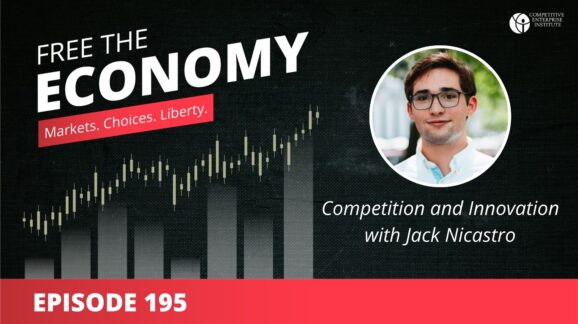
Free the Economy podcast: Competition and innovation with Jack Nicastro
In this week’s episode we cover the case of Suncor v. Boulder County at the Supreme Court, the problems with the Los…
Blog
Here’s how one-in, ten-out is successfully cutting rules — but not draining the swamp
It’s October already, and while there’s no real fiscal year for federal regulation, the September 30 closing of the 2026 budgetary fiscal year marks…

Blog
The week in regulations: Drug prices and inedible almonds
Sen. Eric Schmitt (R-MO) learned the difference between the Atlanta Hawks and the Iowa Hawkeyes. President Trump rolled back some China tariffs and published…
Search Posts
News Release
Trump Executive Orders on Civil Service Reform Are a Huge Win for Taxpayers, Workplace Equity
On news today that President Trump signed three executive orders aimed at making federal workers more accountable and better-performing, Competitive Enterprise Institute experts praised the…
The Wall Street Journal
Trump, the Six Billion Dollar Man*
The Wall Street Journal cited CEI’s Clyde Wayne Crews regarding the Trump administration’s regulatory reform efforts. History shows that when a new President…
The Washington Times
Republicans Giving the Boot to Obama’s Onerous Regulations
The Washington Times cited the Clyde Wayne Crews on the overextension of government regulation and the Competitive Enterprise Institute’s findings of the extreme cost of…
The New York Times
Congress Approves First Big Dodd-Frank Rollback
The New York Times cited CEI’s John Berlau on the limitations of current deregulatory reforms in disassembling the Dodd-Frank Act, which burdens consumers, investors, and…
Op-Eds
Do-er/Thinker Alliances: How Capitalists Can Defend Capitalism
The Fraser Institute of Canada just released a new book called Demographics and Entrepreneurship: Mitigating the Effects of an Aging Population. The book contains a series of 10…
InsideSources
Government Report Breaks Down Taxpayer Funded Union Hours
InsideSources cited Trey Kovacs on the irony and need for getting rid of “official time” where union officials are paid with tax-payer dollars while conducting…
Staff & Scholars

Clyde Wayne Crews
Fred L. Smith Fellow in Regulatory Studies
- Business and Government
- Consumer Freedom
- Deregulation

Ryan Young
Senior Economist and Director of Publications
- Antitrust
- Business and Government
- Regulatory Reform

Fred L. Smith, Jr.
Founder; Chairman Emeritus
- Automobiles and Roads
- Aviation
- Business and Government

Sam Kazman
Counsel Emeritus
- Antitrust
- Automobiles and Roads
- Banking and Finance

Marlo Lewis, Jr.
Senior Fellow
- Climate
- Energy
- Energy and Environment