There are two main areas in which Congress can enact meaningful reform. The first is to rein in regulatory guidance documents, which we refer to as “regulatory dark matter,” whereby agencies regulate through Federal Register notices, guidance documents, and other means outside standard rulemaking procedure. The second is to enact a series of reforms to increase agency transparency and accountability of all regulation and guidance. These include annual regulatory report cards for rulemaking agencies and regulatory cost estimates from the Office of Management and Budget for more than just a small subset of rules.
In 2019, President Trump signed two executive orders aimed at stopping the practice of agencies using guidance documents to effectively implement policy without going through the legally required notice and comment process.
Featured Posts

Blog
The week in regulations: Bone void filler and halibut action
May’s job numbers were strong for the third month in a row, though job growth since Liberation Day remains under 100,000, for a labor force…
Blog
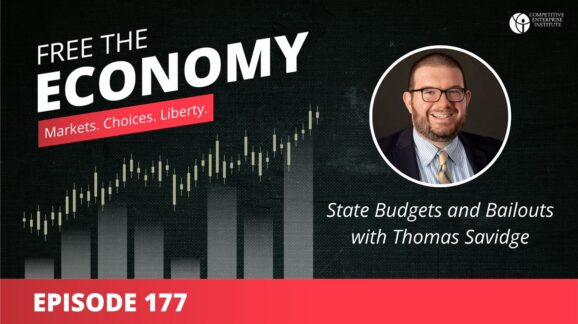
Free the Economy podcast: State budgets and bailouts with Thomas Savidge
In this week’s episode we cover promising new classroom technology, increasing productivity (and avoiding layoffs) with AI, and the repeal of the…

Blog
The week in regulations: Onion marketing and refrigerator leaks
PCE inflation, which the Federal Reserve uses for its interest rate decisions, rose to 3.8 percent, nearly double the Fed’s 2.0 percent target. President Trump…
Search Posts
Blog
Debunking the ‘Race to the Bottom’ Theory of Regulatory Competition
Its success in policymaking notwithstanding, the "race to the bottom" theory has fared poorly with the passage of time.
Reason
Trump Turns One
Reason covers President Trump’s first year in office. The 45th president does not tend to elicit measured evaluations. Since even before his formal entry…
The Washington Times
White House Urged to Kill Obama-era Payday Lending Rule
The Washington Times covers CEI’s letter sent to the Office of Information and Regulatory Affairs (OIRA) regarding the payday-lending rule. A free-market group is urging…
The National Law Review
Overturning the CFPB’s Final Payday Loan Rule by Reopening Rulemaking or CRA Resolution
The National Law Review discusses the various vehicles that could be used to repeal the CFPB’s small-dollar loan rule. On December 1, 2018, three…
Forbes
Net Neutrality and Senate Democrats’ Renewed Love for the Congressional Review Act
The Congressional Review Act (CRA) is the law by which the Republican Congress and the Trump Administration eliminated 14 of…
Blog
Antitrust Resurgence Could Transform Tech Innovators into Lumbering Public Utilities
Regulation in the technology sector is worse than government merely picking winners and losers.
Staff & Scholars

Clyde Wayne Crews
Fred L. Smith Fellow in Regulatory Studies
- Business and Government
- Consumer Freedom
- Deregulation

Ryan Young
Senior Economist and Director of Publications
- Antitrust
- Business and Government
- Regulatory Reform

Fred L. Smith, Jr.
Founder; Chairman Emeritus
- Automobiles and Roads
- Aviation
- Business and Government

Sam Kazman
Counsel Emeritus
- Antitrust
- Automobiles and Roads
- Banking and Finance

Marlo Lewis, Jr.
Senior Fellow
- Climate
- Energy
- Energy and Environment