There are two main areas in which Congress can enact meaningful reform. The first is to rein in regulatory guidance documents, which we refer to as “regulatory dark matter,” whereby agencies regulate through Federal Register notices, guidance documents, and other means outside standard rulemaking procedure. The second is to enact a series of reforms to increase agency transparency and accountability of all regulation and guidance. These include annual regulatory report cards for rulemaking agencies and regulatory cost estimates from the Office of Management and Budget for more than just a small subset of rules.
In 2019, President Trump signed two executive orders aimed at stopping the practice of agencies using guidance documents to effectively implement policy without going through the legally required notice and comment process.
Featured Posts

Blog
The week in regulations: Cyber sanctions and tinnitus relief devices
Inflation is now more than double the Federal Reserve’s target. The Iran war heated up again. Agencies issued new regulations ranging from vending stands to…
Blog
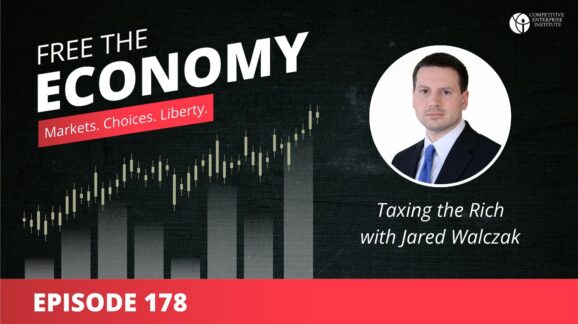
Free the Economy podcast: Taxing the rich with Jared Walczak
In this week’s episode we cover America’s low-income churn, reforms to civil asset forfeiture, changes to vehicle emissions testing, a shout…

Blog
The week in regulations: Bone void filler and halibut action
May’s job numbers were strong for the third month in a row, though job growth since Liberation Day remains under 100,000, for a labor force…
Search Posts
Blog
Red Tapeworm 2014: The Federal Government “Eats” 31 Percent Of The U.S. Economy
This is Part 6 of a series taking a walk through some sections of Ten Thousand Commandments: An Annual…
Blog
Congress Must End Department of Transportation’s Abuse of “Unfair and Deceptive Practices” Authority
The Department of Transportation is opening a rulemaking proceeding to, among other things, require airlines and ticket agents to include ancillary fees (for, e.g.,…
Blog
CEI Podcast for May 20, 2014: Phones on a Plane
CEI Fellow Marc Scribner supports the FCC's attempt to lift a ban on in-flight cell phone use.
Blog
Consumers Will Win in Combined AT&T-DirecTV
AT&T agreed Sunday to purchase DirecTV for $67 billion in cash, stock, and acquired debt. If federal regulators approve the deal, the combined firm…
Blog
The Premises of Net Neutrality
In the electric power industry, if you run an extension cord across the street to serve another, you go to jail. The local utility has…
Blog
CEI’s Battered Business Bureau: The Week in Regulation
77 new regulations, from cotton grading to walk-in coolers.
Staff & Scholars

Clyde Wayne Crews
Fred L. Smith Fellow in Regulatory Studies
- Business and Government
- Consumer Freedom
- Deregulation

Ryan Young
Senior Economist and Director of Publications
- Antitrust
- Business and Government
- Regulatory Reform

Fred L. Smith, Jr.
Founder; Chairman Emeritus
- Automobiles and Roads
- Aviation
- Business and Government

Sam Kazman
Counsel Emeritus
- Antitrust
- Automobiles and Roads
- Banking and Finance

Marlo Lewis, Jr.
Senior Fellow
- Climate
- Energy
- Energy and Environment