There are two main areas in which Congress can enact meaningful reform. The first is to rein in regulatory guidance documents, which we refer to as “regulatory dark matter,” whereby agencies regulate through Federal Register notices, guidance documents, and other means outside standard rulemaking procedure. The second is to enact a series of reforms to increase agency transparency and accountability of all regulation and guidance. These include annual regulatory report cards for rulemaking agencies and regulatory cost estimates from the Office of Management and Budget for more than just a small subset of rules.
In 2019, President Trump signed two executive orders aimed at stopping the practice of agencies using guidance documents to effectively implement policy without going through the legally required notice and comment process.
Featured Posts
Blog
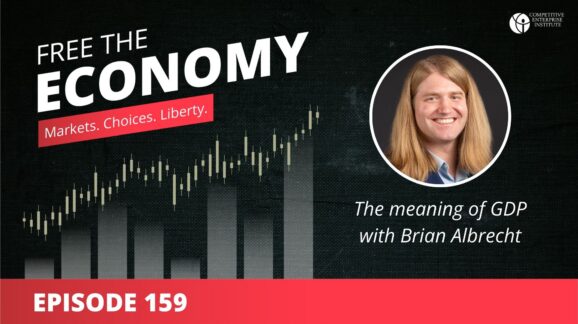
Free the Economy podcast: The meaning of GDP with Brian Albrecht
In this week’s episode we talk about the last 50 years of regulatory reform, a new study on climate adaptation, and reforms…

Blog
The week in regulations: Homework gaps and cannabimimetic agents
At Davos, President Trump withdrew his threats to invade Greenland and tariff European countries. The Supreme Court appeared skeptical about his attempt to fire Lisa…

Blog
Free the Economy podcast: Permitting for speed with Grant Dever
In this week’s episode we talk about making a living in podcasting, confronting our mounting national debt, and assessing President Trump’s new…
Search Posts
Blog
This week in ridiculous regulations: historical captain permits and apricot marketing
The Supreme Court agreed to hear CEI’s Moore v. U.S. tax case in its upcoming term. It also handed down rulings in controversial cases…
Daily Caller
Don’t Stop At College — End Race-Based Admissions In Public Schools
There’s an important battle brewing in our public schools between equity and treating students equally under the law. Equitable treatment of one class of students…
Blog
Bidenomics? Here are the 297 costliest rules in the president’s Spring 2023 Unified Agenda
Federal agencies issue thousands of rules, regulations and guidance documents every year compared to the relative handful of laws enacted by Congress.
Comment
OMB’s Problematic Circular A-4 Rewrite
OUTLINE Discard the pro-regulatory bias of the federal government Restore regulatory streamlining prior to Circular A-4 rewrite Restore the $100 million threshold for regulation…
Comment
CEI Comments on Proposed Circular A-4, Regulatory Analysis
Dear Administrator Revesz: I appreciate this opportunity to provide comments on the proposed Circular A-4, “Regulatory Analysis.”1 The focus of my comments is on the…
News Release
House passes sensible regulatory reform bills to shrink power of the administrative state
Earlier today, the House passed 220 to 211 the Separation of Powers Restoration Act (SOPRA) sponsored by Rep. Scott Fitzgerald (R-WI).
Staff & Scholars

Clyde Wayne Crews
Fred L. Smith Fellow in Regulatory Studies
- Business and Government
- Consumer Freedom
- Deregulation

Ryan Young
Senior Economist and Director of Publications
- Antitrust
- Business and Government
- Regulatory Reform

Fred L. Smith, Jr.
Founder; Chairman Emeritus
- Automobiles and Roads
- Aviation
- Business and Government

Sam Kazman
Counsel Emeritus
- Antitrust
- Automobiles and Roads
- Banking and Finance

Marlo Lewis, Jr.
Senior Fellow
- Climate
- Energy
- Energy and Environment