There are two main areas in which Congress can enact meaningful reform. The first is to rein in regulatory guidance documents, which we refer to as “regulatory dark matter,” whereby agencies regulate through Federal Register notices, guidance documents, and other means outside standard rulemaking procedure. The second is to enact a series of reforms to increase agency transparency and accountability of all regulation and guidance. These include annual regulatory report cards for rulemaking agencies and regulatory cost estimates from the Office of Management and Budget for more than just a small subset of rules.
In 2019, President Trump signed two executive orders aimed at stopping the practice of agencies using guidance documents to effectively implement policy without going through the legally required notice and comment process.
Featured Posts
Blog
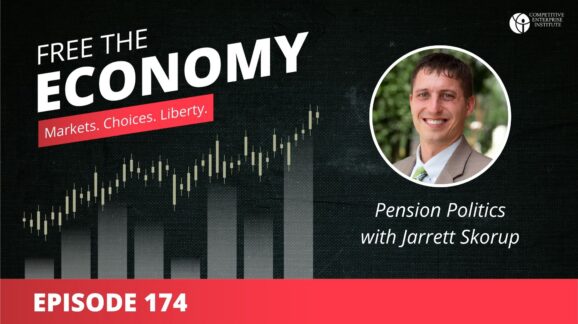
Free the Economy podcast: Pension politics with Jarrett Skorup
In this week’s episode we cover more legal headaches for the Trump tariffs, keeping kids safe in an AI world, and California’s…

Blog
The week in regulations: Fluid milk options and battleship safety zones
The Court of International Trade struck down President Trump’s Section 122 tariffs. The labor force shrank by 92,000 people over the last year. Agencies issued…
Blog
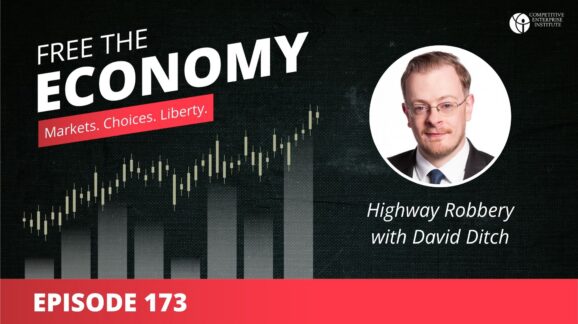
Free the Economy podcast: Highway robbery with David Ditch
In this week’s episode we cover how to make the moral case for capitalism, affordable housing via regulatory reform, and tracking…
Search Posts
Op-Eds
To Stimulate Economy, End Predatory Abuse Of Antitrust
Among numerous steps needed to stimulate a double-dipping economy, one is to make antitrust not pay anymore. AT&T’s $39 billion merger with T-Mobile (a…
Citation
Vincent Vernuccio on the Pay Freeze That Wasn’t
Competitive Enterprise Institute Labor Policy Counsel Vincent Vernuccio explains that President Obama's so-called pay freeze for federal workers did not affect automatic "step" and "grade"…
Blog
The Last Nail in the Coffin for the Fairness Doctrine?
In response to calls by lawmakers for the Fairness Doctrine and related measures to be permanently removed from the Federal Register, FCC Chairman Julius Genachowski…
Blog
Liberal Economist Peter Diamond Withdraws from Contention for Federal Reserve
MIT’s Peter Diamond has withdrawn his nomination to the Board of Governors of the Federal Reserve System. I earlier explained how Diamond’s nomination by…
Blog
Wisconsin Proposal Hurts Craft Beer, Protects Big Brewers
In the battle between international brewing giants SABMiller and ABInBev, Wisconsin craft brewers could bear the heaviest burden. On May 31, the state legislature’s Joint…
Comment
Official Time: Good Value for the Taxpayer?
Full Testimony Available as a PDF Watch Video of the Hearing Here Official time does not represent good value…
Staff & Scholars

Clyde Wayne Crews
Fred L. Smith Fellow in Regulatory Studies
- Business and Government
- Consumer Freedom
- Deregulation

Ryan Young
Senior Economist and Director of Publications
- Antitrust
- Business and Government
- Regulatory Reform
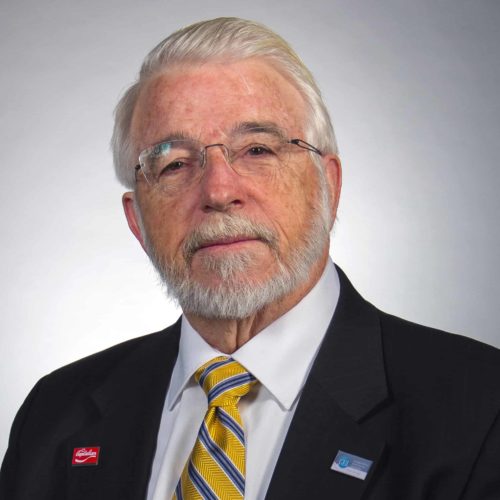
Fred L. Smith, Jr.
Founder; Chairman Emeritus
- Automobiles and Roads
- Aviation
- Business and Government

Sam Kazman
Counsel Emeritus
- Antitrust
- Automobiles and Roads
- Banking and Finance

Marlo Lewis, Jr.
Senior Fellow
- Climate
- Energy
- Energy and Environment