There are two main areas in which Congress can enact meaningful reform. The first is to rein in regulatory guidance documents, which we refer to as “regulatory dark matter,” whereby agencies regulate through Federal Register notices, guidance documents, and other means outside standard rulemaking procedure. The second is to enact a series of reforms to increase agency transparency and accountability of all regulation and guidance. These include annual regulatory report cards for rulemaking agencies and regulatory cost estimates from the Office of Management and Budget for more than just a small subset of rules.
In 2019, President Trump signed two executive orders aimed at stopping the practice of agencies using guidance documents to effectively implement policy without going through the legally required notice and comment process.
Featured Posts

Blog
The week in regulations: Mailing live animals and crash test dummy comments
A Trump administration envoy to Russia called Vladimir Putin a humanitarian. The Justice Department announced it will sue if the Republican Senate candidate in…
Blog
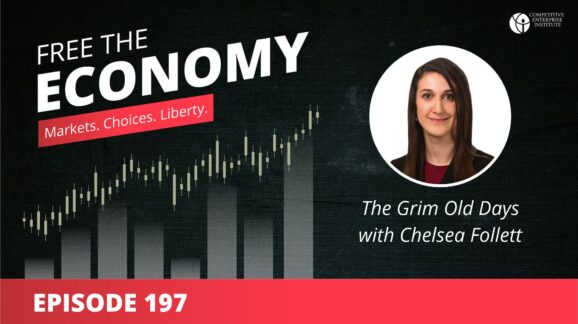
Free the Economy podcast: The Grim Old Days with Chelsea Follett
In this week’s episode we cover global energy security, a new lawsuit against Section 338 tariffs, and fresh talent in…

News Release
CEI challenges Wisconsin’s treatment of election prediction-market contracts
The Competitive Enterprise Institute has filed a federal lawsuit on behalf of Wisconsin voter and Green Bay radio host Joseph Giganti, Sr., challenging the…
Search Posts
Blog
Preemption in Wyeth v. Levine: Broader Implications
The legal arguments of the parties, and the incremental approach typical of the Supreme Court, strongly suggest that the Court will issue a narrow legal…
Blog
Uber-Attorney Bert Rein to Guest Blog on Federal Preemption Case
Back in November, I wrote about the pending Supreme Court case Wyeth v. Levine, the decision in which will have a huge impact on the…
Blog
What unlimited government means to you.
Ran across this excerpt from a Wall Street Journal piece that I thought I’d pass along. And this was before the Anti-Stimulus added…
Blog
Coming to a Pharmacy Near You: One Size Fits All
Tucked away in the stimulus bill is $1.1 billion to fund a new agency modeled after the UK’s NICE, which has repeatedly denied Brits access…
Blog
“Porkulus” has no relation to economic recovery; But other reforms do.
Today CEI and other free-enterprise analysts and advocates are making one last pitch to stop the anti-stimulus package that President Obama is likely to…
Blog
Iain Murray on the Anti-Stimulus
On behalf of my distinguished colleague Iain Murray, who is busy speaking at a very important press conference this morning, let me present his…
Staff & Scholars

Clyde Wayne Crews
Fred L. Smith Fellow in Regulatory Studies
- Business and Government
- Consumer Freedom
- Deregulation

Ryan Young
Senior Economist and Director of Publications
- Antitrust
- Business and Government
- Regulatory Reform

Fred L. Smith, Jr.
Founder; Chairman Emeritus
- Automobiles and Roads
- Aviation
- Business and Government

Sam Kazman
Counsel Emeritus
- Antitrust
- Automobiles and Roads
- Banking and Finance

Marlo Lewis, Jr.
Senior Fellow
- Climate
- Energy
- Energy and Environment