There are two main areas in which Congress can enact meaningful reform. The first is to rein in regulatory guidance documents, which we refer to as “regulatory dark matter,” whereby agencies regulate through Federal Register notices, guidance documents, and other means outside standard rulemaking procedure. The second is to enact a series of reforms to increase agency transparency and accountability of all regulation and guidance. These include annual regulatory report cards for rulemaking agencies and regulatory cost estimates from the Office of Management and Budget for more than just a small subset of rules.
In 2019, President Trump signed two executive orders aimed at stopping the practice of agencies using guidance documents to effectively implement policy without going through the legally required notice and comment process.
Featured Posts
Blog
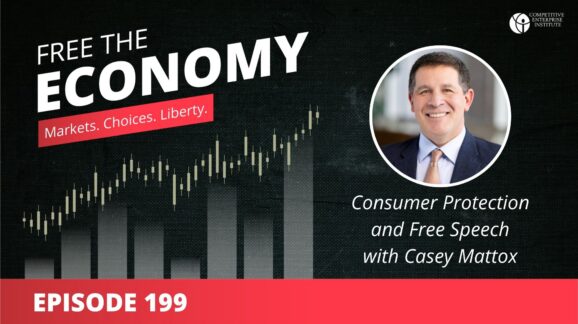
Free the Economy podcast: Consumer protection and free speech with Casey Mattox
In this week’s episode we cover the debt load of state and local governments, advances in nuclear waste storage, and hope…

News Release
Update in CEI’s case against Wisconsin’s unconstitutional rule barring voter participation in prediction markets
Yesterday, a District Court denied CEI’s motion for a preliminary injunction against Wisconsin’s rule denying voters the right to participate in election prediction market…

Blog
The regulatory dark matter beyond Washington’s graveyard of rules: 83,141 ghosts and counting
The clocks have turned back, the days are growing darker, and Washington’s regulatory shadows lengthen. Washington’s policy ghouls are waking up to the fact…
Search Posts
Blog
This week in ridiculous regulations: Refrigeration products and off-road vehicle debris
Iran fired 180 missiles at Israel. Hurricane Helene devastated North Carolina. Longshoremen went on strike. The unemployment rate dropped to 4.1 percent.
Blog
This week in ridiculous regulations: Bent coins and Irish potato taxes
The leader of the Hezbollah terrorist group died in an Israeli military strike. The 2024 Federal Register is poised to reach 80,000 pages this…
Blog
Iowa’s ‘Lean-in’ approach to successful permitting reform
The State of Iowa has made significant strides in improving its environmental permitting processes, thanks to innovative reforms spearheaded by the state’s Department of…
Blog
Pen and phone power: How presidential documents are changing the rules
Presidential executive orders and directives have long played a pivotal role in shaping federal policies and regulations. As President Obama famously remarked in 2014,…
Blog
Congress decides, not agencies: The significance of the REINvented REINS Act
It’s been repeated a million times that in our constitutional republic, lawmaking power belongs to Congress. But over the years, this authority has increasingly…
Washington Examiner
Congress needs to end regulation without representation
Taxation without representation is the antithesis of freedom and runs counter to the basic principles guiding our nation. So why is regulation without representation…
Staff & Scholars

Clyde Wayne Crews
Fred L. Smith Fellow in Regulatory Studies
- Business and Government
- Consumer Freedom
- Deregulation

Ryan Young
Senior Economist and Director of Publications
- Antitrust
- Business and Government
- Regulatory Reform

Fred L. Smith, Jr.
Founder; Chairman Emeritus
- Automobiles and Roads
- Aviation
- Business and Government

Sam Kazman
Counsel Emeritus
- Antitrust
- Automobiles and Roads
- Banking and Finance

Marlo Lewis, Jr.
Senior Fellow
- Climate
- Energy
- Energy and Environment