Giants of the Free Society
Figures from Smith to Simon point the way
Introduction
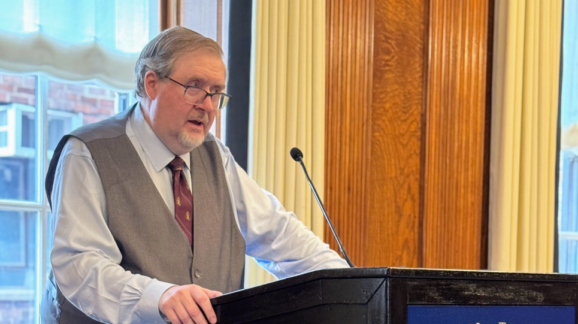
I was invited to deliver remarks to the Philadelphia Society on the subject, “Giants on Whose Shoulders We Stand: What We Owe to Adam Smith, Milton Friedman, Friedrich Hayek, Ludwig von Mises” in September 2025. Following the success of this speech, I was asked to give a condensed version to the Competitive Enterprise Institute’s (CEI) New York Luncheon Club in October. This version shortens the discussion of Smith, Mises, Hayek, and Friedman, and adds brief discussions of the importance of Frederic Bastiat, Ronald Coase, and Julian Simon to CEI’s work in particular. I argued that these giants of economics give us enduring principles and tools to enable us to respond to old challenges that resurface regularly and new challenges that arise in our modern world. This paper is adapted lightly from those remarks.
Big shoulders to stand upon
Let us now speak of giants. These are not the giants of fairy tales — the ones who, in my childhood nightmares, ground Englishmen’s bones into bread — but rather are giants of a different and altogether more noble sort: the intellectual giants on whose shoulders we stand.
It is their work that allows us to understand the free society. They remind us that prosperity and liberty are not historical accidents, but outcomes of principle, of choice, of human action, all within a moral framework. They also remind us that what we inherit we can lose, unless we guard it with vigilance.
The free society has many forebears, but today I want to focus on four towering figures: Adam Smith, Ludwig von Mises, Friedrich Hayek, and Milton Friedman. Their work, across centuries, still shapes the debates we have today. I shall mention three other giants as well who particularly influence our work at the Competitive Enterprise Institute.
To stand on the shoulders of these giants is not just to admire the view, but so we can see further to glimpse dangers ahead, and also opportunities. Each giant contended with monsters of his own day, and ours: mercantilism, socialism, totalitarianism, interventionism. None of them are truly dead. They lurk, ready to return when vigilance lapses.
Smith’s wealth of wisdom
We begin in Scotland, in the 18th century, where Adam Smith was writing in the intellectual company of one of history’s most remarkable circles of thinkers. Edinburgh and London buzzed with intellectual clubs and salons. The Select Society and the Poker Club in Scotland, and The Club in London gathered figures like David Hume, Edmund Burke, Dr. Samuel Johnson, Sir Joshua Reynolds, David Garrick, Edward Gibbon, and an agent of the Province of Pennsylvania named Ben Franklin. Smith belonged in this company of giants, and it is inconceivable to me that he and Franklin did not converse, even if records are thin.
Smith is remembered as an economist, but at heart he was a philosopher. His first great work, The Theory of Moral Sentiments, begins not with money but with sympathy — the natural human impulse to place ourselves in another’s shoes. Sympathy, he argued, forms the basis of judgment. But because our sympathies can mislead us, we appeal to an “impartial spectator,” the man within the breast, to check our selfish impulses with propriety and fairness.
Here lies the moral underpinning of markets. Commerce for Smith was never about unrestrained greed. It was about self-interest operating within a framework of custom, virtue, and trust. The butcher, baker, and brewer serve us, not through altruism, but because serving us serves them too. At the same time, reputation, honesty, and fairness ensure that service is trustworthy.
This moral framework is the soil in which the division of labor, specialization, and exchange grow. It is what makes the invisible hand more than a metaphor. Without trust, commerce collapses into exploitation.
Smith also defined the proper role of government: to preserve peace, enforce justice, and protect against threats domestic and foreign. Government’s job was not to direct trade, manage production, or favor industries. “Little else” is necessary to “carry a state to the highest degree of opulence from the lowest barbarism, but peace, easy taxes, and a tolerable administration of justice,” he said. Those words could serve as the preamble to any modern constitution, and we would be better for it.
The Wealth of Nations was published in 1776, the same year the United States declared independence. George Washington owned copies of Smith’s works. Thomas Jefferson, though impatient with Smith’s prose, recommended them often. The moral and economic case for liberty informed the Founding as surely as John Locke’s political philosophy.
The resistance of von Mises
We fast forward a century and a half to our second giant, Ludwig von Mises, who lived in a darker age. Where Smith had argued against mercantilism, Mises confronted the rising power of socialism and fascism.
In his 1920 essay Economic Calculation in the Socialist Commonwealth, he struck a blow from which intellectual socialism has never really recovered. Without prices formed in free exchange, he argued, planners cannot allocate resources rationally. They have no way to compare costs, no mechanism to test efficiency. Planning, however sophisticated, collapses into chaos because it cannot calculate.
This was not a mere theoretical point. Mises watched as empires crumbled, as socialist and fascist experiments ruined economies, as talent and capital fled. He himself fled to Switzerland, and then to America, escaping regimes that proved his warnings accurate.
In Liberalism (1927), he made the case that free markets, private property, and peace were inseparable. Prosperity is not a gift of planning but the outcome of voluntary exchange. And in his masterpiece, Human Action (1949), he placed economics squarely on the choices of individuals.
For Mises, economics was not a branch of physics. It was the study of purposeful action. Prices, wages, and interest rates are the results of human beings making choices under conditions of scarcity and uncertainty.
At the center stood the entrepreneur. Unlike the bureaucrat or the planner, the entrepreneur risks failure, reads signals of profit and loss, and adapts. The entrepreneur coordinates resources, discovers opportunities, and advances progress. As my friend, the philosopher Douglas Rasmussen, has put it, the entrepreneur is a moral hero.
Mises also warned that interventionism is inherently unstable. A tariff begets retaliation, which begets subsidies, which begets controls. Each intervention produces distortions that call forth new interventions. The process cascades until society faces a choice between comprehensive planning or a restoration of liberty.
For Mises, to plan an economy was to plan people’s lives. Economic control becomes political control. Socialism, whether nationalist or internationalist, leads not to utopia but to tyranny. His lesson remains clear. Without economic liberty, political liberty cannot survive.
The spontaneous Hayek
Friedrich Hayek, Mises’s student and friend, brought these insights to Britain and America. Arriving at the London School of Economics in the early 1930s, he sparred with John Maynard Keynes over money and employment. Yet it was during the Second World War that his most famous warning appeared.
The Road to Serfdom (1944) argued that centralized economic planning, even when motivated by good intentions, erodes liberty. To direct the economy, the state must centralize decision-making. Centralization, in turn, corrodes the rule of law and leads societies down a path toward authoritarianism.
Hayek stressed that no single policy is decisive. What matters is the acceptance of the principle that government may plan the economy. Once conceded, the machinery of planning expands, and the scope of freedom contracts.
In later works such as The Constitution of Liberty (1960) and Law, Legislation, and Liberty in the 1970s, Hayek explored deeper philosophical ground. He distinguished between law, the evolved rules of conduct that enable social cooperation, and legislation, the commands aimed at specific collective ends.
A society governed by law is what he called a nomocracy. A society governed by collective purpose is a teleocracy. The difference matters enormously. In a teleocracy, government treats society as an enterprise with an end-state to achieve. In a nomocracy, government’s role is limited: to maintain rules of just conduct, not to dictate outcomes.
Hayek connected this to the idea of spontaneous order. Social institutions, like markets and common law, evolve through countless interactions, not by central design. Order without command is not only possible, it is the foundation of liberty.
Against this, he set the fatal conceit: the belief that planners possess the knowledge to design society. In his essay The Use of Knowledge in Society, he explained why they do not. Knowledge is dispersed, local, and often tacit, embedded in the choices of millions. No planner, however brilliant, can replace the coordination of free markets.
This was Hayek’s civilizational argument. Liberty is not an abstract preference, but the condition that allows human knowledge to be used most fully.
Capitalism and Friedman
Our fourth giant, Milton Friedman, knew Hayek at Chicago. If Hayek was the theorist, Friedman was the communicator — the happy warrior of free-market ideas.
Friedman’s Capitalism and Freedom (1962) remains the most lucid case for liberty in the postwar world. In clear, accessible prose, he linked economic freedom to political freedom, and showed how that principle applied to education, monopoly, welfare, and more. Where Smith, Mises, and Hayek sometimes required patience from the reader, Friedman never did.
His television series Free to Choose (1980) carried the message even further. Millions of viewers saw, often for the first time, how markets worked, why government interventions failed, and how liberty served ordinary people. His demonstration of Leonard Read’s “I, Pencil” remains unforgettable.
As a policy economist, Friedman will always be remembered for his dictum: “Inflation is always and everywhere a monetary phenomenon.” At a time when inflation ravaged economies, he argued that governments must restrain monetary expansion.
In Britain, Margaret Thatcher absorbed the lesson. In America, Paul Volcker applied it. The pain was real. Interest rates rose to 17 percent, and recessions endured But the result was a defeat of inflation that paved the way for decades of growth. Germany’s Bundesbank became the model of disciplined monetary policy, and even the European Central Bank was built on those foundations.
Unfortunately, the lesson has to be relearned. During the worldwide COVID pandemic and lockdowns, central banks expanded balance sheets at astonishing rates. “Magic money printer go BRRR,” as my son’s generation likes to say. The result, of course, was inflation. Friedman’s warning was confirmed yet again.
Perhaps Friedman’s greatest legacy is his manner. He relished debate, appearing on Phil Donohue’s show to face skeptical audiences, always smiling, always clear, never strident. He embodied Wordsworth’s happy warrior, diligent to learn, confident in reason, and cheerful in combat.
In an age when argument is often replaced by outrage, when free speech itself is under pressure, Friedman’s example is more needed than ever. He showed that ideas can be defended with wit and civility.
How to fight monsters
Each of these giants faced a monster. Smith fought mercantilism: the belief that government should direct trade. Mises fought socialism: the belief that planning could replace markets. Hayek fought totalitarianism: the belief that political will could reshape society. Friedman fought interventionism: the belief that a little government tinkering would not threaten liberty.
None of those monsters are extinct. Mercantilism has returned in trade wars and tariffs. Socialism is fashionable again even here in the capital of capitalism, New York City. Authoritarian regimes are admired by some who should know better. And soft interventionism is now bipartisan orthodoxy.
Fortunately, the giants left us weapons: Smith’s moral foundations, Mises’s defense of entrepreneurship, Hayek’s philosophy of spontaneous order, Friedman’s gift for persuasion. They showed that freedom is not a default condition but a choice — and a fragile one.
Three more giants
If Smith, Mises, Hayek, and Friedman are the four giants on whose shoulders the free market movement is built, I want to mention three more that have been of particular influence on the work of CEI itself.
First, and perhaps the favorite of this Englishman, is the Frenchman Frédéric Bastiat, the 19th century economic journalist whose wit and clarity made him the great popularizer of liberty. Bastiat grasped that the challenge was not merely to describe how markets worked, but to pierce the fog of what he called “the seen and the unseen.”
Bastiat’s parable of the broken window endures precisely because it is so simple. When a boy throws a stone through a shopkeeper’s window, people can see the windowmaker’s gain. What they do not see is what the shopkeeper might have done with his money had the window remained intact.
The lesson is obvious, yet forgotten every budget season. Politicians proudly point to jobs “created” by subsidies, tariffs, or public works. Bastiat would remind them of the unseen jobs destroyed when resources are diverted from where consumers would have freely directed them. The task of the economist, he said, is to make the unseen visible.
Bastiat also gave us a bracing clarity about the state itself. “The state,” he quipped, “is that great fiction by which everyone seeks to live at the expense of everyone else.” No line has better captured the logic of modern interest-group politics. Bastiat showed that the real danger lies not simply in overtaxation or overspending, but in the way politics systematically rewards organized demands at the expense of dispersed majorities. In this way, he anticipated the public choice school of economics by a century, and provided a moral as well as economic defense of limited government.
In the 20th century, Ronald Coase, the favorite economist of CEI’s founder, Fred Smith, extended this insight in another direction. Where Bastiat asked us to look at the unseen consequences of policy, Coase asked us to look at the unseen costs of exchange itself. Why, he wondered, do firms exist at all if markets are so efficient? His answer, transaction costs, launched a revolution.
The insight was deceptively simple: markets are not frictionless. Contracts must be written, enforced, and monitored. Information must be found and verified. When these costs are high, it can make more sense to organize activity within a firm rather than through open exchange. Thus, institutions are not arbitrary. They are responses to costs.
The same reasoning informed his later, more famous article, “The Problem of Social Cost.” Conventional wisdom held that externalities like pollution demanded government regulation. Coase asked us to look again. If property rights are well defined and transaction costs are low, parties can bargain their way to efficient outcomes without heavy-handed rules. The problem, then, is not markets per se, but the frictions that impede bargaining.
Coase did not deny that government has a role, but he reframed it. The question is always comparative: can the state reduce transaction costs more effectively than private arrangements? Too often, regulation multiplies costs instead of reducing them.
Coase’s lesson is humbling. He reminded us that the real world is messy, that institutions evolve to economize on costs, and that well-meaning interventions can easily make matters worse. He invited us to look not at abstract ideals, but at how human beings actually solve problems. That, too, is part of the free-market tradition: a realism about human limits, and an optimism about human creativity.
Finally, we should recall Fred Smith’s friend Julian Simon, perhaps the most optimistic of free-market thinkers after whom we have named our annual dinner, who waged his battle not with politicians or planners, but with the prophets of doom. In the 1970s, as fears of overpopulation and resource exhaustion dominated public debate, Simon calmly pointed out what others refused to see: the ultimate resource is not oil or copper or farmland, but the human mind.
Simon noticed a stubborn fact. While doomsayers predicted scarcity, the long-term trend was falling resource prices and rising living standards. Every shortage spurred innovation, substitution, and discovery. More people, far from being a burden, meant more problem-solvers, more inventors, more entrepreneurs. To him, human ingenuity was not a liability but an asset.
Simon’s famous wager with Paul Ehrlich symbolized this larger conflict. Ehrlich, the ever-present pope of the church of doom, bet that key metals would become scarcer and dearer. Simon bet the opposite. A decade later, Simon won handily: every chosen resource had fallen in price. Reality had confounded pessimism.
Simon’s lesson is that liberty and abundance go hand in hand. When people are free to think, trade, and create, they transform scarcity into opportunity. This is not naïve optimism; it is an empirical record of centuries. Simon reminded us that despair is a poor guide to policy. Progress comes not from restricting human potential, but from unleashing it. That is something that animates us at CEI every day.
Conclusion
Ronald Reagan reminded us that freedom is always one generation away from extinction. That remains true. But it is also true that freedom is always one generation away from renewal — if we choose to defend it.
Our task, then, is not merely to admire these giants, but to follow their example: to argue with clarity, to act with principle, and to defend liberty with both seriousness and good humor, as both our north star and our heritage.
Standing on their shoulders, we can see further. And what we see is both a warning and a promise: that liberty, if neglected, will be lost; but if cherished, can endure.