There are two main areas in which Congress can enact meaningful reform. The first is to rein in regulatory guidance documents, which we refer to as “regulatory dark matter,” whereby agencies regulate through Federal Register notices, guidance documents, and other means outside standard rulemaking procedure. The second is to enact a series of reforms to increase agency transparency and accountability of all regulation and guidance. These include annual regulatory report cards for rulemaking agencies and regulatory cost estimates from the Office of Management and Budget for more than just a small subset of rules.
In 2019, President Trump signed two executive orders aimed at stopping the practice of agencies using guidance documents to effectively implement policy without going through the legally required notice and comment process.
Featured Posts
Blog
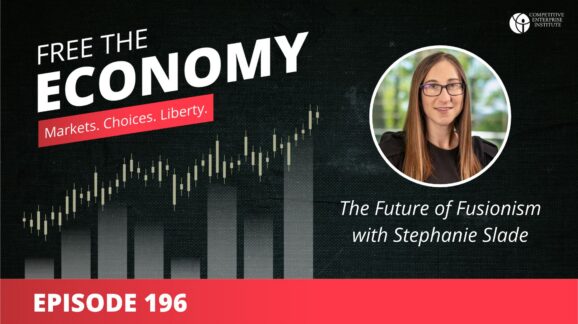
Free the Economy podcast: The future of Fusionism with Stephanie Slade
In this week’s episode we cover federal vs. state rules for prediction markets, the difference between Detroit and Pittsburgh, and a…

Blog
The week in regulations: Mariner training and Maryland trash
The federal government’s annual budget deficit hit $2 trillion. Defense Secretary Pete Hegseth pledged to livestream an execution. Thirty-year Treasury bond interest rates continued…

Blog
Free the Economy podcast: Competition and innovation with Jack Nicastro
In this week’s episode we cover the case of Suncor v. Boulder County at the Supreme Court, the problems with the Los…
Search Posts
Products
Chapter 15: Regulation without Representation: The “Unconstitutionality Index”—13 Rules for Every Law
Administrative agencies, not Congress, do most U.S. lawmaking, despite Article I of the Constitution stipulating otherwise. Congress is to blame here, as it routinely enacts…
Products
Chapter 4: The Unknowable Costs of Regulation and Intervention and a $1.939 Trillion Estimate
The federal government undertakes little review of federal regulation to ensure that regulations individually do more good than bad each year, and it performs no…
Products
Executive Summary – Ten Thousand Commandments 2023
The cost of government extends well beyond what Washington taxes. Federal regulations add another $1.939 trillion to Americans’ annual burden. Federal environmental, safety and health,…
Products
Chapter 2: Competition Policy That Exiles Competitive Enterprise Harms Equity
Biden has repeatedly claimed, “I’m a capitalist.” He also rightly says that capitalism without competition is “exploitation.” However the top-down vision Biden promotes, which is…
Products
Chapter 11: Notable Rules and Rulemakings by Agency
In recent Unified Agenda editions and in other venues, federal agencies have noted the regulatory initiatives listed below, among many others pending or recently completed.
Products
Chapter 14: Government Accountability Office Database on Regulations
The federal government’s reports and databases on regulations serve different purposes: The Federal Register details and depicts the aggregate number of proposed and final rules—both…
Staff & Scholars

Clyde Wayne Crews
Fred L. Smith Fellow in Regulatory Studies
- Business and Government
- Consumer Freedom
- Deregulation

Ryan Young
Senior Economist and Director of Publications
- Antitrust
- Business and Government
- Regulatory Reform

Fred L. Smith, Jr.
Founder; Chairman Emeritus
- Automobiles and Roads
- Aviation
- Business and Government

Sam Kazman
Counsel Emeritus
- Antitrust
- Automobiles and Roads
- Banking and Finance

Marlo Lewis, Jr.
Senior Fellow
- Climate
- Energy
- Energy and Environment