There are two main areas in which Congress can enact meaningful reform. The first is to rein in regulatory guidance documents, which we refer to as “regulatory dark matter,” whereby agencies regulate through Federal Register notices, guidance documents, and other means outside standard rulemaking procedure. The second is to enact a series of reforms to increase agency transparency and accountability of all regulation and guidance. These include annual regulatory report cards for rulemaking agencies and regulatory cost estimates from the Office of Management and Budget for more than just a small subset of rules.
In 2019, President Trump signed two executive orders aimed at stopping the practice of agencies using guidance documents to effectively implement policy without going through the legally required notice and comment process.
Featured Posts

Blog
The week in regulations: Deepwater port licenses and nuclear credit ratings
Voters made known their feelings about tariffs, gas prices, and corruption. The FAA announced that it still uses floppy disks for air traffic control…
Blog
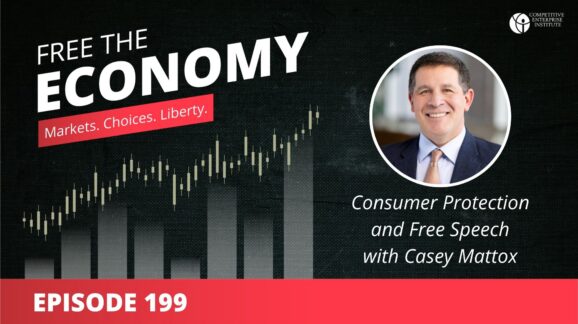
Free the Economy podcast: Consumer protection and free speech with Casey Mattox
In this week’s episode we cover the debt load of state and local governments, advances in nuclear waste storage, and hope…

News Release
Update in CEI’s case against Wisconsin’s unconstitutional rule barring voter participation in prediction markets
Yesterday, a District Court denied CEI’s motion for a preliminary injunction against Wisconsin’s rule denying voters the right to participate in election prediction market…
Search Posts
Forbes
Warning Signs: How Trump’s Ascendant Regulatory Impulses Could Swamp His Deregulatory Program
President Donald Trump has pruned rules and costs and held down regulatory output with more enthusiasm than other presidents. But on the flipside of Trump’s controversial regulatory savings, Trump sports regulatory…
Blog
The Regulatory Costs of Abandoned Federalism
The deterioration of the principle of separation of powers is a signature feature of the powerful federal Administrative State. This corrosion is accompanied by a…
The Hill
Congressional Review Act Rises Again!
The Hill cited Vice President for Policy and a Senior Fellow Wayne Crews on regulatory dark matter. This problem increases considerably when you…
The Cato Institute
Bloomberg Unwittingly Vindicates Stigler
The Cato Institute cited Vice President for Policy and a Senior Fellow Wayne Crews on the Trump administration and regulatory reform. Thankfully, we…
Blog
This Week in Ridiculous Regulations
The Michael Cohen hearing shenanigans gobbled up the headlines, but actual substantive news happened regarding talks with China and North Korea—in particular, a planned tariff…
The Daily Signal
VIDEO: Hope for an Overregulated Nation
Senior Fellow Wayne Crews joined “The Bill Walton Show” on the Daily Signal to explain how to return the U.S. to the path of greater…
Staff & Scholars

Clyde Wayne Crews
Fred L. Smith Fellow in Regulatory Studies
- Business and Government
- Consumer Freedom
- Deregulation

Ryan Young
Senior Economist and Director of Publications
- Antitrust
- Business and Government
- Regulatory Reform

Fred L. Smith, Jr.
Founder; Chairman Emeritus
- Automobiles and Roads
- Aviation
- Business and Government

Sam Kazman
Counsel Emeritus
- Antitrust
- Automobiles and Roads
- Banking and Finance

Marlo Lewis, Jr.
Senior Fellow
- Climate
- Energy
- Energy and Environment