There are two main areas in which Congress can enact meaningful reform. The first is to rein in regulatory guidance documents, which we refer to as “regulatory dark matter,” whereby agencies regulate through Federal Register notices, guidance documents, and other means outside standard rulemaking procedure. The second is to enact a series of reforms to increase agency transparency and accountability of all regulation and guidance. These include annual regulatory report cards for rulemaking agencies and regulatory cost estimates from the Office of Management and Budget for more than just a small subset of rules.
In 2019, President Trump signed two executive orders aimed at stopping the practice of agencies using guidance documents to effectively implement policy without going through the legally required notice and comment process.
Featured Posts

News Release
Regulators propose improvements to Clean Water Act regs: CEI analysis
Today, the Environmental Protection Agency and the U.S. Army Corps of Engineers released a pre-publication copy of a supplemental notice of proposed…
Blog
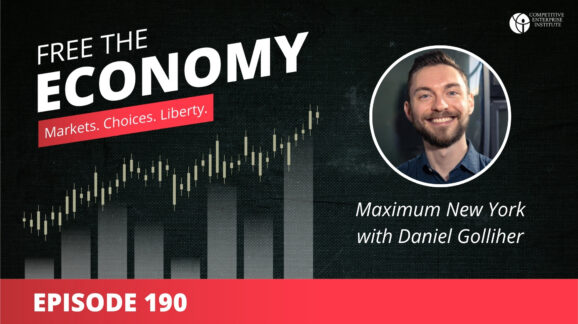
Free the Economy podcast: Maximum New York with Daniel Golliher
In this week’s episode we cover climate collusion between California and Quebec, how luxurious college campuses are breeding socialists, and government…

Blog
The regulatory costs we still aren’t counting
Several years ago, I assembled a “Costberg” working paper surveying the largely impenetrable and undisclosed costs of regulation. The project grew out of…
Search Posts
Blog
Trump’s SOTU conundrum: Deregulation today, swamp tomorrow?
Donald Trump’s 2026 State of the Union (SOTU) address presents an opportunity to confront the federal spending, entitlement, and regulatory behemoth in a new…
Blog
The week in regulations: Grandfathered driver vision and socializing dogs
The Supreme Court declared President Trump’s IEEPA tariffs unconstitutional. The White House responded by enacting a 15 percent global tariff under a different statute.
Blog
Free the Economy podcast: What’s wrong with Congress with Kevin Kosar
In this week’s episode we talk about we talk about Consumer-Regulated Electricity, the amazing falling US poverty rate, and how…
Blog
Trump’s deregulation meets invisible rulemaking: The real 2026 challenge
After a brief shutdown, most fiscal year 2026 appropriations have been enacted, despite continued debate over Department of Homeland Security (DHS) funding. We may…
Blog
The week in regulations: Beet food coloring and crab housekeeping
Culture warriors got upset over the Super Bowl halftime show. A mini-shutdown over ICE funding delayed some labor market indicators. Agencies issued new regulations…
Blog
Free the Economy podcast: Social mobility in the 50 states with Justin Callais
In this week’s episode we talk about satellite shot clocks at the Federal Communications Commission, Federal Reserve nominee Kevin Warsh’s digital-dollar…
Staff & Scholars

Clyde Wayne Crews
Fred L. Smith Fellow in Regulatory Studies
- Business and Government
- Consumer Freedom
- Deregulation

Ryan Young
Senior Economist and Director of Publications
- Antitrust
- Business and Government
- Regulatory Reform
Fred L. Smith, Jr.
Founder; Chairman Emeritus
- Automobiles and Roads
- Aviation
- Business and Government

Sam Kazman
Counsel Emeritus
- Antitrust
- Automobiles and Roads
- Banking and Finance

Marlo Lewis, Jr.
Senior Fellow
- Climate
- Energy
- Energy and Environment